
What Following the Results Actually Involves
The calendar item for this guide is time management for working professionals, and the first thing to refuse is the version of that title which promises to fit betting around a job. There is no such advice in this article, because fitting a negative-expectation product more neatly into a working week is not management; it is optimisation of the thing being managed. What the title can honestly support is an audit. Following results is a set of activities with durations, and once those durations are written down the reader can see what the habit costs in the only currency a working person cannot borrow.
The ledger has five lines. Knowing when a market closes is the first, and it repeats daily because the close times are not the same as the open times. Checking a declaration is the second, and it is the one everyone counts. Reading a chart for a pattern is the third, and it can absorb an evening, as the chart-patterns guide shows. Deciding whether to place anything is the fourth. Reconciling what happened to the money is the fifth, and it is usually invisible because nobody schedules it. Only the second line appears in the sentence people say out loud, which is why the total surprises them.
| Activity | Typical duration | How often | Who is counting it |
|---|---|---|---|
| Checking a close time | 20 seconds | each market touched | nobody |
| Reading one declaration | 30 seconds | each result followed | nobody |
| Studying a chart page | 10 to 30 minutes | when a pattern is suspected | nobody |
| Deciding whether to stake | 1 to 5 minutes | each decision | the player, silently |
| Reconciling stake against payout | 2 minutes | end of day, if at all | nobody |
| One interrupted work task | 23 minutes 15 seconds | each glance made at work | the employer |
The last row is the one this guide exists to put in front of a reader. Every other line measures the habit by the time it appears to take, which is small, and the last line measures it by what it displaces, which is not small. The two numbers come from the same afternoon. That gap is the subject of chapter three, and it is the reason a guide cannot treat a thirty-second check and its real cost as the same figure.
The Platform’s Own Schedule, in Hours
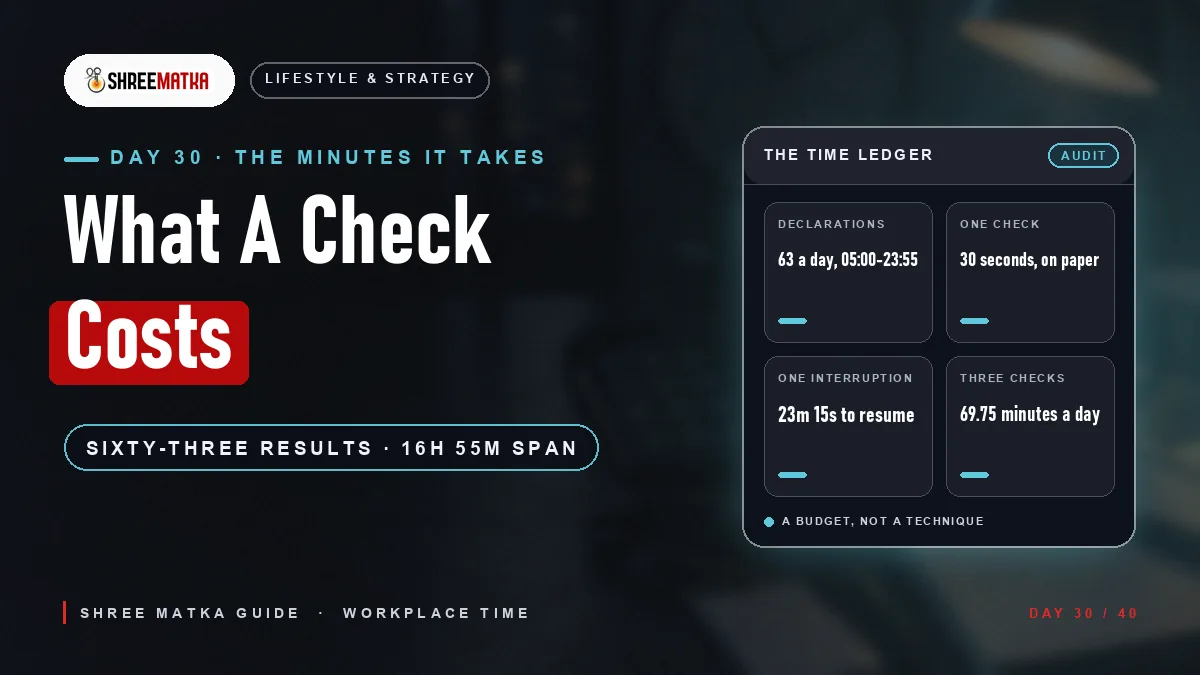
The schedule is not a matter of opinion, because this platform stores it. A database migration seeds thirty-one market rows, each with an opening time and a closing time - the pair the play guide illustrates - and twenty-five of those are main markets that declare a result at each end of their session. Thirteen of the main rows are day markets and twelve are night markets, so the two sessions produce fifty declarations a day between them. A separate starline game generates thirteen hourly slots from ten in the morning to ten at night, with betting closing five minutes before each. The daily total across the platform is sixty-three declared results.
Those results are not spread evenly across useful hours. The earliest main session is Disawar, which opens at five in the morning and closes at seven; the latest are Gali, which closes at five minutes to midnight, and Main Bazar at the same minute. Between the first declaration and the last there are sixteen hours and fifty-five minutes, which is longer than most working days and does not sit inside any of them. A person on a standard shift is necessarily absent for part of the schedule, and the part they miss is set by the market rather than chosen by them.
There is one more piece of the design worth naming. The component that fetches results runs on a fixed sixty-second cycle, so the page a reader opens is never more than a minute out of date at any hour it is running. Freshness is therefore continuous rather than scheduled, which removes the small natural pause that the two-session day described in the history guide used to impose. The old rhythm at least ended; the modern one only has gaps between updates, and a gap that is always about to close is harder to leave alone than a declaration that has already happened.
| Session block | Rows in the seed data | Declarations a day | Clock window |
|---|---|---|---|
| Day-group main rows | 13 rows, including Disawar | 26 | 05:00 to 23:55 |
| Night-group main rows | 12 rows | 24 | 19:00 to 23:55 |
| Starline slots | 1 game, hourly generator | 13 | 10:00 to 22:00 |
| Whole platform | 31 market rows | 63 | 05:00 to 23:55 |
The Interruption Tax: A Sixty-Second Check Is Not Sixty Seconds
The study usually quoted here is Mark, Gudith and Klocke, published at CHI in 2008 as "The Cost of Interrupted Work: More Speed and Stress". It found that after an interruption, participants took on average twenty-three minutes and fifteen seconds before returning to the original task, and that they compensated by working faster and under more stress rather than by recovering the time. The finding is not about phones or gambling; it is about how attention resumes, and it applies to any interruption that carries a decision.
Apply it modestly. A person who checks one declaration during a working morning loses about twenty-three minutes of continuity once. Three checks cost roughly seventy minutes. Six cost more than two hours. The estimates assume the mean and assume the person returns to the same task; both assumptions flatter the habit, because a check that carries money is more likely to be rehearsed afterwards than a check that carries a headline. This is the arithmetic that turns a thirty-second activity into a half-day.
323.25 minutes3 x 23.2569.75 minutes"three quick checks"The notification setting is where the platform’s schedule becomes the reader’s interruptions. A sixty-second poll means the app can always present something new, and an alert converts a declaration the reader did not attend into one they did. Turning notifications off does not change the price and does not create recourse, but it does move the schedule back to the market, which is where it started before software made it portable. The limits guide treats that as a boundary rather than a strategy.
| Checks in a working day | Average refocus each | Attention displaced | In hours |
|---|---|---|---|
| 1 | 23.25 min | 23 min 15 s | 0.39 |
| 3 | 23.25 min | 69 min 45 s | 1.16 |
| 6 | 23.25 min | 139 min 30 s | 2.33 |
| 10 | 23.25 min | 232 min 30 s | 3.88 |
Shift Work, Early Markets and Late Markets
A daytime worker and a night-shift worker do not face the same schedule, and neither of them chose it. Disawar declares between five and seven in the morning, which is the end of a night shift and the beginning of a day one. Gali and Main Bazar declare at five minutes to midnight, which is inside a late shift and past the bedtime of an early one. The night group runs from seven in the evening to almost midnight with twenty-four declarations in it, a density that a person finishing at ten will meet on the way home whether or not they planned to.
The mismatch matters because the usual advice about routine assumes a routine exists. A rotating roster has no stable evening, so any plan built on "after dinner" breaks every few weeks and is then renegotiated at the moment of least resistance. The honest statement is that the schedule is designed around declarations and not around employment, and a shift worker is not failing at discipline when the clock does not line up; they are meeting a product whose hours were never meant to accommodate them.
There is no self-exclusion that binds an operator holding no licence, which is the structural point the legality guide makes at length. What remains is the boundary the person sets and keeps, and the time version of that boundary is narrower than the money version: a deposit limit is enforced by a system, while a no-checks-before-eight rule is enforced by the same tired person who wants to check. That asymmetry is worth knowing before trusting a schedule to do the work of a decision.
| Market example | Betting opens | Closes | Where it lands in a working day |
|---|---|---|---|
| Disawar | 05:00 | 07:00 | end of a night shift |
| Sridevi | 11:35 | 12:35 | a lunch hour |
| Kalyan | 16:10 | 18:10 | the commute home |
| Main Bazar | 21:40 | 23:55 | an evening at home |
| Gali | 23:00 | 23:55 | past the end of a late shift |
| Whole schedule | 05:00 | 23:55 | nobody’s single waking day |
05:0007:0008:30 or later0 or 1the market, not the playerOne Ledger: Money and Attention
The two ledgers this guide has described are the same ledger read twice. Expected loss is the house edge multiplied by turnover, which is arithmetic the mathematics guide derives from the platform’s own rates: 9.8 on a single digit against ten outcomes is a two percent hold, and the pana tiers work out to four. Attention is the same multiplication with a different unit: glances multiplied by the cost of resuming. Both totals grow with repetition, and repetition is the one variable the schedule controls. The bet-type guide prices each shape of that repetition.
Put numbers on both sides. Twenty single-digit bets of ten rupees a day turn over two hundred rupees and cost about four rupees in expectation, which is twenty-eight rupees a week. The same twenty decisions, checked at thirty seconds each, are ten minutes of reading a day. If ten of those checks happen during work, the displacement is not ten minutes but closer to four hours of resumed-task time, and no part of that figure appears on any statement, including the one the taxation guide describes. The risk-management guide calls the money side bankroll; the time side has no such word, which is part of why it goes unmeasured.
Rs 102020 x Rs 10 = Rs 2002.00%2.00% x Rs 200 = Rs 4Rs 4 x 7 = Rs 2820 x 30 s = 10 minutes a dayWhat a Time Budget Can and Cannot Do
A time budget is a boundary written down in advance, and that is all it is. It can move a habit out of working hours, which is real. It can cap the number of checks, which is also real. It cannot change the price of a bet, create a counterparty, or make an unlicensed operator pay. Treating it as a harm-reduction measure is the mistake this chapter exists to name: a boundary reduces exposure at the margin, while treatment addresses the reason the margin keeps moving. The historical-data guide makes the same point about chart study: a week of records measures a week of behaviour, not a system.
This guide will not tell a reader how to place bets during working hours, which settings to change on an office phone, or how to use a lunch break for a market whose close time falls inside it. Those are efficiency tips for a negative-expectation product, and the calendar item asking for time management is not a licence to write them. The refusal is the content: a guide that helped a reader lose money more conveniently would have failed at the only thing it could honestly do.
What survives is a narrower claim. Time is the part of the cost a person can see without a statement, so it makes a good first measurement. If the audit shows that a habit displaces an hour of work a day, that is information a reader can act on without reference to any prediction. The psychology guide covers what to do when the boundary keeps failing, and that is a different conversation from this one.
| Question | Can a time budget answer it? | Why |
|---|---|---|
| When does this market declare? | Yes | It is a published time |
| How many checks do I make? | Yes, by counting | A number, not an intention |
| Does my employer see it? | No | Device and network policy decide |
| Will the operator pay me? | No | A budget creates no recourse |
| Does it lower the price? | No | Hold is set by the payout table |
| Is it a substitute for treatment? | No | Different problem, different help |
The Workplace Boundary, and What an Employer Can See
Work devices are usually monitored, and that is not a secret. A company laptop or phone commonly carries device-management software, its network traffic is logged, and a written policy usually states that use is for work. The relevant fact for this guide is not whether the monitoring is fair but that a record exists and outlives the momentary decision that created it. A bet placed in a two-minute gap is a two-minute act with a permanent trace; the asymmetry between the act and the record is the whole of the workplace risk.
The honest response is not concealment. A person who needs a technique for hiding activity on a work device has already answered the question this chapter asks, and this guide will not supply the technique. What it will state is the plain alternative: if the activity cannot be done openly on personal equipment outside working time, the schedule is doing something the job is paying for, and the boundary has already been crossed before any money moves. The scams guide describes the same pattern from the operator’s side, where the deposit is easy and the withdrawal is not.
There is a legal dimension that belongs to the state-by-state guide rather than here, but one consequence is a time consequence. A regulated operator refuses a deposit when a limit is hit, which is a system acting at a system hour. An unlicensed product has no such hour, so the only clock in the transaction is the one the reader keeps. That is why this chapter ends with a clock rather than a policy summary.
A Routine That Refuses to Be a System
What the audit supports is a short checklist about time, not a system for play in the sense the prediction-system guide tests and sets aside. First: what are the declaration times of every market I actually follow, written down rather than remembered, in the way the printed-records guide recommends for any figure worth keeping. Second: how many times a day do I open the page or the app, counted rather than estimated. Third: how many of those openings fall inside paid hours. Fourth: what is the earliest and latest declaration I have checked in the past week. Fifth: if the platform stopped paying tomorrow, who could I complain to. Four of the five answers are numbers, and the fifth is usually the reason to stop.
The answers can be collected in a single evening, and they cost nothing. A reader who finds that the schedule reaches from five in the morning to five minutes before midnight and that a handful of checks sits inside the working day now has the audit the calendar item asked for, in the only form that does not flatter the habit. The comparison guide shows why no form of this product wins the price argument, the limits guide shows what to do when the boundary fails, and the community guide shows where these arguments are usually held. This guide adds only the clock.
one line per marketcounted, not estimatedcounted, not estimatedfrom the past weekusually noneOne limit on everything above. Shree Matka is an informational and analytics portal: it publishes no guaranteed numbers, sells no predictions, never solicits fees, does not represent any operator and hosts no draw. Nothing in this article is legal, financial or tax advice, it recommends no form of gambling, and it is intended for readers aged 18 and over. The time audit is offered because it can be checked, not because it makes the activity a good use of anyone’s working day.
Frequently Asked Questions
How much time does following Satta Matka results take each day?
Can I follow the results only after work?
Why does a thirty-second check cost twenty-three minutes?
Which markets declare earliest and latest?
Do notifications make the time cost worse?
Can a time budget reduce harm?
Does this site give tips for betting during working hours?
What should I actually write down for the audit?
Download the Official Shree Matka App
Experience real-time live results, complete historic panel records, and 24x7 verified automated withdrawals on your Android smartphone.
Download App
Comments (0)
Loading comments...