
Where the Historical Record Comes From
The word history suggests something kept because it happened. A stored declaration is closer to a receipt: a value arrived, somebody wrote it down, and a process may destroy it. Five actions produce every row an analysis reads, and each leaves a mark on what it can claim.
A poller wakes every sixty seconds behind a master switch, asks an upstream feed for markets, matches each local row by external id and then by an upper-cased name, and declares the sessions as they appear. An operator does the same by hand. A deletion follows whenever a value must be fixed, because a declared session cannot be edited. A nightly rule destroys what it finds complete and old. And the market-day row is created lazily, on the first request of the day.
fixedDelay = 60000, initialDelay = 15000isMasterAutoResultEnabled()api market AND auto result AND activeby external id, then NAME.trim().toUpperCase()panna matches three digits exactlydelete the session, then declare againTwo lines decide what a study can be about. The upstream client exposes two calls, markets and live, and takes no date argument, so a row lost here cannot be re-fetched from the source that supplied it; and a market renamed upstream keeps its old history on a different lineage, silently, which the guide to why results differ between websites follows up.
| Writer | What it puts in the record | What it cannot put back |
|---|---|---|
| Upstream poller, 60 s | A three-digit panna, one session | A day it missed with the switch off |
| Operator declaration | The same shape, with a timestamp | An edit to a declared session |
| Delete and re-declare | A new value, a new timestamp | The old timestamp it replaces |
| Nightly cleanup rule | Nothing | Fully declared rows past 180 days |
| First request of the day | The row every writer fills | When the market really ran |
That last line is why a publication date and a result date are different facts, as the note on publication date against result date explains: a row created at 09:00 for a session that ran the previous evening timestamps an access, not an event.
Data Sourcing and Cleaning: What Can Still Be Fixed
Cleaning a Matka dataset is a question about the schema rather than a spreadsheet chore, because the write path enforced what it was willing to enforce and nothing after it can add a rule. Two constraints fired at write time and no more: a panna had to be exactly three digits, and a market could hold one row per date. There is no checksum, no signature and no second copy to compare against.
What a cleaner can still do is align the file with the shape of the record. Both sessions belong in separate columns, because a jodi pairs the single digits of two sessions and a row storing only a jodi has thrown away the pannas behind it. Every code belongs in a text column: a jodi of 03 becomes 3 the moment a sheet calls the cell a number, as the leading-zero note shows. Placeholders become nulls, since an undeclared day renders as three asterisks.
One trap is in the code: a deprecated jodi getter whose own comment calls its logic wrong returns the first two digits of one session. Recompute the ank as the digit sum modulo ten; a mismatch is a bug in the reader, not an anomaly in the history.
| Hazard in the raw copy | What the page shows | The cleaning rule |
|---|---|---|
| Undeclared session | Three asterisks, or a blank cell | Map to null before any row count |
| Half-declared day | An open value, an empty close | Keep both columns; keep the row |
| Ank from a derived field | A deprecated getter, wrong pair | Recompute from the three digits |
| Whole missing day | Nothing, in the hourly grid | Re-index against the calendar |
| Night session | The logical date, not the clock date | Carry both; state which is keyed |
The last two rows are where cleaning stops being typing, because the two grids hide absence differently. The weekly grid is calendar-driven, laid out in Monday-anchored weeks, so it carries cells for weeks that never ran, and a sheet counting rows reads that padding as data. The hourly grid is result-driven: a date with no settled row produces no row object at all, so the day is absent rather than blank. A 4,000-day run with a sixth of weekdays closed and a four percent session miss returned 3,301 rows and 699 invisible days, with no hole in the file for a chart to see.
Long-Term Trend Analysis on a Short Archive
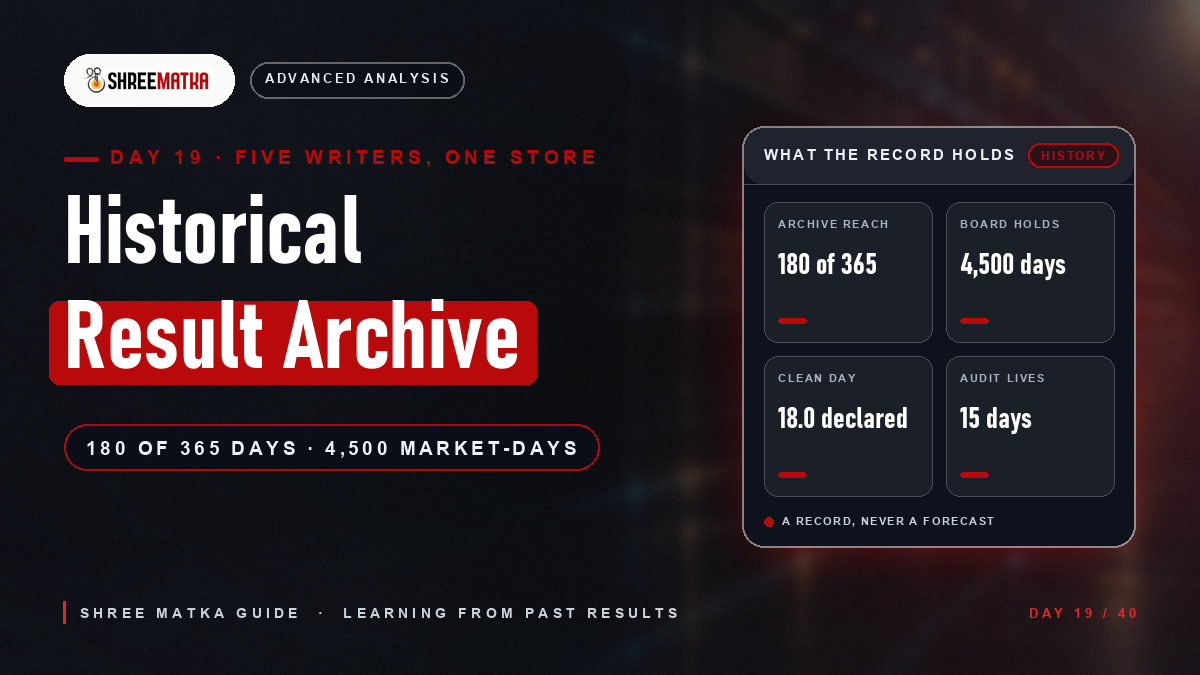
Long-term means longer than the store. The migration that built the cleanup system seeded a retention rule for market days at 180 days, with one condition: only rows whose status is fully declared are eligible. The annual jodi and pana pages ask for 365. The gap is not a rendering artefact; the older half of the window is rows that existed and were deleted, and no feed fetches them back.
180 days, result_status FULL_DECLARED onlyendDate.minusDays(365)180 of 365 = 49.3%154 of 365 = 42.3%129 of 365 = 35.2%25 x 180 = 4,500 market-days25 x 365 = 9,125 market-daysThe first consequence is arithmetic: a trend needing a year of one row gets half a year, and a year of the board needs 9,125 market-days where 4,500 exist. The second is a bias. Because the cleaner deletes only fully declared rows, a day whose close never arrived never leaves, so the oldest surviving end of the archive is enriched in the defects a historian would most want to find.
Within one row’s 180 declarations a named ank is expected 18.0 times with a standard deviation of 4.02, so a count of 25 sits at the edge of a one-sided five-percent band. Split the archive in halves and compare them, which is what a trend chart does, and the difference carries that same 4.02: a swing of 7.9 between the first 90 days and the last 90 is ordinary noise, and a 4,000-run simulation of that split returned a largest swing of +14.
| Claim about the past | Declarations it needs | The archive holds | Verdict |
|---|---|---|---|
| An ank is 12%, not 10% | 1,471 | 180 per row, 4,500 pooled | Pooled board only, and barely |
| An ank is 11%, not 10% | 5,727 | 4,500 | Not affordable here |
| A market has a monthly cycle | 2.03 platform-years | 0.49 of a year | Not affordable |
| A pattern repeats annually | 365 plus | 180 | Longer window than archive |
The smallest rate this archive can call unusual on a single row, by itself, is 13.9 percent: 25 against 18 expected at a one-sided p of 0.058. Pooling 4,500 declarations lifts the bar to 10.8 percent, the honest ceiling for a board-wide flag. The probability and statistics guide derives the denominators these bands sit on.
Seasonal Patterns: The Calendar the Schema Has
Seasonal analysis asks a table for a month and gets a schema that has never heard of one. The market record carries a name, a type, an open and close time, an active flag and two flags for the upstream mirror; there is no month, festival, season or year field anywhere. The platform’s whole calendar is a per-weekday switch, and the entity’s own comment states the rule: where no row exists the market is open, and only an explicit false closes it.
- Weekday is the only season stored: 180 declarations of one row spread over seven levels at 25.7 per cell with a standard deviation of 4.69, so a cell must move about nine declarations, 37 percent of its own expectation, to look odd.
- Month against ank is unaffordable: 120 cells at 3.04 expected declarations per row-year fails the rule of five outright; pooling the board reaches 76.0 per cell and makes the test valid, then needs 2.03 years the retention rule forbids.
- The calendar is mutable, forward-only and not public: the admin endpoint says a change takes effect immediately for future bets and results, and its route returned 403 to an unauthenticated request, so readers cannot rebuild which dates should have existed. Hourly slots add their own weekday filter.
What survives as a seasonal statement is a scheduling fact rather than a statistical one: this market did not run on Tuesdays, this slot was configured for Saturdays, this row was created later than the date it is filed under. Recording those explains most of what a naive chart calls a cycle. A festival effect would need two full board-years, an unchanged calendar and a pre-registered test; the store holds half a year. The pattern vocabulary around these grids is counted in the chart patterns and cycles guide.
Market Correlation Analysis Across Rows
Correlation across markets is the one historical question here the archive can afford, which is why it needs multiple-comparison arithmetic attached. Two main rows share at most 180 logical dates, and on 180 pairs of anks the standard error of a Pearson coefficient under the null is 0.0752, putting the five-percent band at plus or minus 0.147.
2525 x 24 / 2 = 300180 at the retention ceiling1 / sqrt(177) = 0.0752+/- 0.1470.05 x 300 = 15 pairs3.7650.271That last line is the whole argument. A simulation of 300 pairs of independent fair anks over 180 shared dates returned a largest absolute coefficient of 0.241, inside the band a 300-pair sweep would report as a market link and below the 0.271 the correction demands. A study that scans the board, sorts by the printed r and writes up the top three pairs has measured the size of its own search, not a relationship between markets.
| Design | Join key | n | What it can honestly say |
|---|---|---|---|
| Ank to ank, two rows | logical date | 180 | A coefficient and a band; nothing causal |
| Jodi to jodi, two rows | logical date | 180 | Invalid: a jodi is a label, not a number |
| Open ank to close ank | the same row | 180 | A 10 x 10 matrix at 1.8 expected per cell |
| Board-wide daily mean ank | date, pooled | 180 | Valid, one observation per day |
Underneath the arithmetic these rows are linked by nothing except a calendar. The only relations the schema guarantees inside a row are settlement’s own: the close waits for the open, and the sangam families are labels concatenating an open ank with a close panna — definitions, not dependencies, which the terminology glossary sorts.
Anomaly Identification: What a Correction Leaves
Anomaly identification here means finding rows that contradict their own schema, and the honest inventory is short: most errors are invisible, and the visible one survives unintentionally. Start with what cannot be wrong. A panna that is not three digits was rejected at the write; a duplicate market and date cannot exist under the constraint; and a row whose ank disagrees with its digits cannot exist, because the served ank is computed from the digits when the response is built.
Now the errors that survive. All 1,000 panna combinations are legal and exactly 100 of them share each ank, so a mistyped value that is still three digits is undetectable from inside the record: nothing in the row contradicts it and nothing outside it can be fetched. With no draw mechanism on the result path there is no physical process to violate and no consistency check to fail.
new Result(d1, d2, d3, now IST)declaredAt set at constructionIllegalStateException: already declareddestructive, no soft deletewallet credits reversedold value as JSON, reason, admin id15 days; the corrected row up to 180the fix date, not the sessionThe detectable anomaly is temporal. A corrected row carries a declaration timestamp days after the date it is filed under, while an ordinary row is stamped within its session window. The margin is thin and asymmetric: an overnight market files a session that runs after midnight under the previous logical date until a 05:00 IST reset, so a legitimate row may already lag by a day. Anything later is a correction or a late declaration, and the record cannot say which, because the audit entry that could has a fifteen-day life and is served to no public surface: the history and deletion routes this audit probed returned 404 and 403. When a row still looks wrong, the guide to reporting a suspected error is the route.
Practical Application: A Method the Archive Can Carry
Practical application means choosing questions whose denominator the archive can supply and writing the rest down as unanswerable rather than leaving them implicit. Seven steps, each a decision about the record rather than about a number.
| Step | Action | What it buys |
|---|---|---|
| 1. Fix the window | State the extraction date and range | A re-runnable dataset, not a screenshot |
| 2. Re-index the calendar | Fill closed weekdays and absent dates | Zero separated from unknown |
| 3. Split the sessions | Open and close in separate columns | Half-declared days stop being dropped |
| 4. Type the codes as text | 03 stays 03; asterisks become null | Charts stop re-ordering jodis |
| 5. Recompute the derived | Ank from the three digits | Reader bugs separate from record errors |
| 6. Test only what n affords | Counts against 18.0 per row | A band instead of a story |
| 7. Log every gap | Padding separate from absence | A second extraction stays comparable |
Steps two and seven pay the most, because a historical analysis fails on absence more often than on arithmetic: a day with no row, a weekday nobody configured, a slot retired months ago, and a sheet treating all three as zeros. Re-indexing against the calendar separates three statements: the market did not run, it ran and nothing arrived, or it ran and the value is missing from this copy.
What no amount of care produces is a forecast. The record is a set of declarations, the cleanest analysis of it describes which declarations were made, and the next is a 1-in-10 proposition for a named ank whatever the last 180 said. The odds and payouts guide carries the pricing side and the verification guide what to expect from any site claiming otherwise; the data analysis tools guide sorts the software, and this page stays on the record itself.
Limits: What No Archive of Past Results Fixes
The limits of historical Matka analysis are not a shortage of enthusiasm. They are five properties of this archive, each a design fact rather than a task.
- Shorter than a year, and non-renewable: 180 days of fully declared rows against a 365-day chart window, with a feed that exposes markets and live state only.
- Internally consistent, externally unverifiable: 100 legal pannas share each ank, so a wrong triple leaves nothing that contradicts it, and no second source is mirrored.
- Calendar-blind: the weekday switch deciding which dates should exist is admin-only, mutable forward with no history and open by default, so a trend can be a scheduling change wearing a line.
- Corrected without a public trail: a fix overwrites its own value, and its audit row lives 15 days against a 180-day record.
What survives all of that is worth doing because it is modest: a dated extract with an explicit range, a calendar re-index, both sessions kept, codes as text, derived values recomputed, counts compared to 18.0 per row rather than to a hunch, and a written list of what this store cannot answer. That is historical analysis of Satta Matka results in the sense the materials allow, and it is not a basis for predicting the next declaration. Intended for readers aged 18 and over.
Frequently Asked Questions
Where can I download historical Satta Matka data?
How many years of Satta Matka results are available?
Can past Satta Matka results predict future draws?
What is the best way to clean Matka result data?
Are there seasonal patterns in Satta Matka results?
Do different Matka markets correlate with each other?
How do I know whether a published result was corrected?
What are the limits of historical Matka analysis?
Download the Official Shree Matka App
Experience real-time live results, complete historic panel records, and 24x7 verified automated withdrawals on your Android smartphone.
Download App
Comments (0)
Loading comments...