
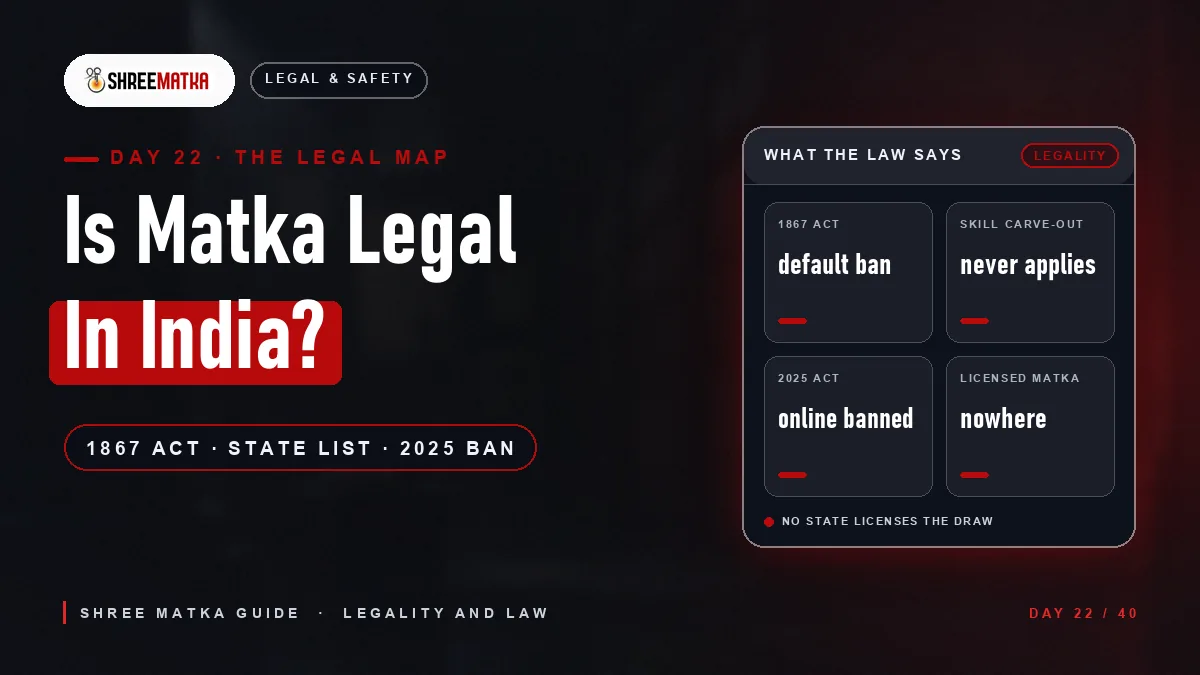
The Federal Baseline: 1867, 2025, and the State List
The short answer to the title question is unflattering and simple: nowhere in India is Satta Matka licensed, and everywhere in India it is prohibited. What makes that sentence true is a stack of three legal layers, and the state-by-state confusion the game is famous for comes from people quoting one layer while standing in the jurisdiction of another.
The bottom layer is constitutional. Betting and gambling sits on the State List of the Seventh Schedule, which means Parliament does not write the general gambling law of the country - each state does. The centre has legislated twice, and both times it legislated around the edges rather than through the middle. In 1867 it passed the Public Gambling Act, whose core offence is keeping or attending a common gaming house, with penalties for the keeper measured in hundreds of rupees and months rather than crores and years - up to a two-hundred-rupee fine or three months in prison, or both. It predates the telephone, says nothing about the internet, and yet it is still the default criminal frame in the states that never enacted their own regime. In 2025 it passed the Promotion and Regulation of Online Gaming Act, which shut the online door for every money game at once. Between those two central frames, the states fill the map.
betting and gambling is a State List subject: each state writes its own lawthe 1867 Act offline and the 2025 Act online - the floor beneath every statefrom the Bombay Prevention of Gambling Act 1887 to the Telangana and Andhra amendmentslegalise a numbers game anywhere, at any timelicense casinos (Goa, Daman, Sikkim), license skill games (Nagaland), or ban outrightlicense matka, in any form, everTwo clarifications before the map. First, this guide describes the law as an informational summary, not legal advice; the closing section says what that means. Second, the one exemption Indian courts have ever carved out of gambling prohibition - games of skill - is the hinge the entire state map turns on, so it gets its own section before the states get theirs.
Why Matka Can Never Use the Skill Exemption
Indian gambling law does not prohibit all gaming; it prohibits gaming and wagering, and courts have held since long before independence that a game in which skill preponderates is not gambling at all. The controlling precedent is State of Andhra Pradesh v. K. Satyanarayana (1968), where the Supreme Court exempted rummy from the Andhra prohibition because the outcome depends on which cards a player chooses to keep and discard. That exemption is the reason fantasy-sport litigation is fought so hard: skill is the only door out, and every operator wants to be standing near it.
Matka is on the wrong side of that door by construction, and not by interpretation. A matka bet is a selection of digits against a draw. Once the number is chosen, nothing the player does can change the result: there is no play left, only waiting. The probability guide puts the space in numbers - every ank value is reached by exactly one hundred of the one thousand ordered panas, and declarations are independent events, so no amount of practice, pattern study or record-keeping moves the distribution. Practice demonstrably improving results is precisely what the skill test asks for, and matka demonstrably cannot deliver it.
| The question the courts ask | In a card game (rummy) | In matka |
|---|---|---|
| Does play affect the outcome? | yes: keeping, discarding and drawing are decisions | no: after digits are picked, only the draw remains |
| Can skill preponderate over chance? | yes - held by the Supreme Court in 1968 | no: the draw dominates by construction |
| Does practice improve results? | substantially | not at all: declarations are independent |
| Verdict | game of skill - exempt | game of chance - never exempt |
The game’s own history agrees with the classification. Matka was born in 1960s Bombay as a wager on the opening and closing cotton rates telegraphed from the New York Cotton Exchange, and when that feed ended the numbers were drawn from playing cards instead - the draw is the game. That is why no state in the map below ever faces a hard question about matka: the skill exemption is the only route to legality, and a numbers draw is the one format that can never walk through it. Everything else is just geography.
The State-by-State Map
Because gambling is a state subject, the honest way to answer where matka stands is to sort the states into regimes rather than recite twenty-eight statutes. Six regimes cover the whole map, and only the first two look, from a distance, like legality.
| Regime | States | Statute | What it means for matka |
|---|---|---|---|
| Licensed casino gaming | Goa, Daman | Goa, Daman and Diu Public Gambling Act 1976 | casinos are legal inside licensed premises; matka is not a licensed product anywhere |
| Licensed online gaming of chance | Sikkim | Sikkim Online Gaming (Regulation) Act 2008 | a real licensing regime for online games within the state; no matka licence has ever been issued |
| Skill-only licensing | Nagaland | Nagaland Prohibition of Gambling and Promotion and Regulation of Online Games of Skill Act, 2015-16 | licences exist only for skill games; a numbers draw never qualifies |
| Explicit bans, online included | Telangana, Andhra Pradesh, Tamil Nadu, Odisha, Assam | state gaming acts as amended (2017, 2020, 2025) | playing and offering are both prohibited, with penalties heavier than the 1867 default |
| Extensions struck down | Karnataka, Kerala, Tamil Nadu (2021 attempt) | high court rulings, 2021-2022 | bans that overreached onto skill games were set aside; the default returned |
| The 1867 default | the remaining states | Public Gambling Act 1867 plus local acts | an offence wherever played for stakes - in Maharashtra under the Bombay Prevention of Gambling Act 1887 |
Two rows deserve emphasis because they generate most of the internet’s wrong answers. “Matka is legal in Goa” is a compression error: Goa licenses casino gaming inside licensed premises, which is a category matka does not belong to, and outside those premises Goa’s own prohibition applies. The same holds for Sikkim, whose 2008 act is genuine licensed-online legislation aimed at formats the state approved, none of which is a matka draw. A legal casino industry and a legal numbers game are different things, and no state has ever had the second one.
| Statute | Year | Scope | Relevance to matka |
|---|---|---|---|
| Public Gambling Act | 1867 | central; common gaming houses | the default criminal frame |
| Bombay Prevention of Gambling Act | 1887 | Maharashtra | the act matka prosecutions in its home state run under |
| Lotteries (Regulation) Act | 1998 | state-run lotteries | the only legal numbers draws, only where a state runs one |
| Goa, Daman and Diu Public Gambling Act | 1976 | licensed casinos | legal table gaming in licensed premises only |
| Sikkim Online Gaming (Regulation) Act | 2008 | licensed online games in Sikkim | a precedent; no matka licence |
| Nagaland skill-games act | 2015-16 | skill games | irrelevant to a draw |
| Telangana Gaming (Amendment) Act | 2017 | bans online stakes | reaches the player, not just the operator |
| Andhra Pradesh Gaming (Amendment) Act | 2020 | bans online stakes | the same, in Andhra Pradesh |
| Promotion and Regulation of Online Gaming Act | 2025 | online money games nationwide | bans online matka outright |
Read the last row against the first. The 1867 Act and the 2025 Act are the floor: offline prohibition everywhere by default, online prohibition everywhere without exception. The state rows sit between them, and not one of them moves matka from prohibited to permitted - the most favourable reading any state regime allows is “not the subject of this licence.”
Online Matka and the 2025 Central Act
For years the honest answer about online matka was a patchwork: already illegal in most states and unaddressed at the centre, served by offshore operators holding licences from regulators in Curacao or Malta that meant nothing in New Delhi. The Promotion and Regulation of Online Gaming Act 2025, passed by Parliament in August 2025, replaced that patchwork with a single national line, and it drew the line in an unexpected place: stakes, not skill. An online money game is defined by whether it is played with stakes, so rummy, fantasy sport and a matka draw all fell to the same prohibition at once, and the fifty-year argument about preponderance of skill stopped mattering online.
a game played with stakes online - skill or chance makes no differenceprohibited (section 5)prohibited (section 6)prohibited (section 7): banks and processors are barredrecognised and regulated, not banneda National Online Gaming Commission for permissible formatsThe penalties are the reason this section exists. Offering or facilitating an online money game is punishable with imprisonment of up to three years and a fine of up to one crore rupees; processing its payments carries the same exposure; advertising or promoting one is punishable with up to two years and up to fifty lakh rupees, which reaches affiliates, influencers and anyone running promotions. Repeat offences are treated more stringently. The one group the act does not punish is the player - there is no federal offence for playing - but the app-safety guide’s legal notice already warned what this guide confirms: states such as Telangana and Andhra Pradesh wrote their own online prohibitions so that playing is an offence too, with penalties far heavier than the 1867 Act’s two hundred rupees.
For online matka specifically, the effect is total. A draw is the least skill-like format that exists, so no reading of the act rescues it; every site or application accepting stakes from Indian players is now operating a banned service nationally rather than merely violating assorted state laws; and the payment prohibition is what turned the ban from paper into plumbing. Whatever one thinks of the policy, the legal question this guide answers has a cleaner answer online than it has had at any point in the game’s sixty-year history.
Recent Developments: Courts, Taxes and Challenges
The map above looks stable, but every regime in it is recent enough to have been litigated, and the pattern of the last five years is consistent: states banning online stakes and courts trimming the overreaches, until the centre ended the argument in 2025. The timeline below is the compressed version.
| Year | Development | Why it matters |
|---|---|---|
| 1867 | Public Gambling Act enacted | the default criminal frame most states still run on |
| 1968 | Satyanarayana ruling | games of skill exempted from gambling prohibitions |
| 1976 | Goa, Daman and Diu act | licensed casino gaming begins |
| 1998 | Lotteries (Regulation) Act | state lotteries codified: legal numbers draws where a state runs one |
| 2008 | Sikkim online gaming act | the first licensed online regime |
| 2015-16 | Nagaland skill-games act | licensing for skill games only |
| 2017 | Telangana amendment | online stakes banned, player included |
| 2020 | Andhra Pradesh amendment | the same in Andhra Pradesh |
| 2021-22 | High court strike-downs | Karnataka (Feb 2022), Kerala and Tamil Nadu (Aug 2021) bans on online skill games set aside |
| 2023 | 28 percent GST on stakes | real-money gaming taxed on turnover from October, reshaping the industry |
| 2025 | central Online Gaming Act; Tamil Nadu prohibition act | online money games banned nationally; a state regime with its own authority and regulations |
| 2026 | Supreme Court challenges pending | the prohibition stands as enacted until the Court decides otherwise |
Three entries need a sentence each. The strike-downs of 2021-22 did not legalise anything for matka: they removed state attempts to ban online skill games, and a draw is not a skill game. The GST change of October 2023 - twenty-eight percent on stakes - is a tax measure, not a legality measure, but it belongs in this timeline because it changed the economics of every real-money operator and accelerated the enforcement climate. And the pending Supreme Court challenges filed against the 2025 Act mean the constitutional argument continues, with the practical consequence that the prohibition remains in force exactly as enacted while the litigation runs. Nobody should read a court calendar as a licence.
What the Law Means for an Individual Player
The operator-side penalties are in every newspaper; the player-side picture is subtler and worth stating precisely, because “players are not punished” is true federally and false in several states. The correct sentence is: the central act leaves the player alone, and the states do not all agree with the centre.
| Act or act-section | What it reaches | Exposure |
|---|---|---|
| Public Gambling Act 1867 | keeping or attending a common gaming house | fine up to Rs 200 or up to 3 months; state acts are heavier |
| Central act, section 5 | offering or facilitating an online money game | up to 3 years and up to Rs 1 crore |
| Central act, section 7 | processing payments for one | up to 3 years and up to Rs 1 crore |
| Central act, section 6 | advertising or promoting one | up to 2 years and up to Rs 50 lakh |
| Central act, the player | playing | no federal penalty - state law still applies |
| Telangana and Andhra amendments | playing online games with stakes | offence for the player, with penalties heavier than the 1867 default |
| Repeat offences | any of the above, again | stricter, with a mandatory minimum |
an offence under the 1867 Act or the state act in force where you arebanned nationally; criminal for the player in states like Telangana and Andhra Pradeshno licence, no regulator, no forum if funds vanishup to two years and up to Rs 50 lakh - this reaches content creatorsnot a defence: an age gate does not legalise a banned gamemarketing, not legality - the next sectionBeyond criminal exposure sit the risks nobody writes statutes for. A stake with an unlicensed operator has no forum: no regulator to complain to, no ombudsman, no chargeback framework that recognises the activity, and the how-to-judge-a-site guide exists precisely because the industry answers that vacuum with clones and whitelabels - the results-differ guide shows what that means for the numbers themselves. Financial loss from a scam is recoverable, if at all, through the general criminal law against fraud, not through any gaming regulator. This paragraph is description, not advice: for any real decision, the only correct source is the current statute in your state, read with a qualified lawyer.
A Foreign Licence Is Not a Permission Slip
Nearly every offshore site serving Indian players carries a licence badge: Curacao, Malta, Kahnawake and their cousins. These are real regulators in their own jurisdictions, and that is exactly the point - their authority stops at their borders, and India is outside all of them. A Curacao licence says the operator answered to Curacao; it has never said anything about India, and no Indian court has ever enforced one as permission to serve Indian players a game their own law prohibits.
issued by a regulator whose jurisdiction ends at its own borderplayers in India, where the 2025 act prohibits the offeringthe offering into India, not the operator’s addressbars Indian payment rails from moving the stakesnothing: no Indian forum, no protection, no recourseThe 2025 Act made this section shorter than it used to be. Before August 2025 the honest analysis had to walk through state-by-state online prohibitions and the absence of central regulation of offshore offers; now the analysis is one line, because offering an online money game into India is prohibited regardless of where the operator is incorporated, and the financial-transaction prohibition gives the ban teeth inside the banking system. The licence badges did not disappear, because they were never aimed at Indian law - they are trust signals for a global market, and this guide’s only interest in them is to say plainly what they are not.
What This Guide Is, and Is Not
This site publishes historical draw records, charts and analysis for readers who study the game; the beginners guide states the same position in one line - most states prohibit games of chance such as matka, and nothing here is an invitation to play. This article is the series’ legal summary, and it is information, not legal advice: it was assembled from public statutes, government press materials and the 2026 country chapter of a legal publisher, by the developer of an informational portal, not by a lawyer, and it creates no lawyer-client relationship and supports no decision by itself.
The subject is also not finished. The 2025 Act is under challenge in the Supreme Court, states keep amending their own acts, and a summary written in 2026 can be overtaken by a gazette notification in 2027. The standing advice this portal gives on its homepage and in its legal notices is unchanged and is the practical takeaway of the whole map: verify that what you are doing complies with the law of your own jurisdiction, assume participation is 18-and-over and involves real financial risk, and treat any site that claims to be legal with the scepticism the last three sections have earned. If the game’s economics are what you came for, the odds guide prices the rate card, the bankroll guide models the losses, and the psychology guide explains the pull; all three assume nothing about where the game is legal, because the answer, everywhere, is: nowhere.
Frequently Asked Questions
Is Satta Matka legal in any Indian state?
What did the 2025 online gaming act change?
Can a player be punished for playing matka?
Are offshore matka sites with Curacao or Malta licences legal?
Which states have legal casinos?
What is the punishment for running a matka operation?
Is a game of skill legal everywhere in India?
Is this guide legal advice?
Download the Official Shree Matka App
Experience real-time live results, complete historic panel records, and 24x7 verified automated withdrawals on your Android smartphone.
Download App
Comments (0)
Loading comments...