
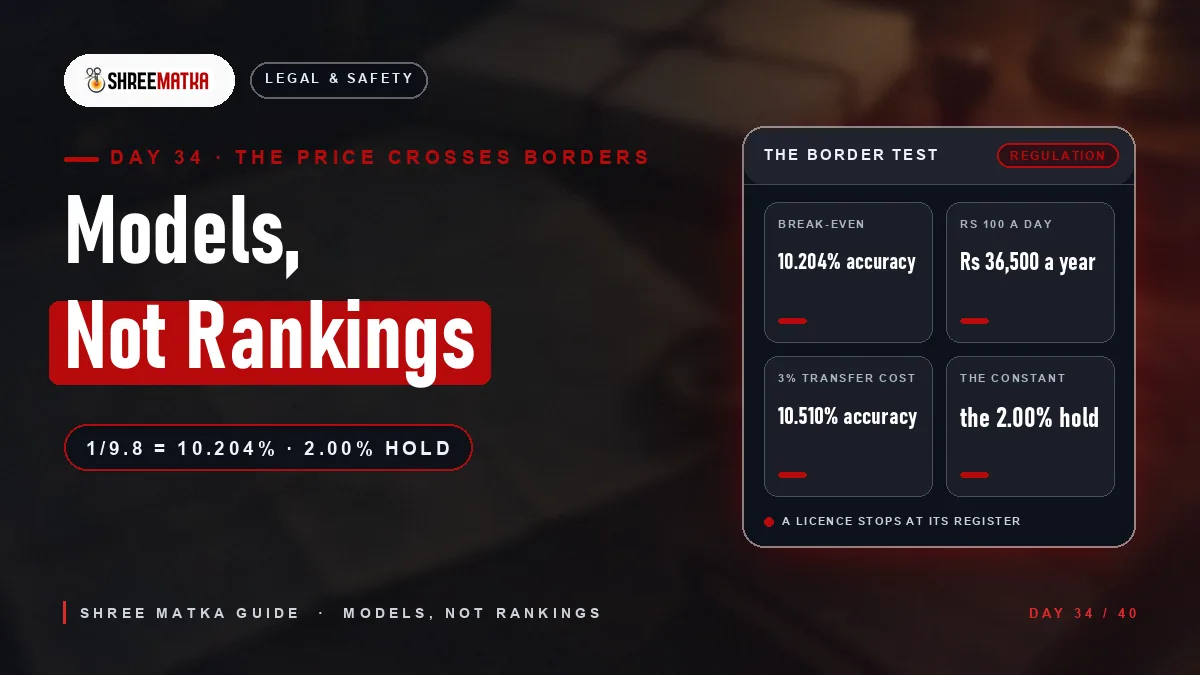
What the Calendar Asks, and What This Article Will Not Do
The calendar item for this guide is an international comparison of gambling regulation, and it lists six subheads: regulatory approaches by region, offshore licensing jurisdictions, international player considerations, cross-border legal issues, compliance strategies and future trends. Two of those are questions about how laws work in places this repository has never operated in. This article handles that honestly: it compares regulatory models, not legal outcomes, and it says so before it says anything else.
Three refusals shape the piece. It gives no legal advice about any country, and it is not a substitute for a lawyer qualified where the reader is. It names no jurisdiction as safe or favourable, because a ranking of that kind is either stale within a year or an advertisement. And it supplies no method for getting around a restriction — no workaround, no route through a virtual private network, no technique for presenting a payment as something it is not. A guide that helped a reader evade a rule would be giving the advice it just disclaimed.
What remains is more useful than a country list. There are four broad regulatory models, and each one answers a different question about who may operate and who can complain. A licence is a document about an operator, not a permission for a player. The price of the product is set in code and does not change when a site crosses a border, while the friction of moving money across one does. The declaration means the same thing everywhere, and the price itself is set out in the play guide.
Four Regulatory Models, and What Each One Decides
Stripped of country names, gambling regulation tends to take one of four shapes. The first prohibits the activity outright. The second grants the state or a state-backed body a monopoly. The third licenses private operators under a regulator, with conditions on games, advertising and payouts. The fourth opens the market to licensed competition and regulates it through consumer, advertising and tax rules rather than through ownership. Most real systems are a mixture, and a mixture can change in a single legislative session.
| Model | Who may operate | What a player can verify | What the model does not fix |
|---|---|---|---|
| Prohibition | Nobody, in theory | Whether enforcement is visible | The price of an unlicensed product |
| State monopoly | The state or its licensee | Where the money goes | Payout value and game design |
| Licensed private market | Registered operators only | The public licence register | The 2.00 percent hold |
| Liberalised market | Licensed competition | Advertising and complaint rules | Whether a player wins |
| Hybrid systems | A mix, often by product | Which rule applies to which game | Consistency across borders |
The right-hand column is the discipline of the table. A model decides who is allowed to sell and where a complaint can go. It does not decide whether the product is worth the price, and it cannot turn a 9.8 payout against ten outcomes into a positive expectation. A reader who assumes that a strict regime means a generous product has confused two different questions, and the confusion is profitable to anyone selling the assumption.
India is a hybrid in exactly this sense. The legality guide in this series owns the state-by-state detail and the central legislation of 2025 with the rules effective 1 May 2026, and it treats the online money-game question as a moving target rather than a settled one. What travels from that article into this one is narrower: the product under discussion is a scheduled number draw, and no state in this series has been described as licensing one. The legality guide is where that claim belongs, with its dates and its caveats, and the history of the game shows the draw predating most of these models by decades. The comparison with other gambling forms explains why a lottery-style product and a casino product are usually regulated under different headings.
What a Licence Does and Does Not Permit
An offshore licence is the part of this subject that produces the most confident and least accurate sentences. A licence is issued by a regulator to an operator, for a defined scope of products, under the law of the jurisdiction that issues it. It is a statement that the operator has met that regulator’s entry conditions. It is not a passport. It does not travel to the player’s country, and it does not tell the player what is permitted where they are sitting.
| Claim on the page | What it can mean | How to check it |
|---|---|---|
| Licensed and regulated | A named operator holds a named licence | Look the number up on the regulator’s public register |
| Internationally licensed | At least one licence exists somewhere | Ask which regulator, then find that register |
| Officially approved | Almost never true of a private site | A regulator publishes approvals; a badge does not |
| Trusted by players | A marketing line, not a finding | Ask for a complaint record and a dispute route |
| Fully compliant | The operator believes it meets its own rules | Ask which rules, in which jurisdiction |
A register entry is worth having, and it is worth exactly what it says. It tells a reader that an entity exists, that a regulator has listed it, and sometimes which products and which domains are covered. It does not create a complaint route in the reader’s country, guarantee that a payout will arrive, or change the hold. Those are separate questions, and a licence page that answers none of them is decoration. The printed pana records in this archive are a useful contrast: an old ledger entry records a draw that happened, while a licence records a permission someone claims to hold.
the operatorone named regulatornamed products and domainsnothingthe law where they arethe 2.00% holdThis is also where counterfeit paperwork appears. A licence number can be copied from a real operator, a register screenshot can be edited, and a badge can link nowhere. The scam guide treats a fabricated credential as a structural red flag rather than a stylistic one, and the tipster audit makes the same point about people who sell advice: the credential is checkable, so check it instead of admiring it.
The Price Travels Better Than the Permission
The payout table is a set of numbers in a migration, and numbers do not stop at a border. A single digit pays 9.8 against ten outcomes, so the break-even accuracy is 1 / 9.8, or 10.204 percent, and the hold at a fair ten percent is 2.00 percent. A jodi pays 98 against a hundred pairs, and the pana tiers sit at about 4.00 percent. An operator hosted anywhere, licensed anywhere and marketed to anyone is still selling this price list unless its own table says otherwise.
9.8x1 / 9.8 = 10.204%3 percent1.031.03 / 9.8 = 10.510%0.31 pointsThe second cost is not part of the game, which is exactly why it matters. Moving money across a border can attract a currency conversion, a remittance fee or a payment processor charge, and those are paid on the way in regardless of the result. The table below assumes a three percent transfer cost to show the shape of the effect; the assumption is stated rather than presented as a fact, and a reader can substitute their own figure.
| Daily stake | Annual turnover | Hold at 2.00% | Transfer at 3% | Combined cost |
|---|---|---|---|---|
| Rs 50 | Rs 18,250 | Rs 365 | Rs 547.50 | Rs 912.50 |
| Rs 100 | Rs 36,500 | Rs 730 | Rs 1,095 | Rs 1,825 |
| Rs 200 | Rs 73,000 | Rs 1,460 | Rs 2,190 | Rs 3,650 |
| Rs 500 | Rs 182,500 | Rs 3,650 | Rs 5,475 | Rs 9,125 |
The arithmetic is unforgiving in a way that a licence never is. A three percent transfer cost raises the accuracy a player must reach from 10.204 to 10.510 percent, which is a 0.31-point edge that the draw does not owe anyone. And unlike the licence, the transfer cost is invisible on the results page: it appears in a statement, a week later, as a slightly smaller amount than expected. The probability guide derives the break-even line, and the bet-type comparison shows how the same structure is assembled across the five products.
Cross-Border Questions a Reader Can Ask
A comparison becomes useful when it turns into questions with answers that can be found. Five of them cover most of the ground, and none requires a law degree to ask. The value is not in the answers this article could supply, because they change by place and by year; it is in knowing which questions separate a real operation from a page with a flag on it.
| Question | Why it decides something | Where the answer lives |
|---|---|---|
| Where is the operator incorporated? | It determines which courts and tax rules apply | A company register and the site’s terms |
| Where is it licensed, and for what? | A licence has a scope as well as a place | The regulator’s public register |
| Which regulator hears complaints? | A licence without a route is a logo | The regulator’s complaint process |
| Which currency and which fees? | Conversion and transfer costs are paid before the draw | The statement, not the marketing page |
| Which tax applies to a win? | It depends on residence, not on the site | The taxation guide and a local adviser |
The complaint question is the one most often skipped, and it is the one that decides what happens after a dispute. A regulator that publishes a complaints process, an ombudsman scheme or an enforcement register is offering a route. A site that offers only a support inbox is offering a conversation. Neither is the same as a court, and neither changes the expected value of a stake.
named in the termslisted on a registera published processshown before paymentchecked where you liveTax belongs here as a pointer rather than an answer. The taxation guide sets out the Indian treatment of winnings and the questions a filer should ask, and it is explicit that the position depends on residence and on facts this series cannot see. A cross-border site does not move the tax question to the operator’s country; it usually makes it harder, because the paper trail is split between two jurisdictions. The legality guide owns the state-by-state position and the caveats that go with it.
Compliance Is an Operator’s Word for Things You Can See
Compliance sounds like a legal status, and it is better understood as a list of visible behaviours. An age gate that actually blocks, a know-your-customer check that runs before a withdrawal, geo-blocking that names the countries it excludes, a self-exclusion option that takes effect immediately, advertising that states the risk, terms that are dated and versioned, and a complaints page with a real process behind it. Each of those is checkable by a reader, and none of them is a promise about outcomes.
| Compliance claim | Visible evidence | What it still does not prove |
|---|---|---|
| Age verification | A gate before play, not after | That the gate cannot be clicked through |
| KYC and anti-money-laundering | Withdrawal checks with a stated process | That every account is checked |
| Geo-blocking | A published list of excluded countries | That the list matches local law everywhere |
| Self-exclusion | A limit or exclusion that starts at once | That marketing stops as well |
| Advertising standards | Risk warnings and no-win claims | That affiliates follow the same rules |
| Complaint handling | A dated process and an escalation route | That a complainant will be satisfied |
Geo-blocking deserves its own paragraph because it is so often misread. A site that refuses a country is usually the site obeying one rule, not the site telling the reader that the product is safe elsewhere. The correct response to a block is to stop, not to find a route around it, and this article gives none: no configuration, no workaround and no payment trick. Using one may breach the site’s terms at the same time as it breaches the rule the block was enforcing, and it leaves the player with no complaint route in either place.
The time cost of a cross-border habit is easy to undercount. The platform publishes sixty-three results a day between 05:00 and 23:55 on the schedule in this repository, about 22,995 a year, and sixty-three checks at thirty seconds each is 31.5 minutes a day, or 191.6 hours a year. Abroad, the schedule does not move; it simply lands at unfamiliar hours. The time audit measured that cost in a single time zone, and the responsible limits guide treats the limit as the variable a player controls. The community etiquette guide is the practical companion when a group spans countries and deadlines, the psychology guide explains why a rule chosen in advance is easier to keep than one improvised after a loss, and the risk-management guide treats the stake itself as the number that matters.
look it upfind the registerbefore play, not afterstarts immediatelya process, not an inboxon the termsWhat Regulators Are Likely to Do Next
The calendar asks about future regulatory trends, and the honest version is a list of directions rather than predictions. Licensing is consolidating, with more conditions attached to fewer licences. Payment channels are being used as enforcement points, because a regulator that cannot reach a server can often reach a bank. Advertising is being restricted, particularly where it reaches people who have excluded themselves. Age verification is moving from a checkbox to a check, and self-exclusion is moving from an option to an obligation. Tax reporting is being standardised across borders.
Each of those directions has an output a reader can watch. A licence register that grows or shrinks is measurable. Enforcement notices are published. Complaint counts appear in annual reports. Payout disclosure, where it exists, is a number on a page. None of those indicators requires trusting a press release, and together they are a better guide to which way a market is moving than any ranking of countries.
The claims that travel fastest across borders are the ones least tied to a regulator. An AI tipster sold into three countries is still making one claim about one sequence of draws, and the audit of prediction claims shows that the claim needs a holdout wherever it is made. A tipster selling access from another jurisdiction is still selling advice whose value depends on a denominator, as the tipster audit sets out. Regulation can restrict the sale. It cannot make the prediction true.
What regulation does not change is the price. The 2.00 percent hold is a property of the payout table, and a stricter regime, a looser regime or a licence from a small island all leave it in place. That is the constant an international comparison can state without a caveat, and it is the reason this article spends its arithmetic on the hold rather than on a league table of jurisdictions. The guide to the same price for every player reached the identical conclusion from a different direction: the payout table does not know who is asking, so no border and no licence changes the price it offers.
An International Comparison That Stays Honest
An honest comparison compares like with like. Regulatory models can be compared, because they answer the same question in different ways. Prices can be compared, because the payout table is a set of numbers. Complaint routes can be compared, because a process is either published or it is not. What cannot be compared honestly is which country is “best” for a player, because the answer depends on residence, on facts this series cannot see, and on rules that change faster than a ranking can be updated.
The discipline of the series applies here as it does everywhere else: a figure is either in the repository, derived from it in a line of arithmetic, or labelled as an assumption. The three percent transfer cost in this article is labelled. The 10.204 percent break-even and the 2.00 percent hold are derived. The sixty-three daily declarations and the 22,995 a year are read from the schedule. Nothing about a country’s law is asserted, because nothing about it is in this codebase, and the article would rather leave a gap than fill it with a guess.
This article names no jurisdiction as safe, ranks no regulator and supplies no method for evading a restriction. Shree Matka is an informational and analytics portal: it publishes no guaranteed numbers, sells no predictions, never solicits fees, represents no operator and hosts no draw. Nothing in this article is legal, financial or tax advice, and it is intended for readers aged 18 and over.
Frequently Asked Questions
Does an offshore licence make Satta Matka legal where I live?
How do I check a gambling licence?
Do different countries change the payout?
What does a 3 percent transfer cost do?
Why will this article not rank jurisdictions?
What should I do if a site geo-blocks my country?
Which regulator handles a complaint?
Does this site sell predictions or give legal advice?
Download the Official Shree Matka App
Experience real-time live results, complete historic panel records, and 24x7 verified automated withdrawals on your Android smartphone.
Download App
Comments (0)
Loading comments...