
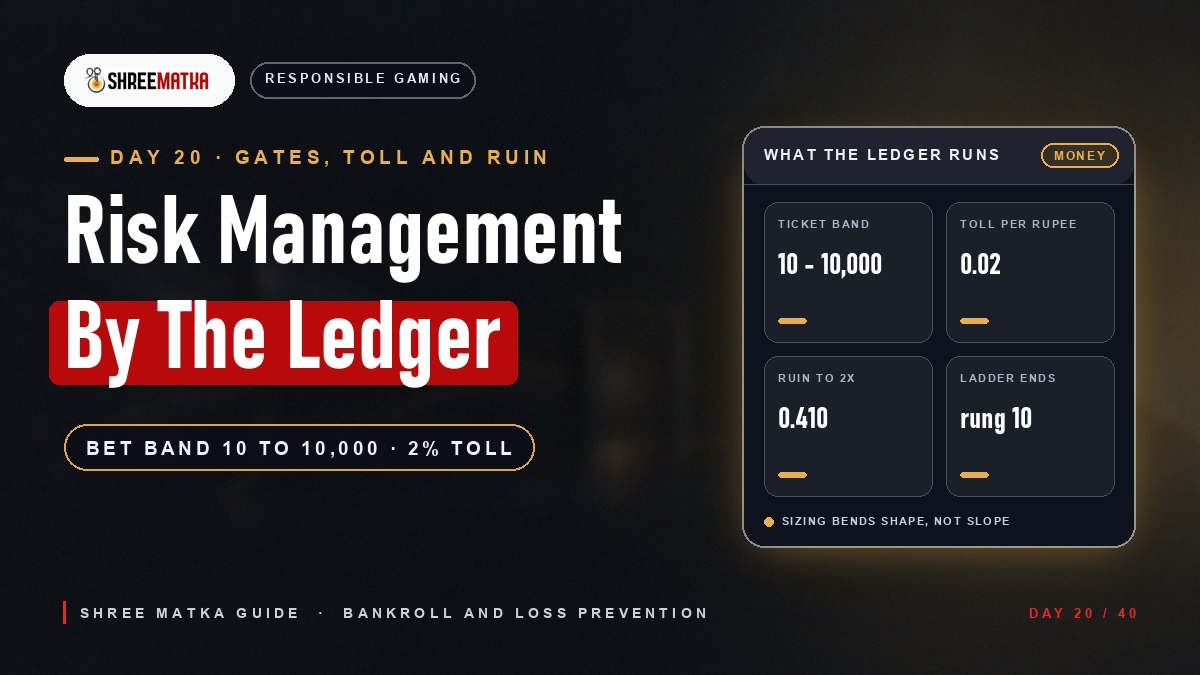
What the Platform Enforces Before a Rupee Is Staked
A stake becomes a ledger row only after it passes checks, and those checks are the honest starting point for any bankroll plan: they are the part of the system that is not a matter of opinion. Four run on every ticket, and a fifth is worth naming for what it does not do.
MIN_BET_10: "Minimum bet is ₹10"MAX_BET_10000: "Maximum bet is ₹10,000""Insufficient balance" - the only aggregate gateBETTING_DISABLED: "disabled by admin"MARKET_CLOSED / OPEN_SESSION_CLOSED / RESULT_ALREADY_DECLAREDINVALID_DIGITS, DUPLICATE_BETThat last line is the finding. Two configuration rows carry a per-user cap of 100 bets and an aggregate of ₹200,000; the admin screen reads both, the public config endpoint echoes them, and placement never asks. Nothing in the shipping path counts tickets or sums stakes, so the wallet balance is the daily limit - a decision made before the deposit, not a wall run into.
| Gate | Where it runs | Value |
|---|---|---|
| Ticket floor | BetService, config key with fallback | ₹10 |
| Ticket ceiling | BetService, config key with fallback | ₹10,000 |
| Money in | FundsService, MIN_DEPOSIT / MAX_DEPOSIT | ₹100 to ₹20,000 |
| Money out | Funds and withdraw services | ₹200 to ₹50,000, ₹1,00,000 per day |
| Deposit intent | auto-reject timer | 30 minutes |
| Bets per user per day | seeded, never read by placement | 100 (inert) |
| Stake per user per day | seeded, never read by placement | ₹2,00,000 (inert) |
| Play switch | admin only, global and per user | betting.enabled |
The other number that moves is the price. Payout multiples are configuration rows, not constants: the first migration seeded 9.5, 95, 140, 280 and 700; a later one rewrote the same keys to 9.8, 98, 160, 320 and 1000. An admin edit checks that a rate is positive and under one hundred thousand, writes the row and evicts the cache, so the next settlement pays the new number. Read the in-app card before sizing; a plan written against someone else’s screenshot of it is stale, and the rate table versus result table guide says where to look.
Bankroll Allocation: Money Labelled Lost in Advance
A bankroll is not a savings figure and not a limit. It is money labelled lost in advance, and the label is what makes later decisions mechanical. The platform supplies the units: a ₹10 floor turns ₹1,000 into one hundred tickets, and the ceiling caps any single ticket at ₹10,000.
Two staking shapes then behave very differently, and mixing them up is the commonest error in bankroll advice. With a flat stake the expected loss is linear in turnover: two hundred ₹10 jodi bets cost ₹40 in expectation, two thousand cost ₹400, whatever the bankroll was. With a fractional stake, each ticket f of the current bankroll, expectation decays as (1 minus 0.02f) to the n.
1 - 0.98 = 0.02expected -₹40, independent of bankrollln(0.5) / ln(0.9998) = 3,465 bets to halveln(0.5) / ln(0.999) = 693 bets to halveThe mean is the least useful statistic here, because a 98-times payout lopsides the distribution. Twenty thousand simulated sessions of 400 jodi bets from a ₹10,000 start finish at a median of ₹2,814 with one percent stakes: 21.1 percent end above the start, 63.1 below half, 8.4 under ₹100. The same run at five percent ends above the start in 0.1 percent of sessions and medians two rupees. Same edge, same toll, two worlds; the only input was the stake fraction.
Ruin is the same story in goal form. A ₹1,000 bankroll staking ₹10 on jodis reaches ₹2,000 before zero with probability 0.410 on an exact absorbing-chain solve, confirmed at 0.411 by simulation, and a ₹1,500 goal 0.545 of the time. State is counted in tickets, so ₹5,000 staking ₹50 toward ₹10,000 returns the identical 0.410: scaling bankroll and stake together buys nothing.
- Deposit ceiling is not a target: ₹20,000 is the maximum single top-up, not a suggested bankroll, and ₹100 is the smallest unit the money path recognises.
- The floor is regressive: a ₹10 ticket is one percent of a ₹1,000 bankroll and five percent of a ₹200 one, pushing small bankrolls into the shape that medians at two rupees.
- Never top up inside a session: the thirty-minute pending-deposit auto-reject is the only forced pause, and it is a side effect rather than a safeguard.
Risk Per Bet: The Rate Card, the Toll, the Optimal Stake
Risk per bet starts as a price list. The card in force, with the outcome space each row matches against, gives the expected return per rupee and so the toll being paid.
| Bet type | Multiple | Outcomes | EV per ₹1 | Edge |
|---|---|---|---|---|
| Single digit | 9.8 | 10 | 0.98 | -2.00% |
| Jodi | 98 | 100 | 0.98 | -2.00% |
| Single panna | 160 | 1,000 | 0.16 | -84.00% |
| Double panna | 320 | 1,000 | 0.32 | -68.00% |
| Triple panna | 1000 | 1,000 | 1.00 | 0.00% |
| Half sangam | 1000 | 10,000 | 0.10 | -90.00% |
| Full sangam | 10000 | 1,000,000 | 0.01 | -99.00% |
Two readings matter for sizing. The digit and the jodi are the same bet at different resolution, both returning 98 paise per rupee, so choosing between them is about variance, not cost. The triple panna is the only row where expected return equals stake: the card carries it without a deduction, and it is still not a profit, because a break-even bet has no growth to size. The panna and sangam families drain fastest, at 84 to 99 percent of turnover; deriving those spaces belongs to the mathematics guide and the pricing side to the odds and payouts guide.
The optimal-stake formula answers this section in one line, and it is not a number to play with. Kelly fraction f* equals p minus (1 minus p) over the net odds: minus 0.002273 for a digit, minus 0.000206 for a jodi, minus 0.005283 for a single panna, exactly 0.000000 for the break-even triple panna. Every row says stake nothing, and the row that pays fair value says stake zero. That is the correct reading of risk per bet on this card: there is no fraction to find, only a toll to schedule.
What the ticket does guarantee is boundedness. A ₹10,000 full-sangam stake promises ₹10 crore gross and risks ₹10,000, deducted up front while a win arrives only after a declaration. That asymmetry is the operator’s exposure problem, and it becomes yours only at correction time.
Stop-Loss Strategies Against a Bimodal Session
A stop-loss is a line drawn on a session, and whether it means anything depends on that session’s shape. Two hundred flat ₹10 jodi bets expect minus ₹40 with a standard deviation of ₹1,378, but outcomes are not spread between those numbers. They jump.
980W - 2,000, where W is hits0.99^200 = 0.134 -> net -₹2,000200 x 0.01 x 0.99^199 = 0.271 -> net -₹1,020net -₹40net +₹940A ₹500 stop-loss on a jodi session therefore does not cut a smooth loss short. It fires on a coin flip indistinguishable from ordinary variance, because the session was always going to end near minus ₹1,020 or near minus ₹40. The same line on a digit session, paying 9.8 times at one hit in ten, behaves like a real threshold: the distribution is closer to symmetric, so a loss beyond the line is evidence rather than noise. A stop-loss is priced by the resolution of the bet, not the intention of the player.
The platform does not help here, which is a code fact: no loss limit, session timer, cool-off, self-exclusion or reality check exists in the shipping path, and the only switches are the global and per-user betting flags, both administrative. What exists is a record. Every bet is stamped in IST at placement and indexed on that timestamp, and every debit and credit reaches a unified passbook view, so a hundred tickets in forty minutes is computable and displayed nowhere.
- What a written stop-loss does: it fixes the worst branch of a bimodal session as a known number in advance.
- What it cannot do: it cannot tell a minus ₹1,020 jodi session from a minus ₹2,000 one after the fact, and it cannot be delegated to software that has no such field.
- Where to put the line: on turnover and on ticket count, both measurable from the passbook, rather than on a rupee loss that a single 98-times win can erase in one row.
Recovery Approaches: Why the Ladder Meets the Ceiling
Recovery means two different things in Matka conversation, and both need pricing: a progression that recovers previous losses, and money back after a correction. The first fails against the ceiling. Doubling from the ₹10 floor reaches ₹5,120 on the tenth ticket; the eleventh would exceed the ₹10,000 maximum, so the whole system is ten tickets and ₹10,230 of turnover.
| Rung | Stake | Cumulative staked | P(no jodi hit yet) |
|---|---|---|---|
| 1 | ₹10 | ₹10 | 0.990 |
| 3 | ₹40 | ₹70 | 0.970 |
| 5 | ₹160 | ₹310 | 0.951 |
| 8 | ₹1,280 | ₹2,550 | 0.923 |
| 10 (ceiling) | ₹5,120 | ₹10,230 | 0.904 |
10 (₹10 up to ₹5,120)₹10,2300.99^10 = 0.9040.98 x 10,230 - 10,230 = -₹204.60ln(0.01) / ln(0.99) = 458.2 -> 45910 x (2^459 - 1) is about 10^139 rupeesDoubling is also the wrong shape for a 98-times payout. It is built for even-money games, where a win must cover the run that preceded it; here one flat ₹10 win already covers ninety-seven previous losses, so the ladder buys nothing and spends the tail of the distribution to do it. Its expected result, minus ₹204.60, is two percent of its turnover, and no arrangement of stakes changes that product.
The second meaning is procedural rather than probabilistic. Deleting a declared session resets its bets to accepted and pending, with an explicit comment in the source that no wallet operation happens: the stake was already deducted and nothing is refunded. A credited win is clawed back. If the balance absorbs it, the win transactions are deleted and the passbook keeps no trace; if not, a reversal debit is written and the balance may go negative. An admin can also edit a placed bet’s amount afterwards without a wallet adjustment. The audit row behind a correction survives fifteen days against a record kept for 180, and the historical data guide follows that trail.
Recovery, in the only sense the software supports, is therefore reconciliation: stop, read the passbook, and treat a returned stake as an accounting event, not a win. Where a value looks wrong, the route is the suspected-error report guide, not another ticket.
Diversification: What Spreading Buys and Never Buys
Diversification lets a player buy variance back at a price that turns out to be identical. Covering k of the hundred jodis at ₹10 each costs 10k a session, hits with probability k over 100 and pays ₹980.
| Jodis covered | Session cost | P(hit) | EV | Standard deviation |
|---|---|---|---|---|
| 1 | ₹10 | 1% | -₹0.20 | ₹97.51 |
| 10 | ₹100 | 10% | -₹2.00 | ₹294.00 |
| 25 | ₹250 | 25% | -₹5.00 | ₹424.35 |
| 50 | ₹500 | 50% | -₹10.00 | ₹490.00 |
| 99 | ₹990 | 99% | -₹19.80 | ₹97.51 |
| 100 | ₹1,000 | 100% | -₹20.00 | ₹0.00 |
The edge column is the point: minus two percent at every row, including the last. Variance peaks at half the board and collapses; covering all hundred jodis converts a lottery into a fee, a certain minus ₹20 a session at zero spread. That is a legitimate risk tool, in the sense insurance is: it removes the surprise and keeps the cost.
Across markets the mechanism is independence. Two rows share at most 180 dates and the ninety-five percent band around zero correlation there is plus or minus 0.147, so treating markets as unrelated is the right default; the chart patterns guide covers what the grids show. Spreading one identical session across five markets divides the standard deviation per rupee at risk by about 2.2, and across twenty-five by five, from 0.689 to 0.308 to 0.138, while the deduction stays two percent of every rupee. A smoother path leads to the same place and multiplies supervision: twenty-five markets is twenty-five stop-loss rules.
Starline is the exception worth knowing, because its risk frame is enforced rather than inert. Its ceiling is per bet type - ₹50,000 on a single digit, ₹10,000 on a single panna, ₹5,000 on a double, ₹2,000 on a triple - and the starline service checks it. The multiplier locks at placement rather than settlement, the day is thirteen hourly slots with a fifty-minute window, and matching is all-or-nothing: a near miss pays zero, with no consolation class anywhere. The starline guide has the structure; here, cadence is the risk.
The Psychological Side of Risk, With a Ledger Attached
The psychological side of risk is usually written as temperament. Here it is written as missing scaffolding: the enforcement layer has no self-exclusion, cool-off, player-set deposit limit, loss limit, play-time cap or reality check, and the user record has no date-of-birth field. So whatever discipline exists belongs to the player, and should be mechanical rather than motivational.
Two structural features do most of the emotional work. The first is the near miss: a jodi one digit away carries the same ledger entry as one nowhere near, and a panna pays only as a class match, so the record holds no category for almost. The second is asymmetric feedback: losses deduct at placement, wins arrive after a declaration, sometimes through a sixty-second poller, so a session feels like debits punctuated by occasional large credits - the shape that reads as luck in both directions.
| Practice | What it controls | What it cannot control |
|---|---|---|
| Fixed unit per ticket | Stake fraction, the only real dial | The two percent toll |
| Ticket-count cap | Turnover, hence the toll | Whether the next declaration is a hit |
| Written stop-loss | The worst branch, in advance | The bimodal jump in outcomes |
| Passbook reconciliation | Actual pace and net, measured | Anything the interface does not show |
| No mid-session top-up | The deposit loop | The thirty-minute reject timer, which is a side effect |
| One market at a time | Supervision load | Independence between markets, which is given |
Tilt is then not a feeling to argue with but a number to notice: tickets per hour, from the placement timestamps. Because the ₹10 floor is small, a tilted session raises the count rather than the stake, so the impulse costs two percent of whatever it touches - the one place where arithmetic favours restraint. The glossary keeps the vocabulary straight; the verification guide covers what to expect from any site that promises otherwise.
Limits: What Risk Management Cannot Buy Here
The limits here are not a shortage of discipline. They are five properties of this system, none of them a task.
- The toll is fixed: 0.98 per rupee on the digit and jodi rows, 0.16 to 0.01 on the panna and sangam families, 1.00 on the triple panna. Sizing changes the shape of a loss curve, never its slope.
- No player-side control runs: no self-exclusion, cool-off, loss limit, session timer or age field in the shipping code, and the only switches are administrative.
- The daily envelope is inert: 100 bets and ₹2,00,000 exist as configuration rows that placement never reads, so the balance is the limit.
- Corrections reach the money: a deleted declaration resets bets without refund, a credited win can be clawed back, a reversal debit can go negative, and the audit row lasts fifteen days.
- Prices are mutable: the multiples in force are the second values written to the same keys, editable inside a wide sanity band and live at the next settlement.
What survives all of that is a small and honest method: label the bankroll as money already lost, keep the ticket at one percent of it or less, count turnover rather than losses, write the stop before the session, reconcile against the passbook instead of memory, and know that spreading buys smoothness at the same price. That is risk management in the sense this platform allows, not a route to the next number: a stored row is a declaration, and the prediction-system guide shows why no ledger of past ones becomes a forecast. Bankroll rules do not guarantee or predict results. Intended for readers aged 18 and over.
Frequently Asked Questions
What is the minimum and maximum bet on this platform?
Is there a daily betting limit?
How much of a bankroll should one bet risk?
Does a stop-loss work for Matka results?
Can doubling my stake recover losses?
Does betting on several markets reduce risk?
What happens to my money if a result is corrected?
Does the platform have self-exclusion or deposit limits?
Download the Official Shree Matka App
Experience real-time live results, complete historic panel records, and 24x7 verified automated withdrawals on your Android smartphone.
Download App
Comments (0)
Loading comments...