
What the Calendar Asks, and What This Article Refuses
The calendar item for this guide is women and Satta Matka, and it arrives with six subheads already written: historical participation, the current landscape, the challenges, community building, success stories and future directions. Five of those six are empirical questions about the world outside this repository. This repository is a platform codebase: it holds a schedule, a payout table and a result pipeline, and it holds no survey, no register and no census of who plays. A guide that guessed at the share of women in the player base would be manufacturing the very stereotype it claims to break.
Three refusals follow from that, and they are stated first because they shape everything after. This article invents no demographic statistic: where a number about people would be needed, it says so instead of supplying one. It names no winner and publishes no name, because a winner presented without consent and without a complete record is either a privacy problem or a survivorship artefact. And it supplies no method, no tip and no encouragement to play, because the product underneath the conversation pays 9.8 on a single digit against ten outcomes, which is a 2.00 percent hold that no demographic changes.
What is left is more than it sounds, and all of it is checkable. The price is in the payout migration and applies per unit staked, not per person. The time is in the schedule. The visibility is in the way a shared phone works. The frauds are in the scam reports. The community is in the etiquette already practised in this series. The future is a set of design choices that can be measured rather than promised. The declaration means here what it means everywhere else in the series, and the price itself is set out in the play guide.
What the Repository Can Say, and What It Cannot
Start with what the code actually records, because the contrast is the argument. The schema seeds thirty-one market rows, twenty-five of them main markets that declare at open and close, for fifty declarations a day; a starline generator adds thirteen hourly slots, so the platform publishes sixty-three results a day, about 22,995 a year, from an opening slot at 05:00 to a final close at 23:55. The payout migration sets 9.8 on a single digit, 98 on a jodi, 160 on a single panna, 320 on a double and 1,000 on a triple. Now the part that matters: no migration and no Java class in this repository contains a gender field, because the schema models markets, results and payouts, not people.
| Calendar question | What the repository holds | What a real answer would require |
|---|---|---|
| Historical participation | Digitised printed pana records | Registers or membership records from a named archive |
| Current landscape | No survey and no player census | A dated, sampled study with its method published |
| Challenges faced | Payout and result logic only | Consenting interviews or case data with a method |
| Community building | Writing on etiquette, no group census | A named group and its own moderation record |
| Success stories | Result pages, no player accounts | An audited individual record published with consent |
| Future directions | Application code and a roadmap | A stated policy with a measurable target |
The first column is the calendar; the second is the honest extent of this source; the third is what would move a claim from anecdote to evidence. None of the third-column items exists in this repository, and the article does not invent substitutes. That is not modesty. A statistic about who plays, invented by a site that has never counted, would be repeated as fact within a week and would be wrong for years. The printed pana records that this archive digitised are a good example of a real historical source: they record the draw and the payout, and they do not record the person who staked.
The historical data analysis guide makes the same point about archives in general, and the history of the game shows where the documented record thins out into anecdote. The discipline is the same one used throughout this series: a number is either in the code, derived from the code in a line of arithmetic, or labelled as missing. The next chapter does the derivation that the repository can actually support, because it is the one claim about the player base that the payout table settles without needing to know anything about the player.
The Same Price for Every Player
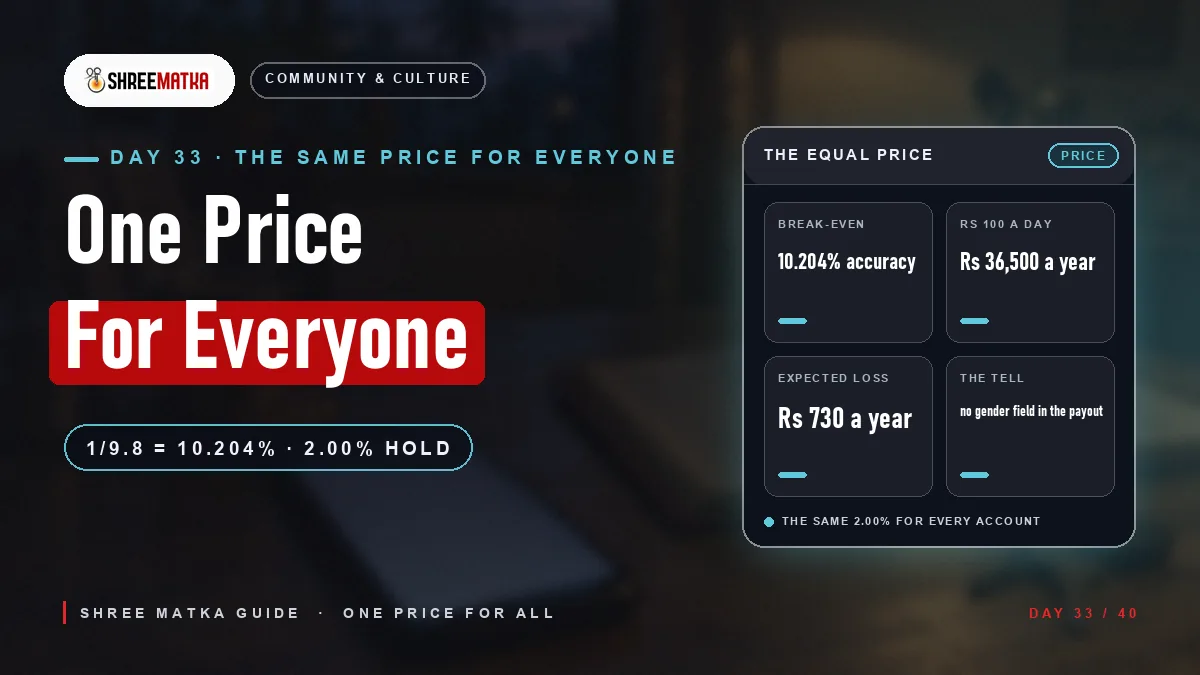
The payout table has five rows and none of them has a column for the person. A single digit pays 9.8 times the stake against ten outcomes, so the implied probability is 1 / 9.8, or 10.204 percent, and a fair game at ten percent would leave a 2.00 percent hold with the operator. A jodi pays 98 against a hundred pairs, which is the same structure with a wider spread. The pana tiers sit at about 4.00 percent. Every account meets those numbers on identical terms, and no account can negotiate them by being older, richer, or of a particular gender.
109.8x1 / 9.810.204%2.00%Rs 730 expected lossPut a stake against the hold and it becomes a household number. Fifty rupees a day is 18,250 rupees of turnover in a year and 365 rupees of expected loss. A hundred a day is 36,500 and 730. Two hundred is 73,000 and 1,460, and five hundred is 182,500 and 3,650. The figures are the same whether the staker is a man, a woman, a student or a shopkeeper, because they are a property of the product rather than of the customer. That is the one sentence about the player base this repository can prove.
| Daily stake | Annual turnover | Expected loss at 2.00% | Monthly equivalent |
|---|---|---|---|
| Rs 50 | Rs 18,250 | Rs 365 | Rs 30.42 |
| Rs 100 | Rs 36,500 | Rs 730 | Rs 60.83 |
| Rs 200 | Rs 73,000 | Rs 1,460 | Rs 121.67 |
| Rs 500 | Rs 182,500 | Rs 3,650 | Rs 304.17 |
A stereotype, by contrast, is a claim about behaviour: that one group stakes more, or less, or for different reasons. Behaviour is exactly the thing this repository cannot measure, so the article leaves it alone. The price is different. It is a claim about the product, and a claim about the product can be checked against the code by anyone with a browser. The bet-type comparison shows how the hold is assembled across the five products, and the probability guide derives the same break-even line from first principles. Neither one needs to know who is holding the slip.
Challenges: Money, Time and a Shared Phone
The calendar asks about challenges, and the honest answer separates the ones that are documented from the ones that are reported. The money is documented: the table above is the arithmetic of a hold that applies to every account. The time is documented too, because the schedule is in the code. Sixty-three declarations at thirty seconds each is 31.5 minutes a day, which is 191.6 hours a year, or almost eight full days spent watching a page refresh for a result that was never in doubt.
6330 seconds31.5 minutes11,497.5 minutes191.6about 8The third cost is visibility, and it is the one a household feels. Matka is usually followed on a phone, and a phone is rarely private. The browser keeps the last result page in its history. The bank or wallet that funded a stake keeps a statement. Message notifications from a group or a promoter arrive on a lock screen. An app-store subscription leaves a receipt with whoever pays the card. The same device that makes the activity convenient makes the record visible to everyone who shares it.
| Exposure | Where it surfaces | Who can see it |
|---|---|---|
| Result page | Browser history and tabs | Anyone who picks up the device |
| Payment | Bank, UPI or wallet statement | Joint account holders and the card payer |
| Group messages | Lock-screen notifications | Anyone near the phone |
| Subscription | App-store receipts | The person who owns the payment method |
| Promoter chats | Inbox previews | The same people who see every other message |
This guide will not tell a reader how to hide an account from a partner or a parent. Concealment is the mechanism by which a manageable loss becomes a hidden one, and the person hiding it removes from their own life the people who could have helped early. The practical alternative is ordinary and dull: decide the monthly amount before the month starts, keep one visible record, and let the people who share the device see the same record. The responsible limits guide sets out how a limit is chosen, and the time audit measures what the checking habit costs in hours.
Stigma belongs here as well, not as a slogan but as a mechanism. A person who expects to be judged for asking a question will not ask it, and a question that is not asked is how a loss stays private until it is large. The answer is not to make the activity invisible; it is to make the question ordinary. Nothing in this chapter claims that one group loses more than another, because nothing in this repository can measure that. It claims only that the three costs — the hold, the hours and the visibility — are charged to everyone.
What a Success Story Would Have to Prove
The calendar asks for success stories, and this is where a guide can quietly become an advertisement. The article refuses for two reasons that do not depend on anyone’s motives. The first is consent: a named person’s finances are not a public resource, and a story told about someone who has not agreed to it is a privacy harm whatever its lesson. The second is arithmetic: a negative-expectation product produces winners every year by variance, so a winner is not evidence of a method. A story that shows only the winning part is the same object as a screenshot.
| Element | What it would prove | What a winning story usually omits |
|---|---|---|
| A start date and a starting bankroll | The denominator | The money that came before |
| A complete stake log | Every attempt, including losses | The losing weeks and the repeats |
| Net position after the hold | Whether the year actually ended up | Fees and the hold |
| An independent check of the log | That the file was not edited | The file is not supplied |
| Written consent to publish | That the person chose to be named | The person was never asked |
The arithmetic of selection is worth restating in one line. If 1,024 accounts make ten calls each, the expected number of perfect records is one, because one divided by 1,024 times 1,024 is one. The account shown to a new reader is the survivor of that selection, not a sample drawn in advance. With sixty-three declarations a day and 22,995 a year, the pool from which a survivor can be chosen is refreshed continuously, and a highlight reel is free to produce.
requiredrequiredrequiredrequiredrequirednot evidenceThere is a second kind of success story that is common in this niche and rarely labelled: the person who is making money from advice rather than from stakes. An affiliate or a subscription seller can have a genuinely profitable year while every reader of the advice carries the hold. That is an income story, not a winnings story, and it becomes honest the moment the payer is named. The series on public figures is written as reportage for exactly this reason: describing a known name is not the same as endorsing a method, and it is not the same as publishing a private bank balance.
The only success story this article will describe is the discipline story, because it is the one the evidence supports. A person who set a monthly amount, kept it visible, stopped when it was gone, and did not chase the loss has a result that can be stated without a record of winnings, and the psychology guide explains why that result is harder to achieve than it sounds. It is not a story about beating the price. It is a story about not letting the price set the size of the loss.
Community Building That Does Not Need a Winner
A community can be built around almost anything, and the question is what it is built around. A group built around naming winners needs a fresh winner every week, which means it needs a selection process, which means it will produce one whether or not anyone is winning. A group built around record-keeping and limits needs no winner at all, because its material is the published result and the arithmetic that follows it. The second kind is dull, and it is the only kind that survives a bad month without turning on its own members.
| Practice | What it protects | The structural warning it avoids |
|---|---|---|
| Publishing result timestamps | A shared, checkable record | A result quoted from memory |
| Discussing limits before numbers | The boundary is set first | The stake grows with the story |
| Refusing personal payment handles | Any route to recourse | Money that cannot be traced |
| Moderators who can say no | The group’s own standard | A channel owned by one seller |
| Naming the payer of any advice | The incentive is legible | Commission dressed as help |
| Keeping losses in the record | The denominator stays honest | A highlight reel |
The community etiquette guide already sets out how to raise a difficult question in a group without turning it into a fight, and the answer is usually the same: ask for the record rather than the opinion. A group that can produce the result page and its timestamp is having a different conversation from a group that can only produce confidence. The legality guide owns the state-by-state position, because the rules around the underlying product differ by place and nothing in this article is legal advice.
There is also a quieter form of community building that this series has used throughout: writing the arithmetic down where a newcomer can find it. A glossary entry, a worked example, a table of expected loss at four stake sizes — none of these is entertaining, and all of them are reusable. A community that keeps its own numbers is harder to sell to, and that is a feature rather than a bug. The risk-management guide is the long version of the same idea, and it does not require anyone to be named.
Frauds That Target a Person, Not a Gender
Fraud in this niche is aimed at a state, not at a demographic. The preferred target is a person who has just lost, because that person has a documented loss, a motive to recover it and often a reluctance to tell anyone. The pitch is recovery: pay a fee and the loss will be recovered. It cannot be, and the reason is in the payout table. The hold is structural, so recovery would require an edge that the product does not contain, and the fee is collected before the attempt. That pattern, an upfront payment for a service that cannot be delivered, is an advance-fee fraud.
Two related patterns are worth naming. The first is impersonation of support: a message claiming that a win is held and can be released by paying a verification charge, usually to a personal handle. A platform that owes a payout does not ask for a payment to release it. The second is extortion: a threat to disclose a person’s play to family or an employer unless money is paid. That is a police matter, not a dispute, and the correct first step is to keep the messages rather than to delete them.
Rs 100Rs 36,500Rs 730Rs 6,0008.2nothingThe victim is never the one at fault, and a guide that implies otherwise makes the next loss harder to report. What helps is procedural: stop paying, keep the messages and the payment records, tell one person who is not selling anything, and report the account to the platform and the payment provider. The scam guide sets out the reporting route, and the legality guide explains why a payment made by deception belongs with the police rather than in a group chat. No fee and no service changes the 2.00 percent hold, which is why every promise of recovery starts from an impossible position.
Future Directions That Can Be Measured
The calendar ends with future directions, and the useful version of that item is a list of things a platform can measure. Display the hold next to the payout, so a player sees 2.00 percent before staking rather than afterwards. Show a running total of time spent on results pages, because the 191.6 hours in this article are invisible one check at a time. Offer a limit that takes effect in one tap, and publish whether it worked. Publish every result with its timestamp, so a shared record can be checked by a stranger. And refuse marketing that describes a player by a demographic, because the price does not describe them that way.
None of those items requires knowing who plays. Each one is a design choice with a visible output, which is what makes it a direction rather than a promise. The tipster-evaluation guide applies the same test to advice, and the audit of AI prediction claims applies it to software: a claim that cannot be checked is not a plan. The test is deliberately unglamorous, and it is the only test that survives contact with a negative-expectation product.
The stereotype this article was asked to break turns out to be breakable without a single invented number. The stereotype says that a group plays differently, or spends differently, or is affected differently. The record says something narrower and firmer: the product charges 9.8 against ten outcomes, which is a 10.204 percent break-even and a 2.00 percent hold, and it charges that to every account. Breaking the stereotype is not recruiting anyone into the product. It is refusing to let a market describe a person by a category while charging them the same price it charges everyone else.
This article names no winner, publishes no name and reports no demographic statistic, because the repository holds none and a guess would become a fact. Shree Matka is an informational and analytics portal: it publishes no guaranteed numbers, sells no predictions, never solicits fees, represents no operator and hosts no draw. Nothing in this article is legal, financial or tax advice, and it is intended for readers aged 18 and over.
Frequently Asked Questions
How many women play Satta Matka?
Is the game priced differently for women?
Why will this article not name a success story?
What changes when the phone is shared?
Which challenges can actually be documented?
What is a recovery scam?
What does a healthy matka community do?
Does this site sell predictions, name winners or offer advice?
Download the Official Shree Matka App
Experience real-time live results, complete historic panel records, and 24x7 verified automated withdrawals on your Android smartphone.
Download App
Comments (0)
Loading comments...