
What Actually Differs Between the Three Bet Types
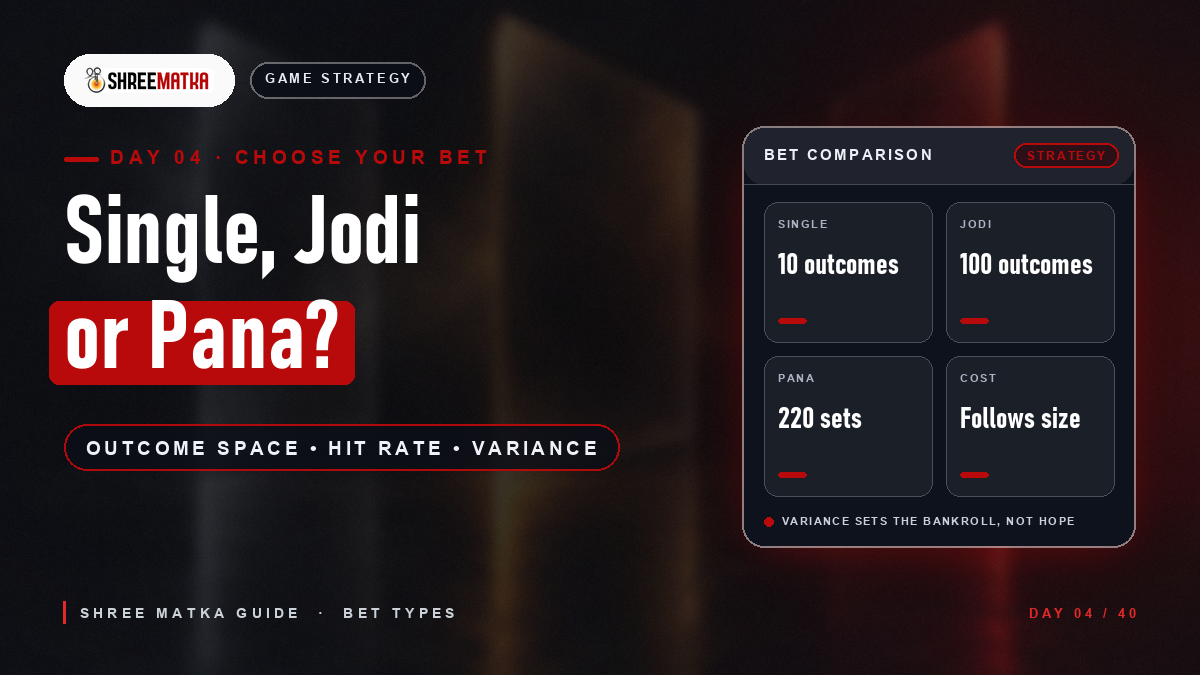
A single, a jodi and a pana are not three games. They are three questions asked about the same declared result, and once you can name the question each one asks, the comparison stops being mysterious. The beginner’s guide to rules and terminology defines them formally; here they are restated as outcome problems:
- Single (Ank): name one digit. You win if it equals the declared open or close digit. Ten possible digits, one winner — an outcome space of 10.
- Jodi: name the two-digit pair formed by joining the open digit to the close digit. One hundred possible pairs — an outcome space of 100.
- Pana: name the full three-digit combination. Because panas are recorded in ascending digit order, only 220 distinct panas exist, not 1,000 — the reason is worked through in the 220 Patti chart list.
Everything that people argue about — which is “better”, which suits a beginner, which the experienced prefer — follows from those three denominators plus one number from the rate card. Two things do not differ between them, and both are widely assumed to:
The draw does not care which you picked. The open and close panas are declared without reference to tickets sold. Choosing the rare bet does not make the common outcome less likely, and choosing the common bet does not bend the rare one toward you.
The cost of a bet is not its difficulty. How much a position returns on average is set by the multiple the market publishes, not by how impressive the match looks. That calculation belongs to the odds & payouts guide, and this article deliberately does not repeat it — because comparing the three bets on price alone hides the difference that actually affects your experience of them.
Risk vs Reward, Side by Side
The table below is the comparison most readers want, expressed in the units that matter for behaviour rather than for pricing. Hit frequency is stated as an expectation over sessions, and the dry-spell column is the arithmetic of Section 3.
| Property | Single (Ank) | Jodi | Named Pana |
|---|---|---|---|
| Outcome space | 10 | 100 | 220 |
| Probability per session | 1 / 10 | 1 / 100 | 1 / 220 |
| Expected gap between hits | ~10 sessions | ~100 sessions | ~220 sessions |
| Chance of nothing in that gap | ~37% | ~37% | ~37% |
| Result character | Small, frequent events | Long silences, occasional hits | Very long silences, rare large multiples |
| What it rewards | Session-to-session record keeping | Pair and grid study | Archive and family analysis |
Read down the columns and the trade-off is a single slope: as the outcome space widens, hits get scarcer, the quoted multiple gets larger, and the emotional experience of holding the position changes completely. That slope — not the rate card — is what “risk” means in practice, and it is why two people can watch the same Kalyan session and find one of these positions boring and the other unbearable.
The Probability Mathematics in Plain Terms
Three facts carry almost all of the practical weight here, and none of them requires more than multiplication.
1. Independent events do not accumulate obligation. A position with a 1-in-100 chance is 1-in-100 on every single session, forever. Twenty misses do not raise the odds on session twenty-one; they are simply twenty sessions that produced a result other than yours. This is the point at which gap charts and “it is due” reasoning die, and it is worth internalising before any of the rest.
2. The expected gap is not a promise date. If a bet hits once in 100 sessions, then over 100 sessions the chance of seeing at least one hit is not 100% or even 50% — it is (1 − (99/100)100) ≈ 63%. The same 63% figure applies to the single digit over ten sessions and to the pana over 220, because the mathematics is identical once you scale the window. Waiting the “average” gap is therefore unremarkable; roughly four positions in ten will still not have hit by then.
3. Dry spells three times the average are ordinary. Extend the window to 3× the expected gap and the probability of at least one hit rises to about 95% — which means about one position in twenty goes that long without a single hit, purely by chance. On a market that declares six sessions a week, a jodi’s 3× gap is roughly a year of nothing. That is not bad luck or a broken record; it is the shape of a 1-in-100 event.
Nothing in this section is an argument for one bet over another. It is the reason the choice in Section 8 is about temperament and budget rather than about being right more often.
How Each Bet Type Behaves
Single digit (ank): the high-frequency profile
The ank resolves every session, which makes it the only one of the three you can actually study as a sequence. Ten sessions of open digits is a readable sample; ten sessions of jodis is ten blanks and a coincidence. That frequency is also why the ank is the teaching bet: it is where you learn that the open digit is a derived value — the unit digit of the open pana’s digit sum — and not a separately drawn number, a mechanic laid out in the how-to-play guide.
Its weakness is the mirror image of its strength. Because hits arrive constantly, the position feels like it is going somewhere even across a long stretch in which the arithmetic has been quietly working against you. Frequency is the easiest thing in the game to mistake for progress.
Jodi: the middle band
The jodi is where most Matka culture lives, because it is the smallest unit that carries a market’s full daily identity: one pair, open and close together, recorded in every chart archive. A hundred-outcome space is large enough for the multiples to look interesting and small enough that the pair actually appears in a human timescale, which is exactly the combination that keeps attention on it.
For reading purposes the jodi is also the most instructive, because it is not an independent fact — it is two digits joined. If you can re-derive a published jodi from the two panas on its own row, you can spot a corrupted row on any mirror site, which is the skill developed in the Kalyan chart reading guide and the jodi & panel chart guide.
Pana: the low-frequency, high-multiple profile
The named pana asks for the whole three-digit combination, and its 1-in-220 structure makes it a fundamentally different activity: you are holding a position that expects to lose for a year at a time. The pana also has the widest spread of published multiples of any core bet, precisely because a 220-outcome space gives a market more room to price as it likes.
Where the pana earns its keep is analysis rather than play. Because every declared result is a pana, family distribution — how often the market produced a single, double or triple pana across a window — is the most direct description of a market’s behaviour available, and it is the entry point to the sangam combinations, which pair two declarations into a single outcome.
Official Shree Matka Mobile Application
Access live 1-second results, historic panel charts, and verified game rate tables directly on your Android phone.
Skill vs Luck: What You Actually Control
The honest split is unusually clean in this game, and it does not favour the player.
Outside your control: the open pana, the close pana, the derived digits, the jodi, and every declared result. A ticket wins by matching digits that were settled without reference to who holds what. There is no decision in the chain — not sizing, not timing, not market selection — that changes which digits are declared.
Firmly inside your control: whether you read the record correctly, whether you verify it against a maintained archive instead of a copied mirror, whether you can recompute a jodi from its own row to catch a transcription error, and how much of your budget any of this consumes. Those are real skills, they are learnable, and they are the reason two people can look at the same chart and see different things.
The distinction matters commercially. Every product sold around this game — guaranteed leaks, paid sure-shot pairs, formula services — works by blurring the boundary, implying that a skill applies to the declaration itself. It does not. If a method genuinely predicted a declared digit, its value would be in the prediction, not in the subscription you are being asked to pay for it.
Combining Bet Types Honestly
Readers often meet all three positions at once — an ank on the open, a jodi on the pair, a pana on the combination — and describe the result as a strategy. It is worth being precise about what that construction does and does not achieve.
What it changes: the shape of your experience. The ank leg fires often and keeps something visible happening; the jodi leg carries the day’s identity; the pana leg is a long-tail position that will probably never pay. A blended book therefore feels calmer than a pure pana book and more dramatic than a pure ank book.
What it does not change: the average. Expectations add across positions, so a blend returns the weighted average of its parts — the same arithmetic as each leg on its own, mixed. Diversification is a budget and temperament decision, not a source of edge, and describing it as one is how readers end up paying for “combination panels” that are three ordinary bets with a label on them.
One genuinely useful hybrid is analytical rather than practical: hold a small record of all three against the same window of declared results. Comparing how often each would have hit on identical data is the fastest way to internalise the frequency differences in Section 2 — and it costs nothing but the bookkeeping.
Bankroll Requirements by Bet Type
“How much do I need?” is usually asked about ticket prices, and it is the wrong variable. Ticket price is trivially controllable; the binding constraint is losing-run length, which is set by hit frequency and is not controllable at all.
- Single (ank): expects a gap of about ten sessions. A budget that survives thirty consecutive sessions without a hit is sized for an event that occurs roughly one time in twenty.
- Jodi: expects a gap of about a hundred sessions. Three times that is a year of a six-day market, and it happens to about 5% of positions by pure chance.
- Named pana: expects a gap of about 220 sessions. Any plan that assumes a hit inside a season has misread the structure of the bet, not the luck of the draw.
Notice what follows: the bet with the smallest ticket is not the cheapest to hold, and the bet with the largest multiple is not the one that costs most — the one that costs most is whichever you refuse to size honestly. This is also where staking systems fail. Doubling after a loss does not shorten a dry spell, it converts a bounded entertainment budget into an unbounded liability, and the 5% three-times-average gap is exactly the scenario that destroys such plans.
Which Bet Suits Which Purpose
Reframed around what a reader is trying to do rather than what pays, the choice becomes almost mechanical. The three purposes below are learning and record-keeping purposes; none of them is a route to better outcomes, because there is no such route.
| Purpose | Best-suited bet | Why |
|---|---|---|
| Learn to parse a result line correctly | Single (ank) | Resolves every session; teaches pana-to-digit reduction by repetition. |
| Follow a market’s day-to-day record | Jodi | The compact daily identity of a market; one pair per row in every archive. |
| Study long-run market behaviour | Pana | Family distribution (single/double/triple) describes a market over a window. |
| Understand how sessions combine | Sangam (built on pana) | Forces both declarations into one outcome; the clearest independence lesson. |
| Improve the chance of winning | None of them | No bet type alters a declaration. Anyone selling that is selling something else. |
If you want the price side of the same question — what each of these multiples is actually worth per rupee — that is computed bet by bet in the odds & payouts guide. If you want the verification habit that makes all of this trustworthy, start with why results differ between websites, and confirm any app or source against the safe-install checklist before relying on its data.
Frequently Asked Questions
What is the difference between single, jodi and pana bets?
Which Satta Matka bet type wins most often?
Is a pana bet really 1 in 1000?
Which bet type has the best payout?
Does combining bet types improve my odds?
Is Satta Matka a game of skill or a game of luck?
How much bankroll does each bet type require?
Which bet type should a beginner study first?
Download the Official Shree Matka App
Experience real-time live results, complete historic panel records, and 24x7 verified automated withdrawals on your Android smartphone.
Download App
Comments (0)
Loading comments...