
How the Tax Law Sees Matka Winnings
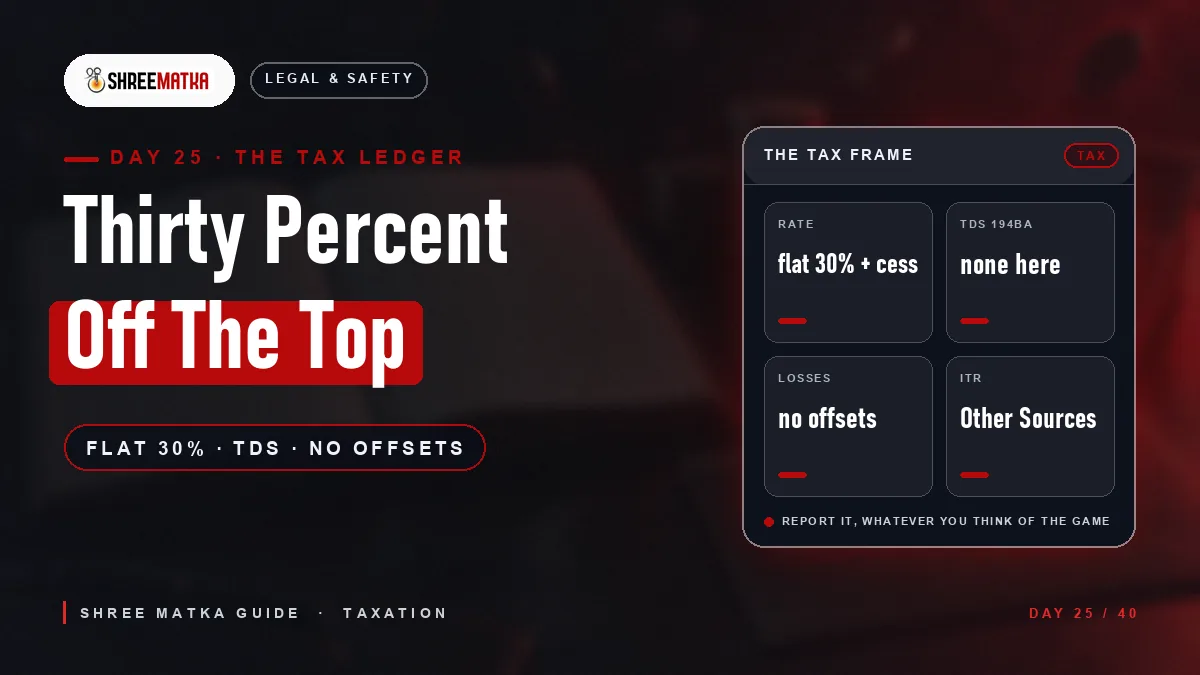
Winnings are income the moment they are received, and the Income-tax Act does not ask what you think of the game that produced them. Gambling winnings, betting, lotteries, card games and online-game winnings are each named in the Act as taxable receipts, and taxability does not wait for the source to be legal - Indian tax law taxes illegal receipts as income too. That is the first tax fact of this guide, and it is worth stating without decoration: the question “does Matka count” is answered yes at the tax portal long before anyone argues about the game’s legality. The legality guide maps where the game stands in law; this guide maps what the tax system does with the money either way.
Three layers stack over one win. Income tax is the player’s side: a flat 30 percent on winnings, detailed in chapter two. TDS is the collection mechanism: the payer withholds the tax before money reaches you, where the machinery exists - chapter three. And GST is the operator’s side: 28 percent on the face value of bets, a tax you never file and never pay directly - chapter four. Around them sits the paperwork: the return that reports winnings under Other Sources, advance tax when the year’s bill grows, and the records that make the whole thing survivable. Each layer is small by itself; the reason this guide exists is that almost nobody assembles them honestly.
One scope note before the arithmetic. This guide reads the published provisions of the Act the way this series reads everything - at the source, in this case the official income-tax portal - and uses round numbers for examples. It is not tax advice; surcharge, other income and the shape of your year can all move the final cheque, and a chartered accountant earns their fee exactly there.
The Flat Thirty Percent: Sections 115BBJ and 115BB
Section 115BBJ is the modern provision: winnings from online games, taxed at a flat 30 percent on net winnings for the year - and the section is deliberately indifferent to whether the game is skill or chance, so the fantasy-football argument and the Matka argument end at the same rate. Net winnings means what came out minus what went in, computed the way the TDS rules prescribe, so a player who deposited 80,000 and withdrew 95,000 across the year has net winnings of 15,000, not 95,000. Because cadence matters here - the starline guide documents markets that settle every hour - a year of play can hold hundreds of small settlements; the net-winnings frame is what folds all of them into one number.
Section 115BB is the older sibling: winnings from lotteries, crossword puzzles, card games, gambling and betting of any kind, taxed at a flat 30 percent on the amount received - gross, with no expense deduction allowed. It entered the Act in 1986 at 40 percent and was cut to 30; it still governs receipts that do not pass through an online-game pipe. Which of the two covers a given Matka win depends on how the play happened - online platform play reads most naturally as online-game winnings on the net basis, informal offline play falls under 115BB’s gross basis - but the rate is the same either way. What changes is the base, and that difference is worth seeing side by side.
| Section | What it covers | Taxed on | Deductions allowed |
|---|---|---|---|
| Section 115BBJ | winnings from online games - skill or chance alike | net winnings for the year: what came out minus what went in | none - Chapter VI-A and expenses are barred |
| Section 115BB | lottery, crossword, card games, gambling and betting of any kind | the amount received - gross receipts, no cost netting | none |
| Both sections | no slab merging with salary, no basic-exemption offset | flat 30 percent, plus 4 percent health and education cess | cess takes the effective rate to 31.2 percent |
₹50,000 - withdrew 95,000, deposited 80,000₹15,000₹600₹15,60031.2 percentWhat “flat” means in practice is worth a paragraph of examples. The 30 percent does not merge with your salary slabs: 5,00,000 of salary pays slab tax and 50,000 of net winnings pays 15,600, and neither number moves the other. The basic exemption limit cannot absorb winnings either - a player with no other income still pays 30 percent from the first rupee of net winnings, because winnings never qualify for the zero band. And no provision lets you shave the base with costs: the stake is not an expense, the data subscription is not an expense, and the time is worth nothing to the Act. The base is the base.
TDS: Money Off the Top Before You See It
TDS - tax deducted at source - is the mechanism that takes income-tax money off the top before the money reaches you, and two provisions do it for winnings. Section 194BA, in force from FY 2023-24, applies to online games: the payer deducts 30 percent on net winnings at the time of withdrawal, and on any unwithdrawn net winnings at year end - and there is no minimum threshold, so the first rupee of net winnings withdrawn already carries tax. Section 194B is the older offline rule for lottery, crossword and game-show winnings, cash or in kind: 30 percent once a payment crosses 10,000 rupees, with aggregation rules able to pull several payments together - and payout slips often show 31.2 percent because cess is loaded on top.
| Provision | Applies to | Threshold | When it bites |
|---|---|---|---|
| Section 194BA | net winnings from online games | none - every withdrawal of net winnings | at withdrawal; year-end on the unwithdrawn balance |
| Section 194B | lottery, crossword, game shows, prizes in kind | above 10,000 rupees per payment (aggregation applies) | at payment; slips often show 31.2 percent with cess |
| Section 206AA | payments where no PAN is on file | not a threshold - a rate rule | the higher of the stated rate or 20 percent - still 30 here, credit harder |
| This platform | read from its code: no TDS machinery exists | none applies - payouts leave in full | the liability does not vanish; it moves to you |
₹40,000₹25,000₹7,500, credited against your PAN₹17,500taxed at withdrawal or at year endNow the fact this series exists to state: this platform - read from its own code, not from a disclaimer - has no TDS machinery at all. There is no withholding step in the payout flow, no PAN-gated deduction, no year-end netting; a withdrawal here leaves in full. That is plumbing, not a loophole: the income-tax liability on your net winnings exists whether or not anyone withheld it, and where nobody withholds, the entire reporting duty in chapter five is yours. The nearest things the site ships to guidance are its footer - an 18+ notice and a play-tips page - and neither is a tax document.
The absence of withholding has a darker mirror, because scammers dress as the machinery. If a “site official” messages that your winnings are frozen pending tax and asks you to pay the 30 percent to a personal UPI handle to release them, that is the fee-trap the scam guide dismantles - no genuine tax is collected by a chat admin, no genuine tax is paid to a personal handle, and real TDS is deducted automatically at source before money reaches you, never demanded afterward. Close the chat and follow the scam guide’s reporting steps; the money was gone the moment the story started.
GST: The Twenty-Eight Percent You Never Pay Directly
The third tax sits behind the game entirely: GST. After the GST Council’s July 2023 decision, online money gaming is taxed at 28 percent on the full face value of bets - the whole amount staked, not just the platform’s commission - effective from 1 October 2023, and the Supreme Court upheld the framework in 2026 against challenges including retrospective demands. This is the operator’s tax: it lands on the platform’s returns, on deposits and stakes at face value, and it is priced into what the game costs to run.
What it means for a player is mostly a list of things that do not happen. You do not file GST. You do not pay 28 percent on winnings - GST never touches a payout and is not deducted from it. Your income-tax rate is unchanged by it. Its effect on you is indirect: it makes running a real-money game more expensive, and that cost lives in the game’s economics alongside the structural toll every stake already carries - the pricing reality this series works through in its odds chapter. The tax you personally owe is the flat 30 percent of chapter two; the 28 percent belongs to the house.
The honest caveat, in keeping with the series: what the law says and what the grey market does are different questions. Whether any given matka operator registers, collects and pays GST is not something a records site can verify from the outside, and this guide will not pretend otherwise. What is unambiguous is the law itself - and the direction of travel: face-value taxation with the courts’ blessing is the framework formal gaming now lives under.
Reporting Requirements: ITR, Other Sources, Advance Tax
Reporting is where winnings stop being abstract. In the return, winnings from lottery, games and betting go under the head Income from Other Sources - not salary, not business. The short ITR-1 form is off the table: its instructions exclude gambling winnings, so most readers file ITR-2, or ITR-3 where business income exists. Where TDS was withheld it shows up in AIS and Form 26AS against your PAN, and the return must claim the credit; a mismatch between the AIS and what the return reports is precisely the shape a notice takes.
| Situation | Where it lands | What it demands |
|---|---|---|
| Winnings with TDS deducted | Other Sources, with the credit claimed | the Form 16A / AIS / 26AS trail - reconcile before filing |
| Winnings with no TDS - this platform | Other Sources, self-assessed | your own ledger: deposits, withdrawals, net for the year |
| Advance tax due | the instalments after receipt | casual winnings are paid for in the instalment following the money |
| Form choice | ITR-2 for most; ITR-3 with business income | ITR-1 excludes gambling winnings by instruction |
| No filing at all | an unexplained credit instead | high-visibility income: TDS entries and payment trails exist either way |
₹1,00,000₹30,000₹1,200liability above ₹10,000 after TDS credit₹31,200 payable through the instalmentsAdvance tax is the piece that surprises salaried players, because salary never trains you for it. Once the year’s total tax after TDS credit crosses 10,000 rupees, advance tax is obligatory - and a good year on a platform with no withholding is exactly that case. Casual winnings carry their own timing rule: they are meant to be paid for in the instalment that follows the receipt, not parked until March. Interest runs on shortfalls, which is the Act’s way of noting that the calendar is part of the tax.
The no-filing trap deserves its blunt sentence: winnings are high-visibility income. Formal platforms’ TDS entries land in AIS against your PAN automatically, bank and UPI trails exist everywhere, and skipping the return does not make income invisible - it makes it unexplained, which is worse. The raw material for filing this honestly is the same material this series keeps asking you to keep: the spreadsheet habit of the data-tools guide and the ledger the prediction-system guide builds. They were written for analysis; they double as your tax file.
Deductions and Set-Off: The Honest No
Every losing player eventually asks whether the tax code can soften the blow, and the honest answer is no at every door. Section 115BBJ taxes net winnings and expressly bars Chapter VI-A deductions - the 80C and 80D family - and expenses of any kind. Section 115BB taxes gross receipts with the same refusal. Losses from gambling, lottery, card games and betting cannot be set off against any other income, and they cannot be carried forward to a better year. The single exception in the Act - losses from maintaining race horses set against horse-race winnings - has nothing to do with Matka.
| What a losing player hopes for | What the Act actually says |
|---|---|
| Deduct stakes as a cost of earning | no - gross or net, the provisions bar expense deductions |
| Set losses off against salary | no - gambling losses cannot touch any other head of income |
| Carry losses forward to a better year | no - no carry-forward exists for these losses |
| Claim 80C or 80D against winnings | no - Chapter VI-A is expressly barred under 115BBJ |
| Refund TDS in a losing year | only through the return - net winnings of nil mean nil tax, so wrongly withheld TDS comes back filed, not automatic |
| The one exception in the Act | race-horse maintenance against horse-race winnings - irrelevant here |
₹60,000₹20,000nil - the computation does not go below zero₹0not deductible, not set-offable, not carried forwardThis is where the series’ earlier guides acquire a tax dimension. The affordable-loss rule of the responsible-gaming guide - stake only what can vanish whole - is not softened by the tax code: because losses do zero tax work, the only money the Act recognises is the money you won. The bankroll guide already modelled the expected cost of the game in ruin arithmetic; the tax code declines to refund any of it. Plan stakes on the understanding that a lost rupee is simply a lost rupee, and let no filing-season fantasy tell you otherwise.
Professional Gambling vs Hobby: What Changes (Very Little)
Players who take the game seriously often describe themselves as professionals and expect the tax code to agree: business income, deductible expenses, losses that offset. For a draw game like Matka, it will not. Winnings from wagering are treated as casual income reported under Other Sources, not as business profits, and there is no professional-gambler status that converts a game of chance into a trade. The label changes how seriously you take the work; it does not change the rate, the base, the head of income or the refusal to deduct expenses. A 20,000-net hobbyist and a 2,00,000-net professional both pay the same flat 30 percent plus cess - scale changes the cheque, not the rule.
What professional discipline still buys is real, and it is all in the records. The psychology guide’s decision record and the ledger habit of the prediction-system guide produce exactly the deposit-withdrawal trail that chapter five’s net-winnings computation and chapter eight’s filing need; the discipline is worth adopting for the paperwork alone. What it cannot buy is deductions: even a fully professional self-image cannot make research stakes, data subscriptions or hours deductible, because the provisions bar them at the door regardless of who is doing the spending.
State Variation and the Records That Protect You
State-specific variation is the shortest chapter in this guide, because the honest answer is that there is almost none. Income tax on winnings is central law: no state adds a surcharge on winnings or taxes them separately, and the flat 30 percent follows the player everywhere in India. Where states genuinely vary is legality - the legality guide maps the bans state by state and the 2025 online money-games law - and that variation changes whether you should be playing at all, not what the tax on winnings would be. Lottery licensing is a state subject; Matka is not a state lottery; the distinction buys no exemptions.
Records are the chapter that decides whether everything above goes smoothly or painfully, and the list is short. Keep the deposit and withdrawal trail, the running ledger, the TDS certificates where they exist, the advance-tax challans and the filed returns - and keep them for years, not months, because returns can be reopened for past years and the statement trail is what converts an unexplained credit into an explained one. Exported, dated, unchanged: the same archiving discipline the historical-data guide teaches for results, pointed at money instead of numbers.
| Record | What it proves | Where it lives |
|---|---|---|
| Deposit and withdrawal statements | the in-out flow the net-winnings computation needs | bank and UPI history - export it monthly |
| A running ledger of stakes and receipts | the per-session, per-market totals behind the annual figure | the spreadsheet habit from the data-tools guide |
| TDS certificates - Form 16A | the credit the return must claim | the paying platform; cross-check against AIS and 26AS |
| Advance-tax challans | proof the instalments were paid | the tax portal - save the PDFs |
| Copies of filed returns | the trail if a year is reopened | the e-filing archive |
The stance, as always in this series: this site publishes historical draw records, charts and analysis; it sells nothing, solicits no fees, does not represent any operator, and offers no legal, financial or tax advice - a chartered accountant is the right person for a return with real money on it, and this guide is the briefing you bring to that meeting, not a substitute for it. The whole guide compresses into five sentences: winnings are income, taxed flat at 30 percent plus cess on net winnings; TDS takes it off the top where machinery exists - and here, read from the code, none does, so the duty is yours; GST is the house’s 28 percent, never yours; losses get nothing at any door; and the ledger you keep is what stands between you and a scramble. Decide on records the way the series decides on limits: before the year ends, not after the notice arrives.
Frequently Asked Questions
Do I really have to pay tax on Satta Matka winnings?
Is tax deducted from my payout on this platform?
A site official is asking me to pay tax before releasing my winnings. Is that real?
Can I deduct my stakes or set off my losses?
Which ITR form do I use, and when do I pay?
Are small wins below the TDS threshold tax-free?
If I play professionally, is the tax different?
Does the 28 percent GST mean I pay less on winnings?
Download the Official Shree Matka App
Experience real-time live results, complete historic panel records, and 24x7 verified automated withdrawals on your Android smartphone.
Download App
Comments (0)
Loading comments...