
Where the Machine Stops and the Mind Starts
Almost every article about betting psychology is written as if the platform were a neutral backdrop. On this one it is not neutral, and the clearest way to see what psychology has to do is to read the list of things the software already decides for you. A stake becomes a ledger row only after it survives a validation pass, and that pass is a short, fixed list of mechanical questions.
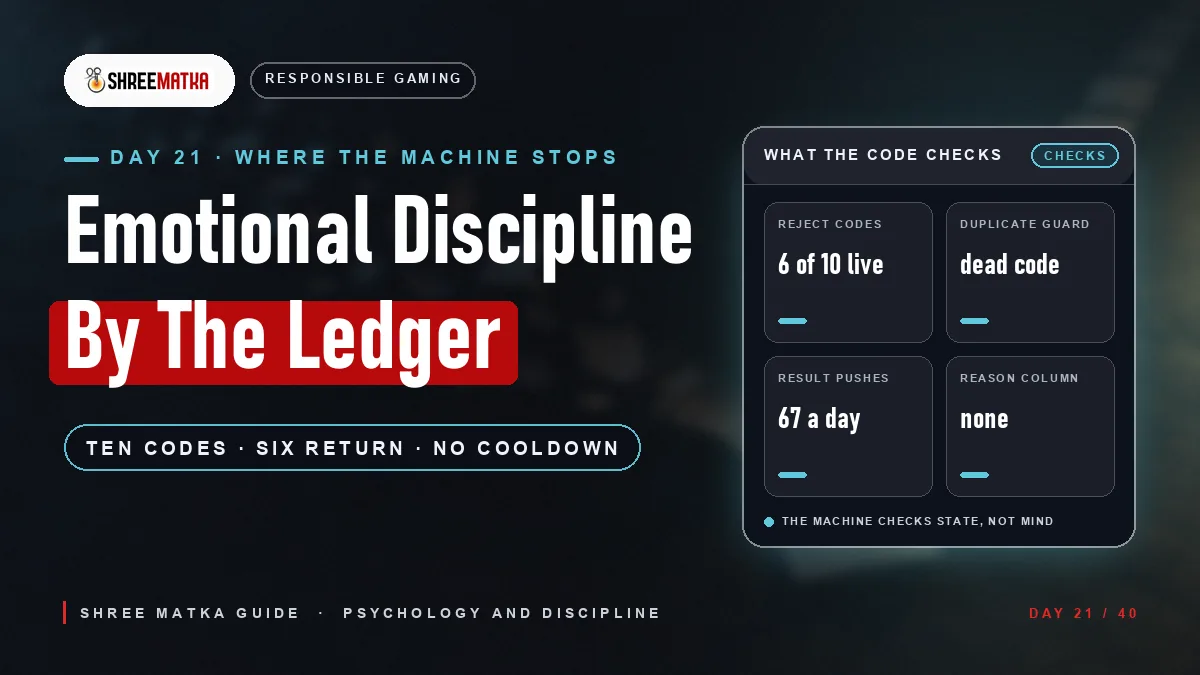
The rejection vocabulary is declared as an enum of ten values on the bet entity. Six of them are returned by real code paths. Four - a bad amount, a bad session, a duplicate bet and a catch-all - are declared and never referenced anywhere in the shipping source: the compiler knows them, the placement service does not. The one that matters most for psychology is the unused duplicate guard, because it means the platform has no idea whether this ticket is the one you meant to place or the fourth copy of it that you did not.
| Reject code | Returned by real code? | What it actually catches |
|---|---|---|
| INSUFFICIENT_BALANCE | Yes | Wallet cannot cover the stake - the only aggregate money gate that runs |
| MARKET_CLOSED | Yes | Current time is past the close boundary |
| MARKET_CLOSED_WEEKDAY | Yes | The market row is switched off for this weekday |
| OPEN_SESSION_CLOSED | Yes | The open leg is over; the close leg is still bettable |
| INVALID_DIGITS | Yes | A digit outside nought to nine, and also any non-positive amount |
| RESULT_ALREADY_DECLARED | Yes | A published result exists for the leg being bet |
| INVALID_AMOUNT | No - never referenced | Nothing. The band check that does run lives in the batch path |
| INVALID_SESSION | No - never referenced | Nothing |
| DUPLICATE_BET | No - never referenced | Nothing: an identical repeat ticket is accepted silently |
| UNKNOWN_ERROR | No - never referenced | Nothing |
INVALID_DIGITS - the only shape checkalso reported as INVALID_DIGITS, not INVALID_AMOUNTMIN_BET / MAX_BET, enforced in the batch path onlyINSUFFICIENT_BALANCE - balance, not budgetno check exists; DUPLICATE_BET is dead codeno check exists; the daily rows are never readThat is the honest frame for everything that follows. The machine intercepts arithmetic and state. It intercepts nothing about intention, pace, size or stopping, and it will accept the same number four times in a minute if the balance covers it. Risk management, covered in the bankroll guide, is what the code leaves out; this article is about the mind that has to fill the gap.
Cognitive Biases, Each With Its Denominator
A bias is not a mood; it is a claim about numbers that happens to be wrong. That makes them answerable, which is the useful thing about treating them this way. Each of the six below asserts something about a quantity the platform either stores or does not store, and each can be closed by naming the denominator rather than by arguing with the feeling.
| Bias | The claim it makes | The fact that answers it | Where the number lives |
|---|---|---|---|
| Gambler’s fallacy | a number is due because it has been absent | a declaration is a stored row, not a draw from a machine with memory; nothing in the schema carries a previous value into the next one | pattern taxonomy |
| Hot hand | a run of hits predicts the next hit | on 365 declarations the two-sigma band is nought to seven hits for a jodi (mean 3.65) and twenty-five to forty-eight for an ank (mean 36.5): a run inside it is not evidence | noise band |
| Illusion of control | a chosen number behaves differently from a random one | every one of the ten ank values is reached by exactly 100 of the 1,000 ordered panas; the choice does not move the space | machine frame |
| Near miss | a pana one digit away was close to winning | settlement is positional and exact, so 149 and 147 are as far apart in the ledger as 149 and 902 | settlement rules |
| Sunk cost | the session has already spent, so it must be worked back | the stake was deducted at placement and a loss is a completed transaction, not an unpaid balance | the toll |
| Availability | the last result seen is the most likely next one | result pushes reach every registered device on every declaration, so recency is manufactured by the notification layer | this article, section four |
Two of those answers deserve a second look because they are cheap to check and expensive to get wrong. The leading-zero rule that makes 03 a jodi and not 3 is a display convention with a real arithmetic consequence, described in the leading-zero guide. And the expected-gap arithmetic - a jodi waits a hundred declarations on average, with a standard deviation of 99.5, so a dry spell three times the mean is unremarkable - is in the mathematics guide. A bias that survives contact with its own denominator has stopped being a bias and become a preference, which is a much smaller problem.
What the schema adds to this is a negative worth stating plainly. The bet record carries the market day, the bet type, three digits, an amount, a status, an outcome, a win amount and a settlement timestamp. It has no field for why. There is no column where a reason, a confidence, a note or a mood could be stored, and no user-writable text field anywhere on the record. The platform therefore cannot be the place where your own decision quality is reviewed, because the thing under review was never written down.
The Window That Feels Like Skill
There is one moment in a market day when the platform lets a bettor act on partial information, and it is worth understanding precisely, because it is the strongest experience of skill the schedule manufactures. A market has three session states, and the two betting predicates do not treat them the same way.
open leg bettable, close leg bettableopen leg closed - close leg still bettableboth legs closed: result dominates timenothing is bettablethe open ank may already be publishedthe close leg, and the jodi, which settles from bothSo between the open declaration and the close deadline you can stake on a leg whose partner is already known. The short-window analysis covers the mechanics of that asymmetry; the psychological consequence is what matters here. It feels like the one point in the day where knowledge beats chance, and it is exactly the point where the arithmetic says otherwise: the open and close digits are separate declarations, every ank is reached by 100 of the 1,000 ordered panas, and conditioning on the open changes nothing about the distribution of the close. Knowing the open ank does not narrow the close. It narrows nothing, while feeling like it narrows a hundred possibilities to a few.
This is why the window is where the largest tickets of a session tend to appear. A bet that feels informed is a bet that invites sizing up, and sizing up is the one decision the rate card punishes regardless of direction: the toll is two percent of turnover on a digit or a jodi whatever you know. If you use the window, use it as a scheduled part of a written plan with a stake fixed in advance, not as a reaction to a number that arrived.
Emotional Regulation Against a Ping You Cannot Tune
Regulation is usually described as an inside job. On a betting platform part of it is outside: the software decides when to interrupt you, and how much control you get over the interruption. Two mechanisms do most of the work - push notifications and rate limits - and they point in opposite directions.
The notification layer broadcasts. When an operator declares a session, the result service fires a push whose own comment says it is not limited to users who placed bets, because everyone should know the result. It goes to every registered token. Multiply that by the schedule: twenty-five main market rows with up to two declared legs each, thirteen hourly starline slots and four jackpot markets with one result time each, which is at least sixty-seven pushes a day, and the six Starline-type rows held in the same markets table sit on top of that. The real count is lower only because rows go undeclared. Against all of it, the player’s only control is to unregister the device entirely. There is no per-type toggle, no quiet-hours setting and no preference column on any entity in the schema.
| Surface | Limit | What you get when it is exceeded | Can you reset it? |
|---|---|---|---|
| Bet placement | 300 / min, 100 / 10 s | HTTP 429 with a Retry-After header and a wait in seconds | Yes - the bucket is keyed on the token |
| Wallet operations | 200 / min, 60 / 15 s | HTTP 429, same shape | Yes |
| General API | 500 / min, 150 / 10 s | HTTP 429, same shape | Yes |
| Sign-in | 30 / min, 10 / 30 s | HTTP 429, same shape | Yes |
| Between two bets | none | nothing: there is no cooldown, delay or waiting period in the placement path | n/a |
| The only real cooldown | 60 s | registration one-time-code resend | n/a |
Read together, those two rows are the whole story of the enforced pause. The platform will make you wait sixty seconds to prove you are you, and never makes you wait a single second to place another stake. The rate limit that does touch betting is a spam control, not a safeguard, and it is keyed on a hash of the authorisation header - so a refreshed token starts a clean bucket. Anything that slows a player down is therefore a rule the player wrote, and the practical version of that is boring and effective: decide the number of tickets before the first one, because after the first one, nothing outside your own note says stop.
A Decision Record the Schema Cannot Store
Since the platform keeps no why, the review loop has to be kept by the player. The useful observation is that this codebase already contains a well-designed record format, and it is worth copying rather than inventing. Every administrative action in the system is written to an audit table whose reason column is not nullable: a result deletion stores a snapshot of what was removed, how many bets were reverted, how much was refunded, which admin did it and why. A bet revert stores the original amount, the reversal and the refund transaction identifiers with a mandatory reason. The admin action log calls its own description field a mandatory remark.
That is the shape of a record that survives being read later: what happened, which entity it happened to, the money involved, who acted and why - in a field that cannot be left empty. A player’s decision log earns the same trust only if it is written before the outcome, because a note written afterwards is a story about the result rather than about the decision.
| Field | Written when | Which bias it defends against |
|---|---|---|
| Date, market row and session leg | before the ticket | treating two market rows as one market |
| Bet type and the number chosen | before the ticket | illusion of control, recorded honestly |
| Stake, and the fraction of the bankroll it is | before the ticket | sizing drift as a session runs |
| The rule being followed, in one line | before the ticket | deciding in the moment and calling it instinct |
| The stop: ticket count and rupee line | before the session | the sunk-cost pull to work a loss back |
| Outcome, filled in later | after declaration | nothing by itself |
| Was the rule followed? yes or no | after declaration | judging a decision by its result |
The last two rows are the point of the whole table. An outcome arrives whether or not you keep a record, and it is the least informative thing in it, because on this rate card a correct decision loses most of the time. Reviewing compliance rather than profit is the only loop that can actually change behaviour; the beginner-mistakes guide calls the alternative - judging a good loss and a bad win as if they were the same event - the most durable mistake in the game. A weekly count of tickets placed outside the written rule is a number that can go down. A weekly profit figure mostly cannot be made to go up.
Recognising Tilt Before the Next Ticket
Tilt is the state in which the decision process described above stops running while betting continues. It is not an emotion you can be asked about, because the platform never asks. It is recognisable from observable proxies, and the honest list is short: the things you can see changing without needing to trust how you feel.
the fraction was decided by the plan, so drift is the plan leavingpace is the clearest single signal; nothing in the code measures itthe rule was a constraint, and constraints are what tilt removesthe bankroll was defined as money already lostthe partial-knowledge window doing its workno duplicate guard exists, so the machine will not tell youThere is a structural reason none of this can be surfaced for you. The two configuration rows that look like they would - a per-user cap of one hundred bets and a per-user aggregate of two lakh rupees - are read by the admin settings screen and echoed by the public configuration endpoint, and are never consulted when a bet is placed. Nothing in the shipping path counts your tickets today or sums your stakes. The wallet balance is the only running total the software enforces, which is why the bankroll guide puts the entire stop-loss question on the player: a line that no code checks is a line that only a written note can hold.
The recovery move is deliberately small and physical: stop placing, and change what you are looking at. Reading the log you wrote before the session is the only action that returns you to the decision rather than the result, and it works precisely because the log was written when you were not tilted. That is the whole mechanism. There is no cool-off button to press, because there is no cool-off feature in the code.
Resilience, Corrections, and Records That Expire
Resilience after a bad run depends on evidence: what actually happened, how big it was, and whether the process held. The platform holds that evidence for a shorter time than most players assume, because a nightly cleanup job deletes old rows on a fixed schedule. The retention rules are configuration rows, and they are not uniform: the money trail is permanent and the betting trail is not.
| Record | Kept for | What its absence costs you |
|---|---|---|
| Main-market bets, settled and credited | 90 days | a quarterly review of your own stakes is impossible from platform data |
| Starline bets, settled | 45 days | the hourly game is the one you cannot audit a month later |
| Jackpot bets, settled | 60 days | the same, on a different clock |
| Rejected bets and batch requests | 90 and 7 days | the evidence that you tried something twice disappears in a week |
| Result deletions and bet reverts | 15 days | the reason a settlement changed outlives nothing: the explanation goes first |
| Admin and settings audit logs | 15 days | a rate or rule change is untraceable after two weeks |
| Declared market days | 180 days | the archive the annual chart asks a year of is itself on a six-month clock |
| Wallet transactions, deposits, withdrawals | never deleted | the money path is the only durable record you have |
The ordering is the finding. A settled bet survives ninety days; the log row that explains a correction to it survives fifteen. The migration comment on the admin log table calls fifteen days of history noise. So on day sixteen after a re-declaration, the wallet still shows the movement of money - those tables are protected and never cleaned - while the reason it moved has been deleted. The historical-data analysis covers how the archive itself is written and destroyed; the personal consequence is that any review you want to do later has to be done from your own export or your own log, taken while the evidence still exists. The tooling for that export is in the analysis-tools guide.
Handled well, a correction is also the best available lesson in how to hold a loss. When a result is deleted, the bets are reset to their pre-settlement state and the source is explicit that no wallet operation happens - the stake was already gone. A credited win can be taken back, and if the balance cannot absorb the clawback the ledger records a reversal debit and permits a negative balance. The emotional discipline version of that rule is uncomfortable but simple: money already staked is money already spent, and a session that has to be worked back is a session that has already ended.
What Discipline Cannot Change
A psychology article should end by stating its own limit, because the alternative is the claim this series spends its effort refusing to make: that a better mindset is a route to the next number. It is not. The fixed part of this game is a price list, and no amount of regulation changes it.
fixed by the rate card: 0.98 back on a digit or jodifixed at two percent, whatever the stakefixed: six checks, four dead codes, no duplicate guardfixed by the cleanup configurationfixed: no such feature exists in the shipping codeopen: entirely yours, and the subject of this articleThe arithmetic of that slope is in the risk-management guide and is not repeated here except to say it is not movable by mindset: ruin at 0.410 for a doubling goal, a Kelly fraction that returns zero or negative for every row of the card, and a two-percent-of-turnover toll that is charged on the way out of a recovery ladder exactly as it is on the way in. The probability guide shows why no pattern reading changes those figures, and the prediction-system guide why a disciplined log of past declarations still does not forecast the next one.
What is genuinely won is smaller and worth having: a session that ends when it was planned to end, a stake that does not drift, a loss that is recorded rather than chased, and a review that can be done at all because someone wrote the decision down before the result existed. Those are the outcomes this platform’s code neither provides nor prevents. It is an informational and analytics portal: it publishes no guaranteed numbers, sells no predictions and endorses no operator, and nothing above is advice to bet or a claim that discipline improves odds. If betting has stopped being a choice you schedule, the how-to-judge-a-site guide and the results-differ guide are where this series keeps its verification material. Intended for readers aged 18 and over.
Frequently Asked Questions
Does the platform stop me from chasing losses?
Is there a waiting period between bets?
Can I set a deposit limit, loss limit or self-exclusion?
Why does the app notify me about results I did not bet on?
How long does the platform keep my betting history?
Does knowing the open ank help me bet the close leg?
What should a written decision record contain?
Can good discipline improve my results?
Download the Official Shree Matka App
Experience real-time live results, complete historic panel records, and 24x7 verified automated withdrawals on your Android smartphone.
Download App
Comments (0)
Loading comments...