
What the Calendar Asks, and What This Article Refuses
The calendar item for this guide is influencers and tipsters, and it asks two different questions in one sentence: how to evaluate advice, and how to follow it. The first half can be answered with arithmetic, and this article does so. The second half is the part the article refuses. It names no tipster, ranks no tipster and supplies no method for following advice into a profit, because the product underneath the advice pays 9.8 on a single digit against ten outcomes, which is a 2.00 percent hold on every stake. A guide that turned that arithmetic into a strategy would be selling the costume it describes.
What is left is more useful than it sounds. A reader who can sort a claim into checkable and uncheckable is no longer deciding whom to believe; the question becomes whether the claim has a denominator, a timestamp and a disclosed payer. Those three tests do most of the work, and none of them requires trusting this site, the tipster or anyone else. The declaration is the same event here as everywhere else in the series: the published result a market releases at its close, which is the only record anyone can audit.
The standard is the one this series has used throughout. Every figure below is either read out of this repository or derived from the published payout table in a line of arithmetic shown in the text; no external study is borrowed and none is needed. The price itself is set out in the play guide, and the AI claims that arrive in the same chat window were audited in a companion article on machine learning and prediction. This one is about the people who sell advice, and how to price them.
Six Kinds of Tipster, Sorted by Who Pays
Sorting accounts by accuracy before sorting them by income gets the order backwards. A person who is paid before the draw and a person who is paid on turnover are not making the same kind of claim, and the second can be paid while being wrong. There are six shapes worth knowing: the screenshot account that sells advertising, the group administrator who sells membership, the free channel that sells affiliate traffic, the paid group that sells a subscription, the promoter paid a share of the operator’s revenue, and the loss-recovery operator who sells an impossible service.
| Shape | Where it lives | Who pays it | The structural tell |
|---|---|---|---|
| Screenshot account | Public feed | Advertisers and click-throughs | Only winning slips are ever posted |
| Group administrator | Chat group | Members, by entry fee | The group is the product, not the record |
| Free channel | Public channel | Affiliate links | Tips are free, the link is not |
| Paid group | Private channel | Subscribers, monthly | Payment arrives before any result |
| Revenue-share promoter | Site or channel | A share of operator turnover | Commission grows when the player loses more |
| Loss-recovery operator | Direct message | An upfront fee | Recovery is arithmetically impossible |
The tell in the right-hand column is not a moral judgement; it is a description of where the money enters. A promoter earns a percentage of the 2.00 percent hold, so the size of the payment is a function of turnover rather than accuracy, and turnover is produced by the reader. That does not make every promoter a liar. It makes the incentive legible, which is all an evaluation needs. The community etiquette guide covers how to raise the question in a group without turning it into a fight, and the question is worth raising because the answer is usually published nowhere.
The Only Evidence That Counts: A Timestamp Before the Close
A tip is a testable claim only if it existed before the outcome. Everything else is a story told with hindsight, and hindsight is cheap: the platform declares sixty-three results a day, so there is always a recent result that makes any sentence look prophetic. What makes a claim testable is boring and specific. The tip must carry a timestamp that precedes the close, the market must be named, the bet type and stake must be stated, the log must include losses, the sample size must be given, and the compensation must be disclosed without being asked for.
| Criterion | What to demand | Why it decides the question |
|---|---|---|
| Timestamp | A public post dated before the close | A caption added later is not a prediction |
| Completeness | Every tip, wins and losses | A selective log has no denominator |
| Specificity | Market, bet type and stake | A digit at 9.8 and jodi at 98 are different products |
| Sample size | How many tips the rate is computed from | Thirty tips cannot separate skill from noise |
| Compensation | Who pays, and how much | A commission on turnover is paid by the reader |
| Falsifiability | A method that can be wrong | Advice that cannot fail cannot be evaluated |
The technical reason screenshots fail is worth stating precisely. This platform fetches results on a sixty-second cycle, so the page a screenshot captures is never more than a minute old and it carries the declaration it fetched. The image, however, carries only whatever pixels the poster chose to include. A cropped screenshot of a winning slip supplies no denominator, no date and no losing entries, and it can be generated after the result in the time it takes to type a caption. The printed pana records that this archive digitised at least had the property of being hard to edit after the fact; a compressed phone image has lost that property entirely.
This is also why the bet type matters so much. A single digit pays 9.8 and a jodi pays 98, and the two have different break-even rates and wildly different variance, as the bet-type comparison sets out. An account that quotes one hit rate across both products has either not done the arithmetic or has chosen the version that flatters it. Ask which number was quoted, to which product, at what stake, on how many tips, and the claim usually shrinks to something small enough to check.
How Many Tips It Takes to Prove an Edge
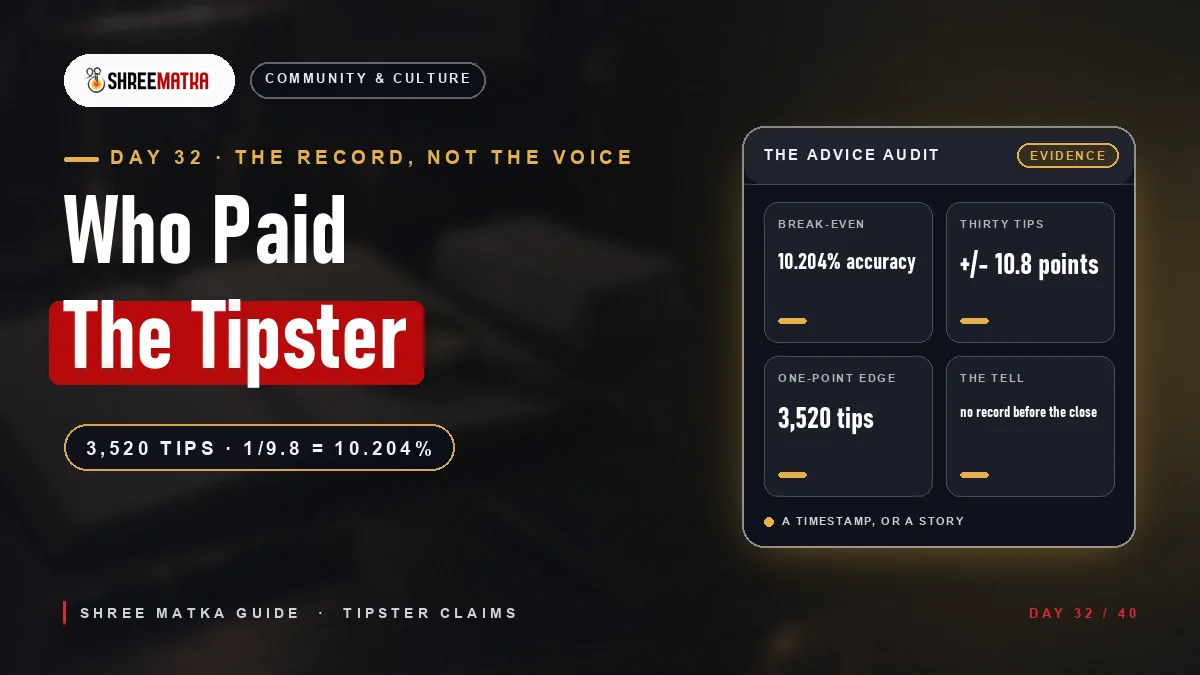
Every accuracy claim in this niche is measured against one line. A single digit is one outcome in ten and pays 9.8 times the stake, so the implied probability is 1 / 9.8, or 10.204 percent, and the hold at a fair ten percent is 2.00 percent. A tipster who is right ten times in a hundred has broken even before costs. A tipster who is right eleven times in a hundred has found an edge, if the eleven is real rather than the top of a noisy sample, and that condition is what the rest of this chapter measures.
109.8x1 / 9.810.204%10.000%0.204 pointsPut a stake against it and the claim becomes money. A ten-rupee single digit returns ninety-eight rupees at the 9.8 payout, so the expected value is 98p - 10 for a hit rate p. At ten percent that is minus twenty paise; at 10.204 percent it is zero; at eleven percent it is plus seventy-eight paise. A tipster quoting an eleven percent record is therefore claiming a small positive edge, not a fortune, which is exactly the size of claim that noise can manufacture for free.
The standard deviation of a hit rate is the square root of p times one minus p divided by the number of tips. At the break-even rate p of 0.10204 that factor is 0.3027, so thirty tips carry a standard deviation of 5.53 percentage points and any result between zero and twenty-one percent sits inside a two-standard-deviation band around chance. A hundred tips narrow it to 3.03 points, four hundred to 1.51, and a thousand to 0.96. Only at the last of those does an eleven percent record sit outside the band at all.
| Tips in the record | Standard deviation | 95% band around 10.20% | What it can settle |
|---|---|---|---|
| 30 | 5.53 pts | 0.0 to 21.0% | Nothing; every plausible rate fits |
| 100 | 3.03 pts | 4.3 to 16.1% | Only whether the claim is absurd |
| 400 | 1.51 pts | 7.2 to 13.2% | Whether the rate is near the line |
| 1,000 | 0.96 pts | 8.3 to 12.1% | Whether a large edge exists |
| 3,520 | 0.51 pts | 9.2 to 11.2% | Whether a one-point edge exists |
To resolve a one-point edge with 95 percent confidence the record needs about 3,520 tips, because 1.96 times 0.3027 divided by 0.01, squared, is 3,520. At three tips a day that is 1,173 tips a year, or roughly three years of continuous posting before the record can even distinguish an eleven percent tipster from a lucky one. Any account smaller than that is offering an anecdote with a percentage sign attached. The probability guide derives the same variance from the other direction, the prediction-system build shows why fitting that variance is not the same as removing it, and the data-analysis tools guide shows the spreadsheet that reproduces every band in this table.
sqrt(0.10204 x 0.89796)0.3027(1.96 x 0.3027 / 0.01)^23,5201,173 a yearabout three yearsWhy the Lucky Account Exists: Survivorship and Deleted Posts
There is a second reason a small record looks impressive, and it has nothing to do with the tipster’s skill. Run the experiment at scale and a winner appears by construction. If 1,024 accounts each make ten calls on a fair coin, the chance of ten correct in a row is one in 1,024, so the expected number of perfect accounts is exactly one. The experiment costs nothing but screenshots, and it can be repeated every ten days until a winner exists. The account you are shown is the survivor of that selection, not a sample drawn in advance.
1,024101 / 1,0241screenshotsten daysDeletion does the same work in slower motion. A public channel that removes losing posts does not change what happened; it changes the denominator of what a new reader sees. The surviving record is the sample after selection, which is precisely the quantity that looked skilful before the deletions were known. This is why the completeness criterion in chapter three is not pedantry: a record you cannot audit as a fixed file, with timestamps and losses intact, is a highlight reel, and a highlight reel is what the survivorship experiment produces for free.
Volume makes it worse rather than better. Sixty-three declarations a day and about 22,995 a year give a selective account an enormous pool to choose from, and the sixty-second fetch cycle means the pool is refreshed within a minute of every close. The historical data analysis in this series makes the same point from the archive side: a long record is only informative if it is complete, and a chart with the losing weeks removed is a different object from a chart. The chart-pattern guide is the same argument drawn on a grid, because a pattern is a summary of a complete record and the summary loses its meaning when the record is trimmed.
Red Flags That Are Structural, Not Stylistic
Loud fonts and emoji are not evidence of anything, and neither is a calm voice. The flags worth acting on are structural: they change what the reader can check or what the reader must pay. Guaranteed returns and loss cover are the strongest, because the hold makes both impossible and a seller who promises them has either not done the arithmetic or is relying on the reader not having done it. Tips that appear after the close, logs that lose their losses, deposits into a personal UPI handle, countdown timers and claims of inside knowledge all belong to the same family.
| Flag | Why it is structural | What it usually means |
|---|---|---|
| Guaranteed return | The 2.00 percent hold cannot be promised away | The claim is false when made |
| Loss cover | Recovery would require a positive-edge product | An upfront fee for nothing |
| Tip after the close | No prediction existed before the outcome | A caption written with hindsight |
| Screenshots only | No denominator, no date, editable image | The record is a selection |
| Personal UPI deposit | No entity, no invoice, no recourse | The money is unrecoverable |
| Countdown pressure | A decision that cannot be checked in time | The sale depends on haste |
| Insider knowledge | Knowledge of a draw is not a forecast | Either a false claim or a crime |
| Undisclosed commission | The payer is the reader | Advice shaped by turnover, not accuracy |
The insider claim deserves its own sentence, because it is offered as the strongest possible credential and is in fact the weakest. A person who says they know a draw in advance is describing either a fabrication or an interference with the draw, and neither is advice a reader should want. The same logic covers the promise of recovery: no service can add an edge to a negative-expectation product, so the fee buys a conversation rather than a result. The scam guide sets out the reporting route when money has already moved, and the legality guide owns the state-by-state detail; if money was taken by deception, that is a police matter and not a dispute to settle in a group chat.
Subscriptions, Revenue Share and the Loss-Recovery Fraud
The cleanest way to price advice is to convert every fee into a per-stake cost and ask what accuracy would be needed to pay it. A subscription at five hundred rupees a month is six thousand a year. On a turnover of one lakh rupees, which is ten thousand stakes of ten rupees, that fee is sixty paise a stake, so the required accuracy rises from 10.204 to 10.816 percent: the advice must add 0.61 points before it has paid for itself, and that is before the price of the product it recommends.
Rs 500 a monthRs 6,000Rs 1,00,00010,000Rs 0.60(10 + 0.60) / 98 = 10.816%Revenue share works differently and is worth doing in money. The operator retains 2.00 percent of turnover, which is two thousand rupees on one lakh. A promoter on a thirty percent share of that hold receives six hundred rupees, and the reader’s expected loss over the same turnover is two thousand rupees. The payment is real, it is funded by the loss rather than the accuracy, and it grows when the reader stakes more. That is the whole of the economics behind advice that costs nothing to receive.
| Compensation model | Who pays | Cost on Rs 1,00,000 turnover | The conflict |
|---|---|---|---|
| Affiliate link | The operator, from hold | About Rs 600 at a 30% share | Paid on turnover, not accuracy |
| Monthly subscription | The reader, in advance | Rs 6,000 a year, or Rs 500 a month | Paid whether or not the tips win |
| Per-tip fee | The reader, per message | Fixed before the result | Volume of tips beats quality |
| Revenue share | The operator, from hold | Paid out of the reader’s loss | Encourages more staking |
| Loss recovery | The reader, upfront | Whatever the fee is, plus the loss | The service cannot exist |
Loss recovery is the case where the arithmetic is not merely unfavourable but fatal. The hold is structural, so a service promising to recover losses through more betting needs an edge nobody has, and the fee is collected before the attempt. That pattern, an upfront payment for a service that cannot be delivered, is the definition of an advance-fee fraud. If it has happened, keep the messages and the payment records and treat it as a police matter rather than an argument. The time audit measured the other cost of the same habit; the point here is that both costs are written in money.
None of this argues that every paid service is fraudulent. It argues that a reader can compute the fee per stake and the accuracy required, and that a service which will not state those two numbers has chosen not to be evaluated. Disclosed, fixed and free of outcome promises is the best case, and the best case still does not change the 2.00 percent hold on the product being recommended.
An Advisory Network Worth Building, and the Five Questions
The calendar’s last item asks about building an advisory network, and the honest version of that answer is a network of record-keepers rather than predictors. It has three members: the operator’s own result page, which declares from 05:00 to 23:55 across the schedule and is the only source with a timestamp; a written log of your own claims, kept whether they win or lose; and one person willing to redo your arithmetic. That network cannot be sold, cannot be bought, and will never be quoted by an influencer, which is a fair description of its value.
For any account that wants to join the conversation, five questions decide it. Where is the timestamp from before the close? Where is the full log, including losses? Which stake and which bet type? How many tips, and how many methods were tried and discarded? And who pays you, and how much? A claim that answers all five can be checked by a stranger; a claim that answers fewer is asking for trust instead of evidence, and trust is not a valuation method.
Evaluation can do one thing well and cannot do another. It can sort claims into checkable and uncheckable, which removes most of the accounts in any feed and leaves a shortlist of records that might be real. It cannot make the product positive: the 2.00 percent hold survives every honest audit, which is why the responsible limits guide and the risk-management guide treat boundaries as the only variable a reader controls, and why the psychology guide spends its length on the decisions that follow a loss rather than the numbers before it.
This article names no tipster, ranks no tipster, recommends no channel and sells no advice. Shree Matka is an informational and analytics portal: it publishes no guaranteed numbers, sells no predictions, never solicits fees, represents no operator and hosts no draw. Nothing in this article is legal, financial or tax advice, and it is intended for readers aged 18 and over.
Frequently Asked Questions
How do I know whether a Matka tipster is legitimate?
What counts as a good hit rate?
Why are screenshots not proof?
How many tips are needed before a record means anything?
Are free tips really free?
What is loss cover, and why is it a red flag?
Can I build an advisory network of my own?
Does this site sell tips or rank tipsters?
Download the Official Shree Matka App
Experience real-time live results, complete historic panel records, and 24x7 verified automated withdrawals on your Android smartphone.
Download App
Comments (0)
Loading comments...