
What Responsible Gambling Actually Means
Responsible gambling is not a tone of voice and not a disclaimer; it is a small set of decisions that are made before the session instead of during it. Three tests separate a planned session from a drifting one: the money was chosen on a calm day and is an amount whose total loss changes nothing about rent, food, EMIs or anyone else’s money; the time was capped before the site was opened; and the mood after the result is the same as the mood before it. The beginners guide explains what the game is and the odds guide prices what it costs: a structural two percent toll on every jodi, every session, at every stake size. Responsible play starts by accepting that price as the entry fee, because a player who is still trying to win the toll back has already left the plan.
One framing note belongs up front, because this series does not do cosy. The legality guide found the game prohibited across India, so “responsible matka” cannot mean regulated play the way it might for a licensed product; here it means harm reduction for adults who are going to play anyway. The only level of play with zero risk is no play, and this guide will not pretend otherwise. For everyone else, limits are the difference between a priced hobby and a spiral - and this site’s own responsible-gaming tips page is the short version of exactly that advice. This guide is the long version.
the amount was fixed on payday and losing all of it changes nothingthe session ended when the timer said, not when the results didthe result changed nothing about the eveningthat is a problem session, whatever the outcome wasthe plan said two sessions; five is a pattern, not a streakthe only risk-free level of an illegal draw is zeroThe tests are deliberately boring. Nothing in them predicts results, reads charts or promises edges, because the moment a session needs an edge it has stopped being the thing the plan priced. Everything that follows in this guide is machinery for keeping the boring version in force on the nights when the interesting version knocks.
The Platform Will Not Limit You
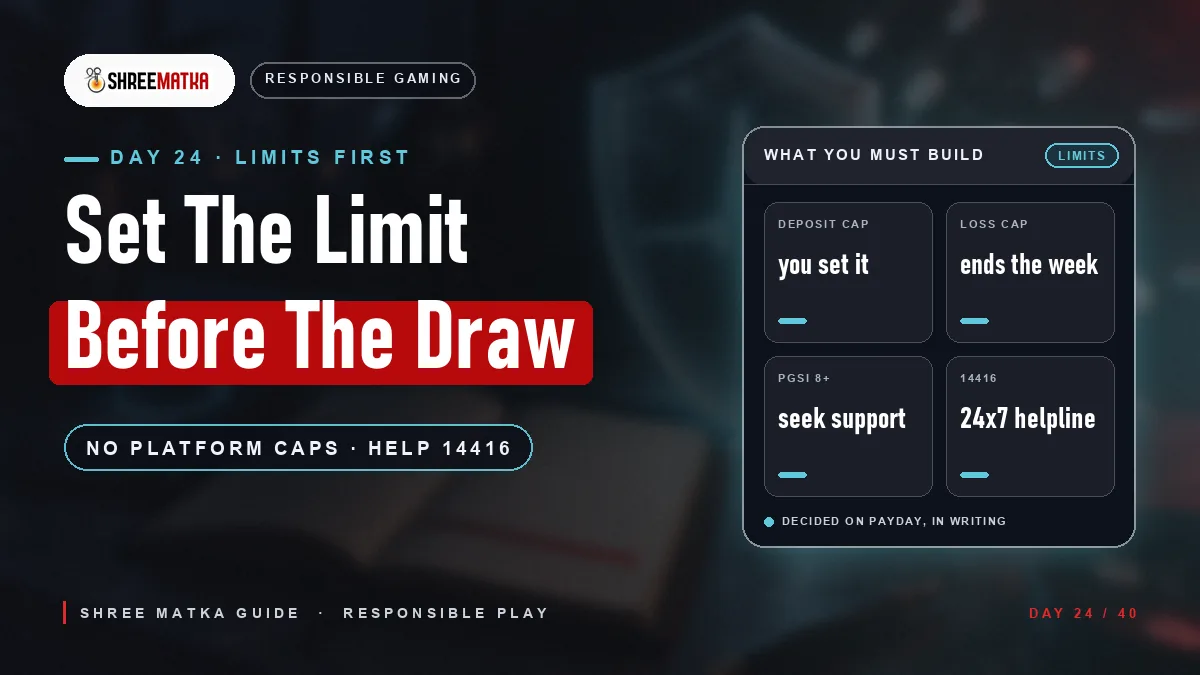
The first fact of this guide is one most readers will never see stated: this platform - read from its own code, not from marketing - has no player-facing limit tools at all. There is no deposit cap, no loss limit, no self-exclusion, no cool-off period. What exists instead is plumbing: the deposit flow records money through a state machine, the withdrawal flow runs inside a published IST window, and the bet endpoint throttles requests at three hundred a minute. That last number is worth stating plainly because it looks like protection and is not - it is anti-spam engineering that stops bots hammering the API, and it would not notice a human losing twice their weekly cap in an afternoon. The nearest thing to a player-facing safeguard anywhere in the stack is the footer’s age notice - players need to be 18+ in order to register, and underage gambling is prohibited - which is a rule, not a tool.
None of this is a confession unique to one site; it is the shape of the whole market. A licensed industry gets ordered to build deposit limits and exclusion registers; an unlicensed grey-zone game has no regulator to issue such orders, so no site in this space builds them unprompted. The table below is the honest inventory, and its last column is the only one that matters.
| Control | What this platform actually has | What you must build instead |
|---|---|---|
| Deposit limits | none: no cap exists anywhere in the deposit code path | one fixed weekly transfer, made on payday, from a separate source |
| Loss limits | none: no stop-loss in the bet path | a written weekly number from the bankroll guide |
| Self-exclusion | none: no block or cool-off feature exists | app removal, site blocks, account steps you take yourself |
| Age gate | the footer notice: 18+, underage gambling prohibited | the same rule enforced at home, not just on screen |
| Withdrawal friction | a published IST window and weekday gate | use it deliberately: withdraw on schedule, never on impulse |
| Bet rate limiting | anti-spam: 300 requests a minute on the bet endpoint | nothing - it throttles bots, not losses |
So treat the absence as the guide’s first instruction, not as a complaint to file. If you wait for the site to stop you, you have already decided - and the decision was made by the version of you that wanted one more market. Every limit that actually binds lives outside the app: in the bank app’s merchant controls, in a separate account that does not touch the game, in a number written on paper, in a person who knows the number. Section three prices that stack.
Limit-Setting Strategies That Survive a Bad Night
A limit is a decision made on a calm day that binds an impulsive one, and every effective limit shares that shape. The deposit cap comes first: one transfer per week, of a fixed amount, decided on payday - when the week’s money is being divided anyway - and never topped up mid-week, because a topped-up cap is not a cap, it is a budget with a hole. The loss cap is the same number written down with a rule attached: reaching it ends the week’s play, full stop, which converts “one more market” from a negotiation into a closed question. The session cap is a timer started when the site opens, and it matters more here than in most games because of cadence: the starline guide shows markets running every hour, so a session can stretch across a whole day without any single moment feeling like a decision.
The stake ceiling is a fraction, not a feeling: never above a fixed part of the week’s bankroll, so one bad night cannot become a bad month - the bankroll guide works the arithmetic and the ruin math behind that fraction. And the withdrawal rule uses the platform’s own friction deliberately: withdraw on the schedule you chose - payday, say - and never on impulse, because the IST window will pass your request through either way and the difference between banking a win and recycling it into stakes is entirely yours. The psychology guide’s decision record closes the stack: write the plan down before the session and score it after, because honesty is easier when the page asks for it.
| Limit | How it is set | Why it holds |
|---|---|---|
| Deposit cap | one transfer per week, fixed amount, chosen on payday | spending stops when the money stops, not when willpower fails |
| Loss cap | a written number; reaching it ends the week’s play | converts “one more market” into a closed question |
| Session cap | a timer started when the site opens | hourly markets make drift invisible |
| Stake ceiling | a fixed fraction of the week’s bankroll | one bad night cannot become a bad month |
| Withdrawal rule | on the schedule - payday - never on impulse | banking a win beats recycling it into stakes |
| The record | the plan written before the session, scored after | honesty is easier when the page asks for it |
one fixed transfer on payday - no mid-week top-upsthe same number in writing; hitting it ends the weekstarted when the site opens; it ends the session, not youa fixed fraction of the week’s bankroll, never exceededon the schedule, never on the impulsethe bank, the notebook, the timer - all outside the appTwo failure modes deserve naming because they arrive disguised as discipline. Raising the loss cap mid-week “just this once” teaches the cap that it is negotiable, and a negotiable cap trains worse than no cap. And playing without the record “because the numbers are boring” removes the only audit the system has - the psychology guide found tilt shows up in the record days before it shows up in the wallet, which is precisely the early warning this guide is for.
Problem Gambling Signs: What Early Looks Like
The line between heavy play and problem play is not stake size; it is control and consequences. A player can lose large amounts on a plan and remain in control, while a player losing small amounts to chase, hide and borrow is in trouble. The signs below are behavioural, ordered by how early they usually appear - and the early ones are quiet, which is why they are worth reading before you need them.
| Stage | What it looks like | Why it matters |
|---|---|---|
| Early | budget creep: stakes or frequency edge past the plan, then the plan gets amended | the plan is losing authority, quietly |
| Early | checking results outside sessions - the game follows you into other rooms | attention is the first thing the game takes |
| Middle | chasing losses: returning the same day to win it back | the game has stopped being entertainment (the beginner-mistakes guide lists it as the classic error) |
| Middle | hiding play: second accounts, deleted chats, vague answers about money | secrecy is load-bearing once the game feels wrong |
| Later | borrowing to play, or staking money meant for bills | the loss is now someone else’s too |
| Later | mood rides the results; irritability in the hours between sessions | the pull now has a physical component |
| Any stage | gambling to escape stress, boredom or an argument | the game is self-medicating, not entertaining |
The two cheapest detectors are budget creep and secrecy, and they are cheap because both are checkable without any self-knowledge at all: has the written plan needed amending in the last month, and would the answer to “how much did you play this week?” be the full answer? A plan that needs a meeting to amend has already lost the meeting. And the escape note deserves its own sentence: the first time the game is used to change a mood rather than to fill an hour, its function has changed - that is the shift the PGSI’s health and guilt items are built to catch, and it is worth taking the screen in section five seriously the day that sentence stops being hypothetical.
Self-Assessment: The PGSI, Taken Honestly
The standard screen for where a player stands is the Problem Gambling Severity Index, and it is worth knowing rather than fearing: nine questions about the last twelve months, each scored 0 for never to 3 for always, for a total between 0 and 27. The items cover the ground this guide has been walking - betting more than you can afford, needing larger stakes to feel it, going back another day to win back losses, borrowing or selling to gamble, health problems, criticism from others, financial trouble, guilt, and the plain question of whether you have a problem. The items, compressed, are worth seeing side by side before scoring anything.
| # | The item asks | What it weighs |
|---|---|---|
| 1 | betting more than you could afford to lose | money control |
| 2 | needing larger amounts to get the same feeling | tolerance |
| 3 | going back another day to win back losses | chasing |
| 4 | borrowing or selling anything to gamble | the brightest line |
| 5 | gambling causing health problems - stress, sleep, mood | the body keeps score |
| 6 | being criticised for gambling by people who matter | the social cost, visible |
| 7 | gambling causing financial trouble for you or the household | consequence |
| 8 | feeling guilt about the way you gamble | the internal alarm |
| 9 | feeling that gambling is a problem for you | the plain question |
The bands do the talking: 0 is the non-problem range, 1 to 2 is low risk, 3 to 7 is moderate risk, and 8 or more is the problem-gambler range, where the standard advice is to seek support.
9 questions, each scored 0 (never) to 3 (always)0 to 27, answered against the last 12 monthsnon-problem gamblinglow riskmoderate riskproblem-gambler range - seek supportTwo honesty rules decide whether the score means anything. First, score what happened, not what you meant: the item asks whether you bet more than you could afford, not whether you planned to. Second, never round down a mid-band score out of politeness to yourself - a 6 that becomes a 4 on the way to the page is the budget-creep move wearing arithmetic. Clinicians use a fuller instrument (nine DSM-5 criteria, four or more within twelve months defining gambling disorder), and the PGSI approximates that line from the outside; what it cannot do is end a conversation. A number in the moderate band is not a verdict, it is an appointment - with the helpline in section six, with a doctor, or with a meeting.
Help Resources in India: What Exists and When to Use It
Two different problems need two different lines, and mixing them up wastes the hours when speed matters. Money stolen by a scam is fraud - the scam guide owns that emergency, and its channel is 1930. Distress, compulsion or a gamble that has stopped feeling optional is a health problem, and India’s standing resource for it is Tele-MANAS: the national tele-mental health helpline run under the Ministry of Health and Family Welfare, reachable around the clock on 14416 or 1-800-891-4416, free, in multiple languages, with no referral and no registration needed. A Tele-MANAS cell is established at NIMHANS in Bengaluru, the institute that anchors the programme’s clinical side, so the first call can lead to structured care rather than ending in sympathy.
| Channel | What it is | How to use it |
|---|---|---|
| Tele-MANAS 14416 | the national tele-mental-health helpline - 24x7, free, Ministry of Health & Family Welfare | call when gambling, mood or stress feel unmanageable; 1-800-891-4416 is the same service |
| NIMHANS | the Bengaluru institute where a Tele-MANAS cell is established | ask the helpline about a referral path if you want structured care |
| Gamblers Anonymous | a fellowship of people who stopped; India meetings are listed by its international service office | a meeting is free, anonymous and needs no appointment |
| Your bank / UPI app | merchant blocks and lower payment limits you control | set the block before you need it, not after |
| A trusted person | the oldest control: someone who holds the numbers with you | tell them the limits from section three, not just the feelings |
The disambiguation is worth one more line each way: cybercrime.gov.in cannot help with compulsion, and Tele-MANAS cannot freeze a transaction - calling the right line is itself a form of the record-keeping discipline this series keeps recommending. For the fellowship option, Gamblers Anonymous runs on the same principles everywhere: free, anonymous, no professionals and no fees, with India meetings discoverable through the international service office’s listing. And the bank channel deserves earlier credit than it usually gets: a merchant block on gaming payments is the limit stack’s strongest wall precisely because it sits outside the game entirely, and it can be set in minutes on a calm payday.
Family and Social Considerations
Families usually notice the money before the player notices the game, which gives them an uncomfortable early-warning role and no playbook. The playbook that works is short. Visibility first: statements, account access, the UPI history - not as surveillance theatre but because the limit stack in section three runs on controls held outside the player, and family visibility is the strongest such control that exists. One scripted conversation second: say what you saw - the numbers, the dates - and ask one question, rather than delivering a verdict; a conversation about behaviour survives contact, an argument about character becomes another thing to hide. Professional help third, and early: Tele-MANAS counsels families as well as players, and the call is easier to make before the crisis than during it.
protects the game, not the playerthe debt returns, now better hiddenthe control moves to where trust is strongestsay what you saw, not what you fearTele-MANAS counsels families too - 14416the person, not the budgetThe bailout rule is the hardest because it is aimed at love: paying off a gambling debt without conditions protects the debt’s availability, not the person. If a bailout happens at all, it happens with visibility attached - accounts, controls, the limit stack - or it simply finances the next debt. The shame loop explains why: hiding, discovery, a bigger argument, deeper hiding - and what breaks the loop is a changed consequence structure, not a louder argument. The same logic runs socially: friends who play together normalise escalation, and the first person in a group to state a limit pays a small social cost once, instead of the larger kind later.
Our Stance and the Closing Checklist
This site publishes historical draw records, charts and analysis for readers who study the game; it publishes no numbers in advance, sells no predictions, never solicits fees of any kind, does not represent any operator, and offers no legal, medical or financial advice. Content is intended for readers aged 18 and over. This guide’s platform facts were read from the code that runs the site - the absence of limit tools among them - and its help channels were verified at publication. Nothing in it is a diagnosis, a prescription or a promise; the PGSI is a screen, and screens start conversations.
The whole guide compresses into six sentences. The platform has no limit tools, so every limit that works is built outside the app, on payday, in writing. The loss cap ends the week, the timer ends the session, and neither negotiates. Budget creep and secrecy are the two cheap detectors, and escape-gambling is the moment to take the PGSI seriously. In India the health line is Tele-MANAS 14416, the fraud line is 1930, and knowing which is which is part of the discipline. Families help with visibility and a script, and never with a bailout.
For readers carrying this into the rest of the series: the odds guide prices the game, the bankroll guide models what the price costs, the psychology guide explains the pull and hands you the decision record, the legality guide maps where the game stands in law, and the scam guide guards the money a limit system leaves. The framework guide remains the full checklist for judging any site in this space. Every layer keeps the same shape: decide on the calm day, so the interested day has nothing left to decide.
Frequently Asked Questions
What does responsible gambling actually mean in practice?
Does Shree Matka have deposit limits or self-exclusion tools?
How much money should my limit be?
What are the first signs of problem gambling?
What is the PGSI and how do I score it?
What number can I call in India for gambling-related distress?
Can family members help when someone else is the gambler?
Is it possible to play Satta Matka responsibly at all?
Download the Official Shree Matka App
Experience real-time live results, complete historic panel records, and 24x7 verified automated withdrawals on your Android smartphone.
Download App
Comments (0)
Loading comments...