
How a Comparison Like This Is Built, and Where It Breaks
The genre this item belongs to has a standard shape: a table of games ranked by odds, a verdict at the bottom, a referral link under the verdict. This guide keeps the table and refuses the verdict, and the reason has to be stated before any number appears. Every product in the comparison is a negative-expectation product, priced so that the aggregate of players loses by construction. Such products can be compared accurately, usefully and completely without any of them being recommended, in the way that a comparison of cigarette brands need not end in advice about which to smoke.
Seven axes are used. Price per unit of action is the house edge, the fraction of a stake kept in expectation, which the terminology guide defines and the play guide illustrates. Skill surface is the share of an outcome a player’s decisions can move. Payout shape is hit rate against prize size. Cadence is how many events the form offers per hour or day. Legal status belongs to the state-by-state guide. Visibility is what tax and reporting see. Recourse is who can be complained about when payment stops, which no ranking table carries and which separates a regulated product from an unregulated one most cleanly.
Two axes are read here first-hand rather than quoted: the price list this platform actually runs, which lives in a database migration, and the declaration schedule its schema defines, which lives in a table of markets with opening and closing times. Both are audited with the arithmetic shown, because a comparison that quotes other people’s figures about a game it never measured is the affiliate genre again. The personalities guide before this one applied the same discipline to fame; here it applies to numbers.
The Price of a Unit of Action: House Edge, Form by Form
The house edge is the cheapest honest instrument available, because it is computable from two published numbers, true odds and paid odds. A single number on a European wheel is one outcome in thirty-seven, so the fair price is thirty-six to one; the table pays thirty-five and the shortfall over thirty-seven is 2.70 percent. Add a second zero, keep the same price, and it becomes 5.26 percent. Nothing about the player changed, which is the mathematics guide’s point in another form.
The rest of the figures are either derivable the same way or published by bodies that have to be right: baccarat on the banker bet near 1.06 percent, the craps pass line near 1.41 percent, blackjack near half a percent for a player who follows the strategy chart. Nevada’s slot hold is reported to the state rather than asserted by a review site; the UNLV Center for Gaming Research put it at about 6.55 percent statewide on average since 2004, about 7.1 percent by 2025, and 7.57 percent on the Strip. At the far end sits the lottery, where about half of what is collected returns as prizes - a hold near fifty percent, printed in the prize structure, which is the business model.
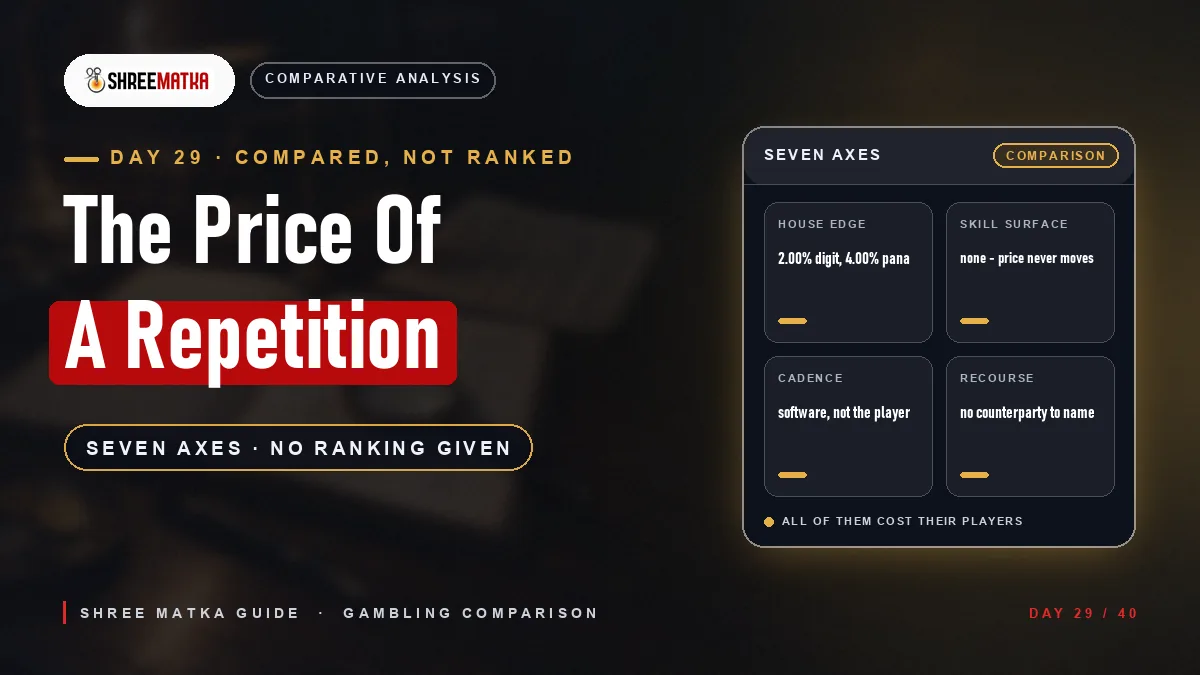
Against those, Satta Matka looks almost generous, and that is the least useful sentence here. This platform’s own payout table - 9.8 for a single digit, 98 for a jodi, 160 and 320 and 1,000 for the pana tiers - converts straight into a hold: a digit comes back at ninety-eight paise in the rupee, a 2 percent hold, and the pana tiers work out to 4 percent in the box below. The price is ordinary, not extreme. And a low edge is not a low loss, because expected loss is the edge multiplied by turnover, and turnover is set by cadence, which is chapter seven. One tier in that table is the exception: the three-alike pana at 1,000 returns true odds and no hold, an observation this guide reports and will not convert into advice.
| Form and bet | Implied hold | Where the number comes from |
|---|---|---|
| Baccarat, banker bet | about 1.06% | Standard published casino figure, after the commission |
| Craps, pass line | about 1.41% | Standard published casino figure |
| Blackjack, basic strategy | about 0.5% | Published range; moves with rules and deck count |
| Roulette, European single number | 2.70% | Derived: 35 paid against 37 outcomes |
| Roulette, American single number | 5.26% | Derived: 35 paid against 38 outcomes |
| Nevada slots, statewide | about 7.1% | UNLV Center for Gaming Research; 6.55% average since 2004 |
| Satta Matka pana tiers | 4.00% | Derived from this platform’s payout table and the draw model |
| Satta Matka single and jodi | 2.00% | Derived from this platform’s payout table |
| State lottery | about 50% | Prize pool is roughly half of sales; 49% median in 1987, Clotfelter 2024 |
1 in 109.8 x stake(1 / 10) x 9.8 = 0.981 - 0.98 = 2.00%(1 / 100) x 98 = 0.98720 of 1,000 ordered draws over 120 combos = 1 in 166.7270 of 1,000 over 90 combos = 1 in 333.3160 / 166.7 = 0.96 and 320 / 333.3 = 0.9610 of 1,000 = 1 in 1,000, priced at 1,000One assumption is stated rather than hidden: three digits drawn independently from nought to nine, so the ordered space is one thousand and repetition is allowed, which the schema supports by using 121 as an example pana. The sangam tiers priced at 1,000 and 10,000 cannot be checked, because a pana-pair bet needs a pairing rulebook that is not in this repository; leaving them unpriced is the difference between this table and an affiliate page.
Skill, Chance, and What a Player Can Actually Change
The second axis is the one readers care most about and the one most often inflated. A skill surface is the set of decisions that move expected value. The best evidence that some people are genuinely better at a gambling game comes from poker: Levitt and Miles, working through a large World Series of Poker dataset, reported that players identified in advance as highly skilled averaged a return on investment over 30 percent while a comparison group averaged minus 15 percent. The mechanism is visible - a poker player faces other people rather than a fixed edge. Meyer and colleagues’ quasi-experimental study remains the necessary counterweight, concluding that poker should still be treated as a game of chance under certain basic conditions. Skill there is real, hard, and available to a small minority.
Satta Matka has no skill surface, and not by a matter of degree. A player chooses a number, a tier and a stake; the draw then happens. No later decision changes a probability and no earlier decision improves the price, which is the same 2 percent on every digit and 4 percent on every pana tier. The chart pattern guide and the historical-data guide exist because readers want a skill surface exactly here, and both find none; the prediction-system guide documents what happens to attempts to build one. For the comparison only the position matters, and it is the machine end, next to the slot and the lottery: the event is scheduled, independent and identical every day.
| Form | What the player decides | Does deciding move expected value? |
|---|---|---|
| Blackjack | Hit, stand, split, double against fixed house rules | Yes - about 1.5 percentage points |
| Poker | Every action, against other people, for a fee per pot | Yes, and measurably |
| Sports betting | Which price to accept and how much to risk | Marginally, against the book’s margin |
| Roulette | Which number, how much | No |
| Slots | Stake, and when to stop | No |
| Lottery | Which numbers, how many tickets, whether to pool | No |
| Satta Matka | Which digit or pana tier, how much, on which market | No - every tier carries the same hold |
The position has a legal consequence in India, which is why the axis earns its space. The statutory tests turn on whether chance predominates over skill, and the games-of-mere-skill exception in the Public Gambling Act of 1867 is the reason rummy has been argued out of the definition at all: the Supreme Court’s 1967 Satyanarayana appeal treated rummy as a game requiring skill, and older judgments treated skill-dominant prize competitions as something other than gambling. The two market strategy guides in this series, Kalyan and Main Bazar, sit inside that argument whether their titles admit it or not.
1 in 1010.00 times the stake9.80 times the stake0.20 of every 10.00 stakedWhich number, which tier, how much, which marketNo - the same price every declarationPlaying correctly moves the edge by about 1.5 pointsStrategic Differences That Are Structure, Not Edge
The word strategy survives translation between these forms in exactly one sense, and most of what is sold as strategy is that sense dressed up as the other. The sense is exposure geometry: how a player arranges the shape of their own results. Every product has a payout shape, a distribution of hit rates against prize sizes, and two forms with identical prices can feel nothing alike. A single digit here returns 9.8 times the stake one time in ten, a drumbeat of small results; a pana tier pays 160 or 320 because its probability is a fraction of that, and the player buys long silence instead. The bet-type guide lays out the trade, and the leading-zero case is the notation trap inside it: a combination written 03 is not the artefact written 3.
So a player may choose the shape, never the price, because the price barely moves: two percent on the digit bets, four on the pana bets, whatever numbers were picked. What a player may not do is add a second axis and call it strategy. Doubling the stake after a loss changes no expectation at all and converts a thin steady edge into a high probability of a ruinous session, as the mathematics guide shows. Repeating a number forever changes nothing either, since each declaration is independent. Everything else called a strategic advantage in these articles is a claim about predicting a draw, and no form on this list is predictable.
| Bet bought here | Chance of hitting | Returns | What the shape feels like |
|---|---|---|---|
| Single digit | 1 in 10 | 9.8 x stake | Frequent small results |
| Jodi | 1 in 100 | 98 x stake | Rare, then one large number |
| Pana, all different | 1 in 166.7 | 160 x stake | Long silence, larger still |
| Pana, one pair | 1 in 333.3 | 320 x stake | Seldom |
| Pana, three alike | 1 in 1,000 | 1,000 x stake | Effectively never, at true odds |
| Roulette, one number (European) | 1 in 37 | 36 x stake | The same shape as jodi, dearer |
| Lottery jackpot | One chance in many millions | A share of a pool | Not a rhythm at all |
100 stakes of Rs 10 on single digitsRs 1,000Rs 980About 10167 stakes of Rs 10 on one panaRs 1,670About Rs 1,603About 1Legal Status Compared, Form by Form, in India
The fifth axis is where the forms separate most cleanly, and the state-by-state legality guide owns the detail; what belongs here is the shape of the comparison. Gambling and betting are State List subjects, so no national answer exists for any of these products. The Public Gambling Act of 1867 and the Bombay Prevention of Gambling Act of 1887 are the instruments the trade spent its life inside, the first carrying the games-of-mere-skill exception. State lotteries are governed separately by the 1998 Lotteries Regulation Act, which lets a state conduct or sell a lottery and binds sellers to rules - hence a ticket for a notified draw is lawful and a numbers ticket issued by nobody is not. Casino gambling is lawful only in Goa, Sikkim and the union territory of Daman, under their own statutes.
Online real-money gaming changed category inside the period this guide covers. The Promotion and Regulation of Online Gaming Act received assent and was notified in August 2025, its rules were gazetted on 22 April 2026 and came into effect on 1 May 2026, creating an authority and prohibiting designated online money games. Whatever one thinks of the policy, the comparison now records an asymmetry: several forms here have a statutory definition, a licence, a complaint route and a named counterparty. Satta Matka has none of the four, has never been licensed in any state, and the history guide records what the state does instead, including a wave of arrests reported in January 2024.
That absence is not a philosophical complaint. A losing ticket bought for a notified lottery was sold by an identifiable agent under published rules, with a claim process and a state that can be asked to answer. A numbers bet placed with a bookmaker, or inside an application with no company name in its store listing, may be unwinnable by design and nothing happens when the player complains, because there is nobody to complain to. That is the structural gap the scams guide catalogues: tipster fees that buy nothing, fake result pages, deposits that cannot be withdrawn. Recourse belongs on the axis rather than in a footnote.
| Form | Basis in India | Named counterparty? |
|---|---|---|
| State lottery | Lotteries Regulation Act 1998; lawful where a state notifies | Yes - the state and its agents |
| Horse racing | Regulated wagering on tracks and by totalisator licence | Yes |
| Casino gaming | Lawful only in Goa, Sikkim and Daman, under their own statutes | Yes, in those three |
| Rummy | Argued as a game of skill; the position varies state to state | Sometimes |
| Online money games | Online Gaming Act notified August 2025; rules in force 1 May 2026 | Yes, for permitted categories |
| Satta Matka | No lawful footing anywhere; caught by gambling statutes and state laws | No |
Tax, Withholding, and What Survives of a Winning
The sixth axis is short and belongs mostly to the taxation guide, but a comparison without it is incomplete, because taxation is one of the places where lawful forms are visibly lawful. Winnings from a lottery, a card game or any other game of any sort or from gambling or betting are taxed flat at thirty percent under section 115BB of the Income Tax Act, with other losses barred from deduction. Online money-game winnings were moved out of that section into their own provision with a withholding obligation attached, so an identifiable person deducts on an identifiable player’s behalf. On the operator side, a twenty-eight percent GST on the full value of deposits into online money games and casinos took effect on 1 October 2023. Both rates are published by institutions that can be quoted.
The irony is worth stating plainly. Satta Matka is not exempt from that tax - the statute is broad enough to catch gambling or betting of any sort - but in practice it is uncollectable, because the transaction the tax would attach to is the one both parties have agreed to hide. A regulated winner has thirty percent withheld and a paper trail; an unregulated winner has the whole amount, no proof of it, no explanation a bank will accept at scale. The absence of withholding here is not a benefit. It is the absence of a licence and of a complaint route seen from the revenue side.
One piece of arithmetic changes how the rest reads. The flat rate applies to what the section counts as winnings and deductions are barred, so a year spent net negative can still carry a tax bill on the sessions that came up. That is a genuinely bad feature and one of the few places where a lawful product looks worse than an unlawful one on a single measured axis; a comparison that hid it would not be honest. It is also legible in a way unregulated play is not, because the player taxed on their good sessions has records.
Risk Profiles: What Actually Makes a Form Dangerous
Price differences between these forms are modest and skill differences are near zero outside poker, so the axis that separates them is cadence: how often a decision is offered, how fast an outcome arrives, how little sits in between. The regulatory record is direct on this. When the UK Gambling Commission published its online measures in February 2021 it banned auto-play, banned losses disguised as wins, and prohibited any online slot spin cycle completing faster than 2.5 seconds. That last rule is about frequency rather than price: a machine that would settle many hundreds of times an hour was legislated to a slower ceiling, because the harm tracked repetitions rather than the amount staked per repetition. No regulator has ever written a 2.5-second rule about the house edge.
The UK government’s 2023 gambling harms evidence review estimated that about half a percent of adults have a problem with gambling while something like 3.8 percent are at risk of one. A systematic review in The Lancet Public Health in 2024 put problem gambling among adults at about 2.3 percent across two hundred studies. Those figures come from a regulated market that can commission them, the framework exists because the risk was measured, and what was measured was speed and access.
Where does a numbers game sit? Cadence is the second first-hand reading here. Each of the twenty-five main-market rows in the platform’s own table carries an opening and a closing declaration time, which is two events a day per market and fifty across the schedule; the starline seed generates hourly declaration times from ten in the morning to ten at night, thirteen for the game it configures; the result-polling job runs on a fixed sixty-second cycle. A traditional market is slower than any machine by construction, and the printed-records guide records what that used to mean. The modern stack removes that slowness entirely. Fifty declared results a day, a chart page for each and an app that pings is a different product from the shop that waited for the evening, and a 2 percent price makes each repetition cheap enough to lose count of. The limits guide owns the practical response.
2.00%10 bets of Rs 10 = Rs 100 turned overRs 22 bets on each of 50 markets = 100 bets a dayRs 1,000 a dayRs 140Nothing except the number of repetitions| Axis | Regulated online slots | Satta Matka on this platform |
|---|---|---|
| Events per hour | Operator-set, capped by a 2.5-second spin floor | Two declarations per market per day; 13 hourly starline slots |
| Outcome latency | Seconds | Hours - fixed declaration times |
| Speed controls | Auto-play banned, spin floor, losses disguised as wins banned | None; no licence to write rules for |
| Deposit ceiling | Age and affordability checks under licence | None available to an unlicensed product |
| Complaint route | Licence, alternative dispute body, chargeback | See the scams guide |
| Hold | About 7% in Nevada statewide | 2% digit bets, 4% pana tiers |
The Suitability Question, and What This Guide Will Not Answer
The last item the calendar asks for is which form suits which kind of player, and the answer is a refusal with something in its place. The word suits implies a choice between comparable goods, and everything above makes that framing false. Every form here costs the aggregate of its players money by design, so this compares ways of losing rather than ways of winning. The price differences that exist are small next to the differences in cadence, recourse and legal exposure, which is why a table sorted by house edge is sorted by the least consequential column. And none of the seven axes measures the thing a reader actually wants, a favourable outcome, because a product that offered one would not be sold. This site publishes no guaranteed numbers, sells no predictions, never solicits fees, and hosts no draw.
What the comparison does support is a checklist, worth more than a ranking. Before money goes into any form, ask: is there a counterparty I can name, complain about and be paid by. Is the price published rather than implied. Can somebody other than me stop me - a deposit limit, a self-exclusion, a cooling-off period that binds the operator. Does the law where I live permit it, and does that permission extend to paying me out rather than merely to the appearance of a game. And is the rhythm chosen by me or designed for me. On those five questions Satta Matka scores worst of every product here: no counterparty, no published price from an identifiable operator, no self-exclusion that binds anyone, no permission anywhere, and a cadence set by software. It is not that matka suits the busy, the patient or the mathematical; by this set of questions the comparison is not close. The community guide shows where these arguments get held.
Frequently Asked Questions
Is Satta Matka better or worse odds than a lottery?
Which form of gambling has the best odds?
Can skill make Satta Matka profitable the way it makes some poker players profitable?
Is Satta Matka legal while rummy and horse racing are?
Does a lower house edge mean I lose less money?
Are online casinos safer than Satta Matka apps?
What about the pana bet - is its price better than a single digit?
So which form should I choose?
Download the Official Shree Matka App
Experience real-time live results, complete historic panel records, and 24x7 verified automated withdrawals on your Android smartphone.
Download App
Comments (0)
Loading comments...