
What a Matka Community Actually Is
Nobody plays a number game alone for long. Within a week of taking an interest in Matka you are in a WhatsApp group, reading a forum thread about last night’s close number, and typing into a box that asks for your name and nothing else. That collection of rooms is the Matka community, and it is the least reliable information source in this series. The other guides read the platform’s code and the published record; this one reads behaviour, because behaviour is what the record cannot show you.
The distinction that matters first is not polite versus rude. It is discussion versus distribution. A room whose admin sells numbers or runs a betting book has a different relationship to the truth than one where ten strangers compare ledgers, and no amount of etiquette makes the first kind honest. The scam guide dismantles the fraud end of that line - the fixed-number seller, the fee trap, the clone app - and this guide stays on the other side: what to do in the ordinary, non-criminal rooms where most players spend their evenings. Etiquette and fraud are not the same subject. A group that tolerates bad manners is a room to leave; a group that sells guaranteed numbers is a room to report.
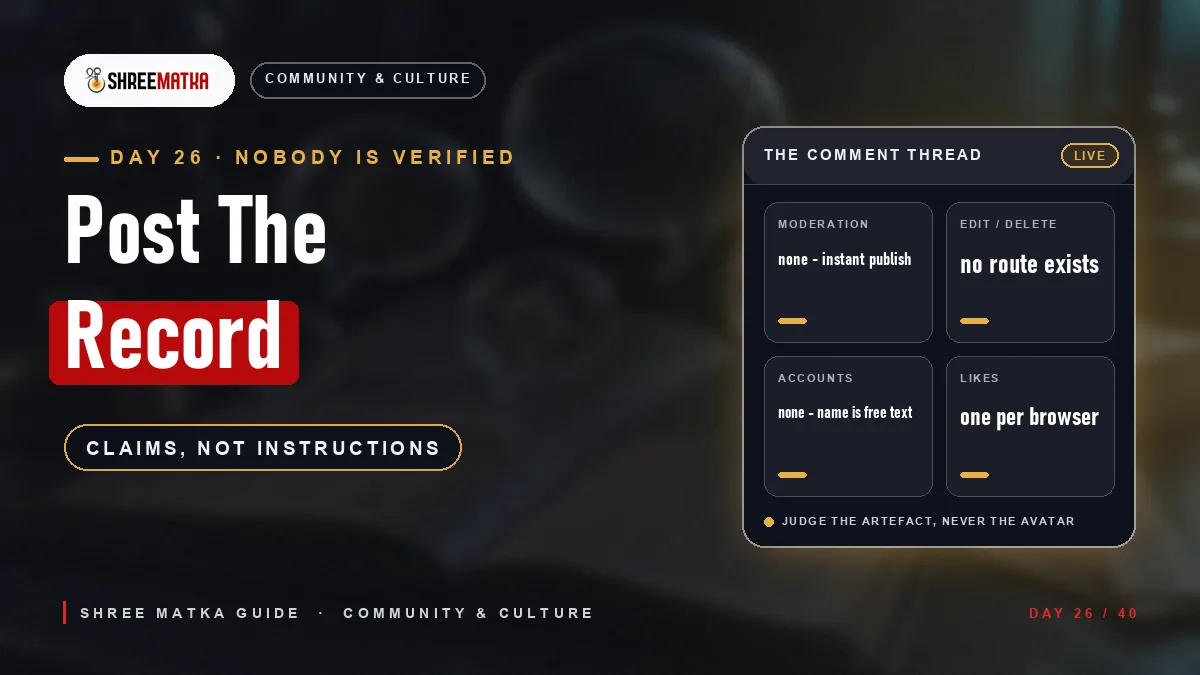
This site is part of that landscape too, so it gets the same honest reading. The only community surface Shree Matka actually ships is the comment thread under each article, and its shape is set by code rather than by culture - which means it can be described precisely. The table below is the map; the rest of this guide is what to do once you are standing in one of these rooms.
| Surface | Who runs it | What you can actually check |
|---|---|---|
| WhatsApp / Telegram tipster groups | an operator, an agent, or a guess-maker selling access | only the messages the admin chose not to delete |
| YouTube and Instagram threads | a creator whose income is the video, not the number | the publish timestamp against the draw time |
| Forum boards | volunteer moderators and paying advertisers | account age and a searchable post history |
| This site’s article comments | the code - which moderates nothing at all | the text in front of you, and nothing else |
| The offline agent and adda network | the person collecting your money | your own ledger of what was promised |
max 100 characters - self-declared, never verifiedmax 1,000 characters - trimmed, then savedno approval flag, no review queue, no filterno edit route and no delete route existsnewest first, ten per pagefirst letter of the name, one of six coloursRead that box twice, because it sets the standard for everything that follows. A comment here is published the instant it is accepted - no approval column, no admin screen, no way to fix or withdraw it afterwards. The like counter is not approval either: a like is keyed to a random value the browser invents, so it counts browsers, not people. That is the honest condition of almost every Matka room on earth. Nobody can prove who they are, so all a reader can weigh is whether what you wrote can be checked.
Community Guidelines: Read the Room Before You Post
Every Matka room has rules; most of them are never written down, and the written ones are usually decorative. Before you type anything, spend five minutes doing what almost nobody does: read the pinned message, look at what the admins actually delete, and notice which claims get challenged. A group whose rules say “no guaranteed numbers” while its admin posts them every evening has one real rule and one ornamental one, and you now know which. That observation tells you more about a room than its member count ever will.
Then set your own floor, which in a gambling community is stricter than in most forums because the downside is somebody’s rent. The core norm is simple: post claims, never instructions. “I am playing 3-1 in Kalyan Night today, here is why, here is my stake, here is what I will lose” is a claim a reader can audit and disagree with. “Play 3-1, it is confirmed” is an instruction that moves your risk into a stranger’s wallet - the sentence that turns a discussion room into a sales room. The play-tips page in this site’s footer makes the same point about limits: the only stake anyone else can responsibly choose for you is zero.
Some things never belong in a Matka room, whatever the rules say. Payment screenshots - yours or anyone’s - carry account details that outlive the post. Another member’s phone number, real name or village, even in a joke, is how harassment starts. A local agent’s contact card is a business introduction you are personally vouching for. And a claim that a game is rigged, phrased as fact without evidence, is the one sentence here that can cost more than standing: the legality guide maps what the law says about the game, and it is not a licence to accuse named people of crimes in a group of four hundred.
| Before you post | Why it matters here | The tell that you skipped it |
|---|---|---|
| Read the pinned rules | they show what the room thinks is worth writing down | you are arguing about a number in a rules-free room |
| Check who profits from the room | an admin selling access has a different relationship to truth | every thread ends in a contact number |
| Write a claim, not an instruction | instructions move your risk into a stranger’s wallet | the words “must play” or “confirmed” |
| Strip anything identifying | payment details and phone numbers outlive every post | a screenshot with a bank header still in frame |
| Date it and name the market | an undated number is decoration, not evidence | a bare “31” with no session or day |
Respectful Communication When Money Is Involved
Money changes the temperature of a room before any of its members notice. A player three losses deep reads a neutral sentence as an attack, and the generous regular is now picking a fight over a close number published two days ago. The psychology guide documents what happens inside a head on a losing run - the pattern-seeking, the chasing, the need to be right immediately - and a comment thread is where all of it lands. Etiquette in a Matka community is therefore mostly a losing-streak protocol, applied to other people.
The rule that carries the most weight: attack the claim, never the person. The shapes are concrete. “That read has no dated record behind it” is checkable and fixable. “You are a fraud” ends the conversation and, if wrong, says more about the speaker than the subject. “I could not reproduce that from the chart” invites a reply. “Anyone who believes this is an idiot” only recruits enemies. And nobody in the room owes anybody their bankroll: asking a stranger how much they staked, or what they lost, is not curiosity, it is targeting. The risk-management guide sizes a bankroll against the structural cost of the game; that arithmetic is private by default, and a healthy room treats it that way.
Two habits do most of the work. The first is the twenty-four-hour rule: after a session you want to explain publicly, wait a day. The post you write at midnight is the one you cannot delete - and on this platform, read from the code, cannot delete at all. The second is how you treat a beginner’s wrong question: the tell that separates a community from a queue. Correct the answer, never the asker, and answer the question actually asked. A thread where the tenth “which number today” is met with patience is a room where people keep learning; one where it is mocked is a room where beginners leave and sellers stay.
Sharing and Learning: Post the Record, Not the Promise
Etiquette becomes useful rather than merely civil here, because the Matka community has a genuine information problem: almost everything shared is a result, and results are the least informative thing a player can publish. A hit screenshot tells you nothing about whether the call was made before the draw, how many were made, or what the misses cost. What a room can learn from is the record - the dated log the prediction-system guide tells every serious player to keep anyway, and the spreadsheet habit the data-tools guide builds. Publishing it is not a favour to the room; it is the only evidence that your analysis exists.
The screenshot problem has a sharper edge than most players realise. A jodi grid cropped without its heading is not the same fact twice over - it is a different fact, and the guide on table headings works through how a number changes meaning when its column label is cut off. Post a record with its headings, its date, its market and its session, or post nothing. Keep the denominators too: the published archive is finite - the historical-data guide measures how far it reaches - so a cycle found in ninety days of data must be read as ninety days of data, not as a law.
| What gets posted | What it actually proves | The version that helps |
|---|---|---|
| A win screenshot | that one payout happened, at some time, on some platform | the dated log entry with the stake and the market named |
| “I called 47 yesterday” | nothing - memory has no timestamp | the pre-draw post, with its own timestamp still visible |
| A five-hit gallery | that five entries survived the admin’s delete button | the full run, misses included, same window |
| A pattern claim | that a shape looked interesting in the sample you looked at | the count, the window, and what you expected by chance |
| “This site is fake” | that the poster is angry | the date, the entry, the screenshot with its headings intact |
40 jodi calls5 - all hits100 percent12.5 percent against a 1 percent base ratethe 35, and whether any call predated its drawNote how that box is worded, because it is the whole chapter in miniature. Twelve-and-a-half percent against a one-percent base rate would be an extraordinary edge, and a well-mannered reader says so - and then asks for the forty. That is the productive form of the disagreement this community never has: nobody wants to be called a liar, and almost nobody wants to be asked for a complete log, because the log is the only thing that could have helped. Share yours first, including the losses, and you have changed the room’s standard without accusing anyone of anything.
Handling Disagreements Without Burning the Thread
Almost every fight in a Matka room is a category error: two people arguing about a chance event as if it had a right answer. Separate the two kinds of disagreement before you type. A number disagreement - which ank is due, whether the pattern holds - has no resolution available: the next draw is independent of both arguments, and the historical-data guide is blunt about what past results support. A fact disagreement - what closed in Milan Night on the ninth, whether the chart shows 4-1 or 4-7 - is checkable, and checkable arguments are the only ones worth having in public.
For the checkable kind there is a route that is not a flame war: the review request. The guide to reporting a suspected chart error sets out what to attach - the date, the market, the entry, the screenshot with its headings - so the claim can be checked rather than argued. Posting “the chart is wrong, this site is a scam” at eleven at night does three things: it does not get corrected, it does not get answered, and it becomes the permanent first impression of whoever wrote it - on this platform a comment cannot be edited or deleted. Filing the proper report gets the first one.
When you are outvoted, out-argued or simply wrong in public, the etiquette is to say so once and stop. “Fair enough, my read was 3-1 and it closed 8, I had no record for it” is the highest-status sentence available in a gambling community, because so few can manage it. And leaving is always on the table: mute the group, archive the thread, close the app. The room is not your reputation and it is not your bankroll. What you should never do is what reads as strength in these spaces - editing a post to pretend you called the other number, deleting the misses, or recruiting three friends to agree in the same hour. Everyone in the room is as anonymous as you are, and everyone is doing exactly that arithmetic.
| The disagreement | Is it checkable? | The etiquette move |
|---|---|---|
| “Your pattern is nonsense” vs “your read is late” | no - it is a forecast about chance | state your record, agree to disagree, stop |
| A chart entry that looks wrong | yes - the published record answers it | file the review request with the date and market |
| A stranger claims a win you cannot see | only they can check it | ask for the log once; do not litigate the refusal |
| An admin deleting your post but not theirs | yes - the pinned rules are the evidence | raise it once in the open, then leave the room |
| A pile-on forming around one member | not a disagreement at all | do not join; do not reply; report if it turns personal |
Building Reputation When Nobody Is Verified
Reputation is the idea most badly misused in Matka rooms, so it needs the code read first. Here there are no accounts, no profiles to visit, no post history to browse, no karma field in the schema, and nothing connecting one comment to the next by the same author. The avatar beside a comment is the first letter of a self-declared string, coloured by a lookup on that letter’s character code across a palette of six - so two readers named Rahul and one named Rajesh appear as the same red R. Nothing about that is a reputation. It is a rendering.
Standing therefore cannot come from identity, nor from confidence - the cheapest thing in these rooms, priced per message. What is left is artefacts. The member with standing is the one whose calls were written down before the draw and are still visible; who publishes the misses in the same thread as the hits; who names the market, the session and the date without being asked; who has never once sold anything; and who says “I was wrong” in public with the same ease as “I was right”. That is a five-line standard, and fewer than one member in a hundred meets it - which is why it works as a filter in both directions.
none - the name field is free text up to 100 charactersnone - comments are per article, newest firstnone - there are no accountsnone - no edit or delete route existsone per browser, and a browser is not a personThe reader’s half is the practical half: you will spend far more time evaluating strangers than impressing them. The discipline is to refuse every proxy: a green tick in a display name, a member-since date on a forum you cannot audit, a group with nine hundred members, a video with a hundred thousand views, a comment with forty likes. None is a claim about numbers, and all are purchasable or inflatable - here, inflating the like count takes a fresh browser profile and no skill. The only proxies worth anything carry a timestamp and a denominator, and there are exactly two: what this person wrote before the result existed, and how much of it is still up.
The Etiquette Mistakes That Cost You Standing or Money
Most etiquette damage in a Matka room is done by players who think they are being helpful. Announcing a number with certainty is the classic: the poster means to share a read, the room hears a promise, and forty people who should not have staked anything stake something on a sentence with no record behind it. That is the arithmetic below, and it is why the phrasing rules in chapter two are not pedantry. You are not responsible for a stranger’s bankroll - the bankroll guide puts that duty where it belongs - but you are responsible for the only sentence you control in the room.
12040 of them₹500₹20,0001 in 100The other end of the list is smaller and steadier: the habits that quietly mark you as somebody not to take seriously. Posting at result time to declare what the number “was always going to be”. Turning every thread into a lecture about your own system. Asking a public room which number to play, which is not a question but an invitation. Treating a moderator’s decision as a personal verdict. And the one that ends more memberships than all the rest: taking it to private chat, because a direct message that starts with a number and ends with a payment request is the shape of the fee-trap scam, and experienced members read that shape instantly.
| Mistake | What it costs you | The fix |
|---|---|---|
| Publishing a number as a certainty | other people’s money, and every future claim of yours | publish the read, the stake and the date, or stay quiet |
| Arguing about a past draw as if it were a fact | the thread, and the reader’s patience | name the market and date, check the record, then stop |
| Posting wins only | your denominator, which was your whole case | post the full run, misses in the same message |
| Screenshots with headings cropped | the meaning of the number itself | capture the header row and the date with the digits |
| Taking it to direct messages | instantly, your standing | keep it in the room where it can be checked |
| Deleting-and-reposting a bad call | nothing here - and everything elsewhere | leave it up and say you were wrong |
Tipsters, Advice, and the Community You Choose
Where etiquette meets economics is the paid group, and the honest read of it is structural rather than moral. A tipster charging five hundred rupees a month to two hundred members earns one lakh whether or not a number lands, and that income has nothing to do with accuracy - it depends on retention, which runs on the hope and pattern-seeking the psychology guide documents. The incentive is not “be right”, it is “look right often enough to renew”. That is not yet fraud - the line between the two is drawn in the scam guide: a seller of optimism is a bad buy, a seller of guarantees is a criminal. Either way, the etiquette question is whether you want a room whose business model requires your renewals.
Good advice, in a room or out of one, is short enough to memorise. It is written before the draw, and the timestamp is visible. It names the market and the session, not just a number. It comes with a stake size and a stop - the ledger habit doing its job. It states its own sample - forty calls, not five. It is free, because anything with a price on it is advertising. And it survives your disagreement: a person who can say “take it or leave it, here is my full log” is telling you about the number and about themselves at once. One who cannot tolerate being ignored is telling you something else.
The closing stance of this guide is the same stance the whole series takes, pointed at the room instead of the chart. Shree Matka publishes historical draw records, charts and analysis; it sells nothing, solicits no fees, hosts no tipster groups, moderates no comments, represents no operator, and offers no legal, financial or tax advice - the tax treatment of what you win is in the taxation guide, not here, whatever the group gallery implies about your year. Choose the room the way you choose a stake: on what you can check. Compress the guide into five sentences and you have it - read the room before you post; write claims, never instructions; attack the claim, never the person; publish the record with its headings, date and misses; and judge every stranger, including this site’s comment thread, by the artefact rather than the avatar. Nobody in a Matka community can prove who they are. Anyone can show what they logged.
Frequently Asked Questions
What are the basic rules of Satta Matka community etiquette?
Does Shree Matka have a forum or a moderated community?
How can I tell if a tipster or group is trustworthy?
What should I do when I disagree with someone in a Matka group?
Can I build a reputation on Satta Matka comment threads?
Is it rude or risky to share my own results and losses?
What is the worst etiquette mistake a player can make?
Are paid Matka WhatsApp and Telegram groups a scam?
Download the Official Shree Matka App
Experience real-time live results, complete historic panel records, and 24x7 verified automated withdrawals on your Android smartphone.
Download App
Comments (0)
Loading comments...