
Where Matka Actually Came From
Every account of this game starts in the same place, and it is not a pot of numbered slips. It is a commodity wire. In mid-century Bombay the bet that became Matka was a wager on the opening and closing prices of cotton, transmitted from the New York Cotton Exchange and read out to a room of people who had an opinion about the difference. The workers who took the most interest in it were the mill hands of the city’s textile districts, for whom the cotton price was not abstraction but payroll. The terminology guide in this series keeps the surviving words in one place; what matters here is that the oldest layer of Matka vocabulary is not gambling language at all. It is futures language.
That explains the single strangest thing about the game as it is played today: a Matka result is still reported as an open number and a close number. Nothing about a random draw of paper slips has an opening and a closing price. The pair survived because the bet that invented the format was about a price that opened and a price that closed, and by the time the source of the numbers changed, the notation was already how the whole trade spoke. This site stores it exactly that way - one row per market per day holding an open result and a close result - so the cotton era is not a story the platform tells. It is the shape of the table.
| Layer | What it originally referred to | What it means on a Matka page now |
|---|---|---|
| Satta | a wager on a transmitted cotton price | any bet placed on a declared number |
| Open and close | the two figures the wire carried | the two numbers declared per market per day |
| Matka | the earthen pot the slips were drawn from | the game itself; the pot is long gone |
| Ank | a single digit derived from the figures | the last digit of a three-digit panna |
| Pana or patta | the printed slip the dealer wrote on | the three-digit panel shown in the chart |
Two cautions belong in the first chapter of any honest history of this game. The first is that the documentary record is thin and secondary: Matka was an illegal trade kept by people who had no reason to file anything, so its chronology reaches us through police reporting, court cases and newspaper features rather than ledgers. Dates that this guide states are the ones the public record repeats consistently, and they are given as approximate where the record is loose. The second caution is more important. The story is fascinating, and fascination is exactly what a room full of strangers will use to sell something. Heritage framing - an old family house, a lineage of dealers, a name from the 1960s - is a marketing device in this market, and the scam guide covers how to read it.
1961: The Year the Numbers Changed Source
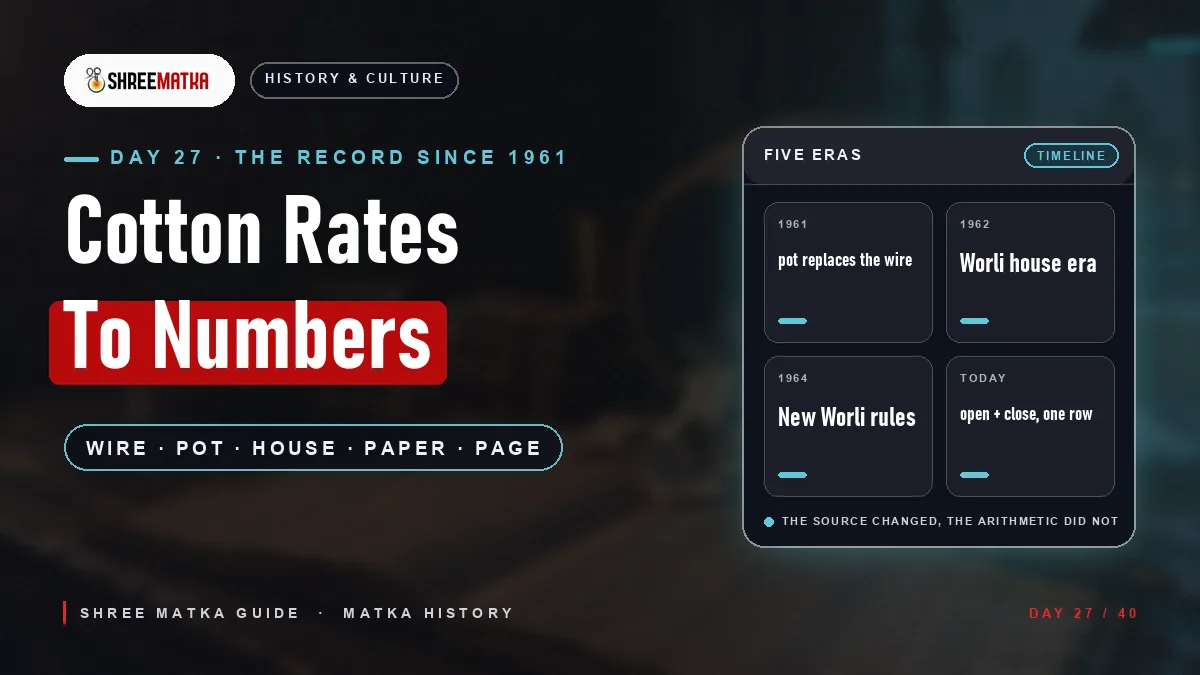
The pivot point of the whole history is a decision nobody in Bombay made. In 1961 the New York Cotton Exchange stopped transmitting its opening and closing rates, and the reference the bet had been built on simply stopped arriving. Everything that followed was the trade solving that problem in real time, and the solution it settled on is the one the game is named after: a clay pot - a matka - holding folded paper slips, from which a number was drawn in front of the room.
It is worth being precise about what changed, because the usual telling is that Matka became a different game. It did not. The bet moved from a number with an outside referent to a number with no referent at all, and every structural feature that made the old game attractive survived the move. There were still two figures per day, still a public declaration, still a small integer a punter could stake on. What was lost was the thing that made the old bet arguable: a cotton price can be reasoned about, and a drawn slip cannot. That single subtraction is the origin of every argument this series has ever had about prediction.
numbers, folded, mixed by handone slip for the open, one for the closeread aloud in the room, written on the boardthe three-digit panel and its single ankthe digit, the pair, or the full panelThe randomisation was also, in practice, the point at which the arithmetic of the game became the arithmetic this series keeps returning to. A drawn number has no memory and no tendency, so the base rates the historical-data guide measures against are not an assumption layered on top of Matka - they are what Matka has been since 1961. Players kept reading patterns in the drawn numbers anyway, and the tension between a genuinely random source and a public that will not accept one is the engine of the entire culture described in the rest of this guide.
The House Era: Worli, Kalyan and New Worli
What turned a pot in a room into an industry was the arrival of the organised house. The public record puts the Worli matka, started by Kalyanji Bhagat in 1962, at the front of that shift, with Ratan Khatri following in 1964 with a New Worli version that modified the rules. These were not merely two men running two games; they were two men fixing the format. A house needed a schedule, a declared result, a rate table and a set of bet types, and once one house had published those, every competitor had to match them. The structure of the modern board is inherited from that competition.
The names of those houses are still the names of the markets on this site. The seeded market list in the schema carries Worli Mumbai and Old Main Mumbai alongside Kalyan and Kalyan Night, and the day-night split that Bhagat’s and Khatri’s schedules introduced is still how the board is organised - it is not a column in the database, it is written into the market’s name. A reader who has used the Kalyan or Main Bazar pages has therefore been trading inside a naming system that is roughly sixty years old and remembers, in its geography, the specific Mumbai localities the games were run from.
| Reported date | House or development | What it contributed |
|---|---|---|
| 1961 | the New York transmissions stop | forced the switch from a price to a drawn number |
| 1962 | Worli matka, Kalyanji Bhagat | a scheduled, publicly declared house game |
| 1964 | New Worli, Ratan Khatri | rule modifications that competitors then had to match |
| 1960s-70s | the format standardises | open and close, panna, ank and jodi as settled vocabulary |
| later | the market names freeze | the houses become the rows on a modern chart page |
The honest limit on this chapter is that the men in it are reported by sources that were writing about a criminal trade, sometimes admiringly, usually loosely. Attributions of specific innovations to specific founders are the least reliable part of the surviving story, and none of it is a claim that any named house was better, fairer or more skilful than another. What is verifiable is the shape: a handful of scheduled houses in the early 1960s, a standardised format by the 1970s, and market names that have survived to appear in a database table today.
The Peak Decades and the Crackdowns
The 1980s and 1990s are the period the public record describes as Matka’s largest, and the figures attached to it are enormous: monthly stakes reported around five hundred crore rupees at the peak, thousands of bookies operating by the mid-1990s, and a sharp fall afterwards as enforcement, migration and eventually new entertainment options took their share. The scale is the historically significant fact, because a trade that large cannot avoid drawing the attention that eventually breaks it.
around ₹500 crore staked monthlyreported above 2,000reported far lower, often under 300around ₹100 crore monthlyout of Mumbai into Gujarat and RajasthanTwo readings of that squeeze are worth separating, because the second is usually left out. The first is the familiar one: police pressure in Mumbai pushed dealers outward, and the game continued elsewhere under different management. The second is that the same period destroyed the customer base’s day. The mill communities that had been Matka’s heart were themselves in decline through the 1980s and 1990s, and the workforce that had gathered around a board at fixed hours dispersed. A game built on a schedule needs a population that shares one, and that population was going away.
The legal position never changed during any of this, and it is worth saying plainly here because the romantic version of the story tends to blur it. The Maharashtra Prevention of Gambling Act of 1887 - enacted as the Bombay Prevention of Gambling Act, and older than the game it covers - is part of the framework that made this trade illegal before it existed in its current form. The full map, including the federal baseline and the state-by-state variation, belongs to the legality guide in this series rather than to this one. The history only needs the point that Matka has been an offence for its entire recorded life, which is precisely why its history is so poorly documented.
From Paper Logs to Result Pages
The second great change of source was quieter than the first and is the one readers of this site actually live inside. For decades the record of a Matka draw was a physical object: a printed pana sheet, ruled as a weekly grid, filled in by hand with a pencil and circulated among the people who had staked on it. The guide to printed records and digital pages works through that medium shift in detail, so this chapter keeps to what the change did to the game rather than the mechanics of the sheet.
| Dimension | The paper era | The online era |
|---|---|---|
| Declaration speed | written up after the draw, passed by hand | published within seconds of being entered |
| Reach of one result | whoever could read the sheet | anyone with the page |
| Corrections | overwritten in pencil, silently | a visible edit and a logged history |
| Memory | whatever a dealer kept in a drawer | whatever the retention rule has not deleted |
| Accountability | the room, and the dealer standing in it | nobody in particular |
That last row is the one to sit with. In the paper era the record and the person who wrote it were inseparable, which gave the record a kind of authority and also gave the punter something to check. Online, the record arrives from a page with no author, and the accountability that used to be personal becomes procedural - which is why this site’s own archive depth is set by a scheduled cleanup rule rather than by what anybody chose to keep. The chart pages ask for a year of history; the retention rule deletes fully declared rows at one hundred and eighty days. The medium gained speed and lost both the person and the drawer.
a slip read aloud and chalked on a boarda pencil entry in a weekly pana gridone row: market, IST date, open, closethe two figures, the panel, the ankthe person who could be asked about itThe mobile app is the third medium and the least examined. It changed nothing about the bet and a great deal about the rhythm: a board you had to walk to imposed waiting, and waiting was the only structural brake the game ever had. A result page in a pocket removes it. That is not a history question, it is a behaviour and a play-discipline question, and this series treats it as one - but it is worth naming that the biggest behavioural shift in Matka’s history arrived with the most recent medium and changed no rule at all.
What the Schema Still Carries From 1961
Most histories of this game end at the culture, because that is where the sources run out. This one can keep going, because the modern platform leaves a record a dealer never bothered with: the database. Read as an artefact rather than as plumbing, the schema this site runs is the most complete surviving document of what the 1960s format actually consisted of.
Start with the row. A result here is one record per market per Indian-standard date, and it carries two embedded results - an open and a close - each of which is three stored digits. The panna is those digits read as they are written; the ank is their sum reduced to a single digit. The jodi is not stored at all: it is built at render time from the open digit and the close digit, and the version of the code that once computed it wrongly is still in the file, deprecated and annotated, which is a small and honest illustration of how hard even this one derivation turned out to be. The leading-zero rule the dedicated guide defends is the same difficulty in visual form.
| What the platform stores or shows | The era it descends from |
|---|---|
| Open result and close result on one row | the two cotton figures the wire carried |
| Three stored digits, read as a panna | the panel a dealer wrote on the slip |
| Ank as the digit sum modulo ten | the single number most punters actually staked on |
| Jodi built from open plus close at render time | the pair a punter read off two separate declarations |
| Day and night inside the market name, not a column | the two schedules the first houses ran |
| Worli Mumbai, Old Main Mumbai, Kalyan as rows | the localities and houses of the 1960s |
1, 3, 5135(1+3+5) mod 10 = 92, 6, 8(2+6+8) mod 10 = 6open 9 then close 6 = 96The red-jodi rule is the last fossil worth pointing at. A jodi is treated as a red jodi when its two digits are equal or differ by exactly five - a rule with no probabilistic content whatsoever, since both conditions are just one shape among many, and yet it carries an entire layer of the culture’s meaning. It is the clearest evidence available that the game kept its notation long after it lost the reason for it. The bet-type guide explains what each of these forms pays; the history explains why they are the forms at all.
The Cultural Footprint Beyond the Board
A game that ran illegally for sixty years in one of the world’s great cities left marks well outside the trade, and the honest way to describe them is as language, occupation and fiction rather than as folklore. Matka supplied Indian cinema with a plot device it has used repeatedly, supplied Mumbai’s underworld mythology with some of its most durable characters, and supplied ordinary Hindi and Marathi usage with the word satta as a general term for betting. The vocabulary alone is a historical document: a phrase whose oldest referent is a cotton quotation is now used to mean any wager at all.
The occupational layer is less romantic and better attested. A trade at the reported scale of the peak decades was an employer - bookies, runners, clerks who wrote the sheets, and the arithmetic work of settling thousands of small bets by hand. That infrastructure vanished as an occupation and reappeared as a feature: the record-keeping that once required a clerk is now a table with a unique constraint on market and date, and the runner who carried a slip is a page that anyone can open. This is the part of Matka’s evolution that is genuinely instructive, and it has nothing to do with numbers.
The footprint also carries the caution that runs through this whole series. Because the game is culturally familiar, its illegality feels informal - a thing everyone knows about rather than a thing the law does. It is the latter: the trade has been an offence for its entire recorded life, and the legal map and the tax guide in this series cover what that means for an individual, because nostalgia is not a defence and a documentary about the 1970s is not a licence. The cultural history is worth knowing precisely because it is so good at making the present feel harmless.
Future Trends: What the Record Shows
A history chapter is the wrong place for predictions, and this series does not make them anywhere. What the record does support is a direction of travel, and it is legible from the same four shifts already described: the source became random in 1961, the format became standard in the 1960s, the medium became digital around the turn of the century, and the device became personal with the phone. Each of those moved the game away from a specific place, a specific person and a specific hour, and nothing in the current state suggests that trend reverses.
| Pressure on the game | What it has already done | The direction it implies |
|---|---|---|
| Enforcement | pushed the trade out of Mumbai into other states | displacement rather than disappearance |
| Digitisation | replaced the sheet and the runner with a page | more markets, faster, with less human contact |
| Taxation of online gaming | changed operator economics rather than the bet | a formal cost layer where there was none |
| New entertainment | took the audience that policing did not | a smaller, older and more scattered player base |
| Random source since 1961 | defeated every prediction method ever sold | unchanged, and not going to change |
The regulatory direction is the one most likely to be misread, so it gets a pointer rather than a narrative. Online money gaming has been pulled steadily into formal taxation and formal restriction, and the specific statutes, dates and state differences are the property of the legality guide and the taxation guide; this chapter is only noting that the longest-running illegal game in the region is being increasingly treated as an economic activity with a paper trail, which is a genuinely new condition in a sixty-year history that had none.
What this site adds to that history is deliberately small and worth stating plainly, because a history of a game is the easiest place in this series to overclaim. Shree Matka is an informational and analytics portal: it publishes declared draw records, charts and arithmetic, it hosts no draw, runs no book, sells no numbers, solicits no fees, represents no operator and offers no legal, financial or tax advice. The archive it keeps is bounded by a retention rule rather than by the historical record, and the depth of that archive is measured elsewhere. Every era described above - the wire, the pot, the house, the pencil and the page - produced numbers, and this platform publishes only the last kind. The game remains illegal in India and this guide is intended for readers aged 18 and over as a record of how a notation survived its own reasons.
Frequently Asked Questions
Where did Satta Matka originate?
Why is it called Matka?
When did the New York cotton rate connection end?
Who started Satta Matka?
How did Satta Matka move online?
Is the modern game the same as the original?
Is Satta Matka legal in India?
What does the future of Satta Matka look like?
Download the Official Shree Matka App
Experience real-time live results, complete historic panel records, and 24x7 verified automated withdrawals on your Android smartphone.
Download App
Comments (0)
Loading comments...