
What the Calendar Asks, and What This Article Will Not Do
The calendar item for this guide is cryptocurrency, and it lists six subheads: cryptocurrency advantages, implementation methods, security considerations, regulatory challenges, anonymity features, and future adoption trends. Five of those have answers that can be read out of a payment schema - a closed list of methods, a deposit state machine, a table of gateway secrets, a withdrawal control and a wallet ledger. The sixth, adoption, is where this genre usually stops being an article and becomes a price pitch; this version does the opposite.
Five refusals shape the piece. It gives no investment advice and no forecast for the price of any coin, and it names no coin at all, because a name invites a price. It publishes no method for moving money anonymously: no mixer, no workaround, no privacy route and nothing that could be followed as one. It gives no legal advice and names no jurisdiction as safe, because a payment rail is a matter of statute and this is not a lawyer. It cites no study and states no market figure, because the codebase holds a payment schema rather than a survey. And it names no operator as a processor and recommends no form of play.
What remains is the part a reader can check. The schema contains a closed list of payment methods, a state machine with two terminal states, a thirty-minute pending timer, a five-minute reconciliation loop and a ledger with an idempotency key. Those five things decide what a payment can be, how long it may wait and who can prove afterwards that it happened, which is the honest version of a payments article. The terminology guide fixes the vocabulary, the state-by-state legality guide is where the legal questions live, and the comparison of regulatory models explains why a licence attaches to a seller rather than to a rail. The guide before this one answered the same kind of question about predictions; this one answers it about payments.
| Subhead | What this article can support | What it will not claim |
|---|---|---|
| Crypto advantages | Which costs are rail costs and which are price costs | That any rail is cheaper |
| Implementation | The columns, secrets and callbacks a new rail must satisfy | A step-by-step for adding one |
| Security | The secrets table, the idempotency key and the state trigger | That a chain removes the need for them |
| Regulation | Where a rule bites: who may sell and who may transmit | That any jurisdiction permits it |
| Anonymity | What this ledger records about every payment | Any method for avoiding that record |
| Adoption | Conditional statements with a dated falsifier | Any forecast of adoption or price |
The Rail Is a Line Item, Not an Edge
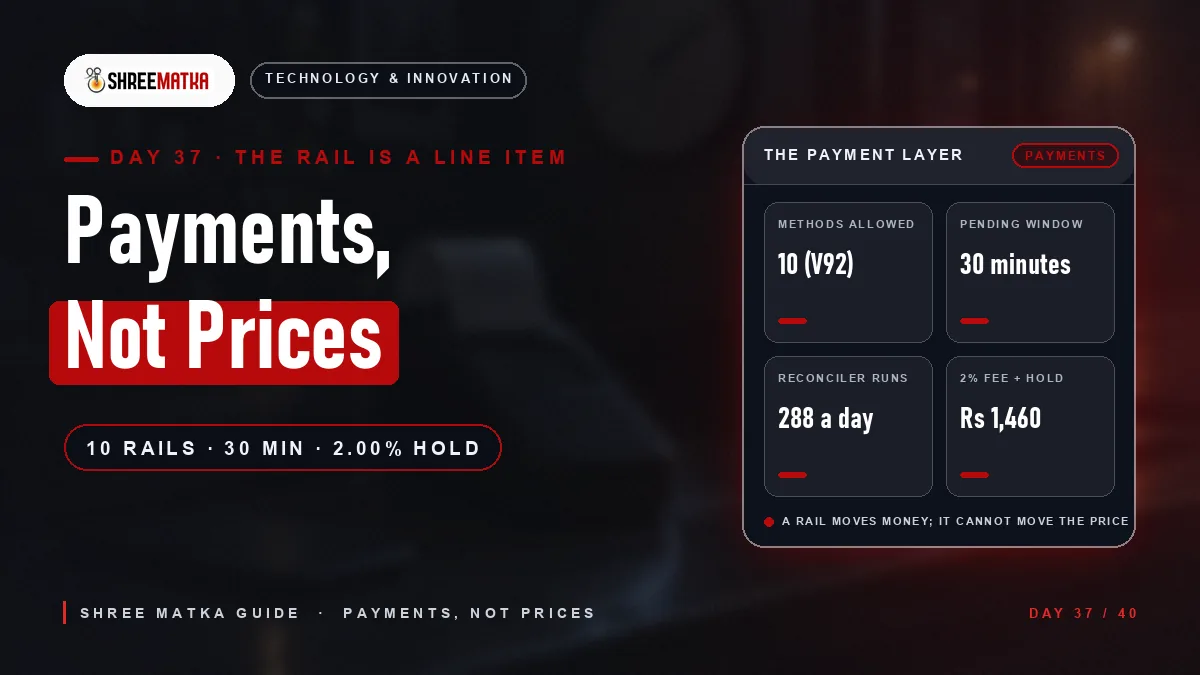
The first checkable fact is the method list. V92 constrains fund_requests.payment_method to ten values: ADMIN, GPAY, PHONEPE, PAYTM, UPI, BANK, BANK_TRANSFER, PAYU, RAZORPAY and ALL_UPI. Every one of them is a rupee rail that ends at a bank account or a UPI handle, and none of them is a coin. A cryptocurrency deposit would not be a setting on this platform; it would need a new value in that constraint before a single transfer could be booked, which is a schema decision with a migration behind it.
The second fact is that every rail keeps a reference. A UPI deposit carries a utr, a bank-issued transaction reference, and a duplicate is already failed as DUPLICATE_UTR. A gateway payment carries gateway_order_id, added for PayU's txnid and reused by the order-based gateways. The gateway rows hold a merchant id, an api key, an api secret and a webhook secret per rail, with auto_verify deciding whether a callback may credit a wallet without a human. The withdrawal side is narrower: V2 creates bank_details with an account holder name, an account number, an IFSC code and a UPI handle, and no migration in this set adds an address column to the users table.
None of that touches the settlement frame. A declaration is three digits, the space is 1,000 ordered triples, and the main digit still pays 9.8 for an expected value of 0.98, which is a 2.00 percent hold. The starline digit pays 9.50, or 0.95, which is 5.00 percent. A payment rail moves money toward a stake; it does not move the stake's price. The probability guide derives the space, the bet-type comparison prices the families, and the printed pana records are the paper version of the same ledger.
| Rail | Reference the schema keeps | What the rail cannot move |
|---|---|---|
| UPI, GPAY, PHONEPE, PAYTM, ALL_UPI | utr, plus the upi_id on the request | the 2.00% on a main digit |
| BANK, BANK_TRANSFER | utr and verified_at | the 1,000 ordered triples |
| PAYU, RAZORPAY | gateway_order_id and a webhook secret | the starline 5.00% |
| Withdrawal, any rail | bank_details: account, IFSC, UPI | the payout a winning row pays |
What the Code Already Settles, and How
A payment callback is a state transition rather than a balance edit, and the database enforces the difference. V32 puts an idempotency key on the wallet ledger with a unique partial index, so a callback that arrives twice with the same key cannot credit the account twice. V35 goes further: a terminal row must carry a verified_at, a FAILED deposit cannot be resurrected, a SUCCESS deposit cannot be modified, and verified_by must name a system process or an admin before the trigger accepts the change. Those are constraints rather than conventions, which is why a duplicated payment is a row the ledger refuses.
Adding a rail is therefore not a theme change; it is a checklist. V17’s gateway table expects a merchant id, an api key, an api secret, a webhook secret, an auto_verify flag and a test_mode flag per rail, and V59 and V65 show what that looks like when PayU and Razorpay were appended to the four seeded rows. A new route also needs a value in the payment-method constraint, a callback endpoint the rail can reach, a reference column if the existing utr and order id do not fit, and a way to rehearse the whole path in test mode before a single rupee moves. None of those steps is exotic; all of them are dated, inspectable artefacts, which is what makes them a fair answer to the implementation subhead.
The security case is the same list read the other way. A webhook secret is only useful if it is rotated and never shipped to a browser; auto_verify is only safe when the callback is authenticated, because that flag decides whether a message can credit a wallet without a human; and test_mode is only a rehearsal if it cannot reach a live balance. The state trigger from V35 is the backstop for all three: it will not accept a terminal deposit without a verified_at, will not resurrect a FAILED row and will not modify a SUCCESS one, so the worst a forged callback can do is leave a row pending until the thirty-minute timer rejects it. That is what a chain does not remove. A new rail changes who signs a message and what a reference looks like; it does not remove the need for a secret, a check and a timer.
The settlement path makes the same point in the other direction. AsyncPayoutService runs payouts on a named executor instead of the request thread, and PayoutReconciliationJob retries every five minutes, looking back seven days for the PARTIAL and IN_PROGRESS statuses and re-crediting with the same idempotency keys. A credit that failed at 23:55 is therefore retried by midnight, and a retry that lands twice still writes one ledger row.
300,000 ms = 5 min1,440 / 5 = 288288 x 365 = 105,1207 daysthe idempotency keya rail that never calls backThe Thirty-Minute Clock
The timer is the part a coin rail collides with first. V64 sets deposit.pending.timeout_minutes to 30, so a deposit still pending after half an hour is auto-rejected, and V35 makes that FAILED state terminal. A confirmation that arrives at minute thirty-one does not complete the original deposit: it lands on a row the platform has already judged, and the money needs a fresh deposit to be booked at all. That is not a policy anyone can argue with at the counter; it is a check constraint.
Against the schedule, thirty minutes is 1.64 declarations. The window runs 05:00 to 23:55, which is 1,135 minutes, and its 63 declarations average one every 18.3 minutes, so a thirty-minute wait spans 1.64 of those gaps and a forty-five-minute wait spans 2.46. At one deposit a day the waiting accumulates: ten minutes is 3,650 minutes a year, or 60.8 hours; thirty is 10,950 minutes, or 182.5 hours; forty-five is 16,425 minutes, or 273.75 hours. For scale, reading all 22,995 declarations a full year would hold at thirty seconds is 191.6 hours, so a daily half-hour wait costs about as much time as checking every result, which is the comparison the time audit makes in its own terms.
30 minutes (V64)30 / 18.3 = 1.6410,950 min = 182.5 h22,995 x 30 s = 191.6 hwhether the row is still pendinga rail slower than the clock| Confirmation | Results declared | Wait a year | Verdict |
|---|---|---|---|
| 1 min | 0.05 | 365 min (6.1 h) | inside |
| 5 min | 0.27 | 1,825 min (30.4 h) | inside |
| 10 min | 0.55 | 3,650 min (60.8 h) | inside |
| 15 min | 0.82 | 5,475 min (91.25 h) | inside |
| 30 min | 1.64 | 10,950 min (182.5 h) | on the boundary |
| 45 min | 2.46 | 16,425 min (273.75 h) | past the timer |
Fees Against the Hold
A rail fee and a house edge are different lines on the same bill, and the bill is where they meet. On Rs 100 a day the turnover is Rs 36,500 a year and the 2.00 percent hold is Rs 730 of expected loss. A rail that charges a fee on each deposit adds a percentage of the same turnover: 0.5 percent is Rs 182.50, 1 percent is Rs 365, 2 percent is Rs 730, 3 percent is Rs 1,095 and 5 percent is Rs 1,825.
The symmetry at 2 percent is the point. A 2 percent payment fee costs exactly what the price list takes over a year, so the same reader pays twice and the total is Rs 1,460, or 4.00 percent of turnover. At 1 percent the total is Rs 1,095 and 3.00 percent; at 5 percent it is Rs 2,555 and 7.00 percent. None of that changes a digit. The hold is a property of the price list, as the comparison with other gambling forms puts it, and the fee is a property of the rail; a reader quoted one without the other has half a price. The one-price guide makes the same point from the player's side: the payout table has no field for who pays the fee.
Rs 100 x 365 = Rs 36,500Rs 730Rs 730Rs 1,4601,460 / 36,500 = 4.00%the 1,000 ordered triples| Rail fee | Rupees a year | Multiple of the hold | Total | Of turnover |
|---|---|---|---|---|
| 0.5% | 182.50 | 0.25x | 912.50 | 2.50% |
| 1% | 365 | 0.5x | 1,095 | 3.00% |
| 2% | 730 | 1x | 1,460 | 4.00% |
| 3% | 1,095 | 1.5x | 1,825 | 5.00% |
| 5% | 1,825 | 2.5x | 2,555 | 7.00% |
Currency Risk and Irreversibility
A rail that quotes in rupees and settles in a coin adds a second exposure that has nothing to do with the draw. If the amount is converted at settlement, a move of 1 percent in the coin's rupee value changes that amount by 1 percent between the quote and the credit. On a year's turnover of Rs 36,500, a 1 percent move is Rs 365, half the hold; a 2 percent move is Rs 730, exactly the hold; a 5 percent move is Rs 1,825, or 2.5 times it; and a 10 percent move is Rs 3,650, or five times it.
Irreversibility is the other half of the same exposure. A bank dispute can be raised and a UPI payment can be reversed through the rail's own process; a transfer that reaches a wrong destination has no equivalent, which is why one mistaken Rs 5,000 transfer equals 6.8 years of expected loss at Rs 100 a day, or fifty full days of staking. That is not an argument against any rail. It is the arithmetic a reader needs before deciding how much money should ever be in transit, and the wellbeing guide treats the same question as a limit rather than a calculation.
Rs 36,500Rs 730Rs 365 = 0.5x the holdRs 730 = 1x the holdRs 1,825 = 2.5x the holda change in the digitsAnonymity, Audited
Anonymity is a claim about a rail, and the ledger is where it gets tested. Every deposit row carries an amount, a payment method, a reference - a utr or a gateway order id - a verified_at, and a verified_by that must name a system process or an admin. Every ledger row carries a balance before and after, a reason, a creator and, since V32, a metadata field. A withdrawal cannot be created without bank_details, which means an account number, an IFSC code or a UPI handle. This schema has no column for a chain address and no column for a chain hash, so a coin rail here would be a new reference recorded beside the same amount, the same time and the same account.
That is also why this article publishes no method for anonymity and describes no workaround. A text that explained how to break the link between a payment and an account would be a guide to defeating the record this platform keeps, and no arithmetic in this repository supports the claim that such a link can be broken reliably. The reader's check is simpler: ask which reference a site stores for a deposit, and whether a withdrawal is possible without a bank or UPI destination. If the answer is no column and no route, the rail is not anonymous; only its name is. The scam guide covers the other end of the same problem, where a brand is imitated and a payment goes somewhere the ledger never sees.
| Record | What it holds | What it proves |
|---|---|---|
| fund_requests | amount, method, utr or order id, verified_at, verified_by | who confirmed a payment and when |
| wallet_transactions | amount, balance before and after, reason, created_by, metadata | what the balance became and why |
| bank_details | account holder, account number, IFSC, UPI handle | where a withdrawal can go |
| payment_gateway_settings | merchant id, api key, api secret, webhook secret | which rail could call back |
| users | name, mobile number, wallet balance, payout flag | who the account is, with no address |
Adoption Claims, Converted Into Checks
Adoption is the subhead that wants a forecast, so here it is as four conditional statements. If a site adds a coin rail, its payment-method list will show a new value and its terms will name who bears the conversion. If it prices a coin deposit, the fee will appear on a rate page or in a quote a reader can screenshot. If it claims speed, the claim will survive a stopwatch against the thirty-minute window. And if a regulator acts, the change will land in who may transmit money rather than in the price of a row. Each statement has a falsifier a dated page could settle, which is the same standard the analysis of AI prediction claims applied to forecasts, and none of it requires a view about next year.
Six checks cover what a reader can actually do. Find the payment-method list and count the rails. Find the reference a deposit keeps and check that it is on a receipt. Time one deposit from payment to credit against the timer the site states. Compute one hold and one rail fee on the same turnover. Confirm that a withdrawal has a named destination. And write down the four numbers the responsible limits guide asks for, so that no limit depends on memory; the historical data audit is how a reader turns records into those numbers, and the tipster audit explains why a claim that cannot be falsified is a sales script rather than a result. The play guide covers the mechanics of each family, and no check requires an account.
This article names no coin, cites no study and states no market figure, and it gives no investment advice and no forecast of any price. It publishes no method for moving money anonymously and describes no workaround. Shree Matka is an informational and analytics portal: it publishes no guaranteed numbers, sells no predictions, never solicits fees, represents no operator and hosts no draw. Nothing in this article is legal, financial or investment advice, it recommends no form of play, and the tax question belongs to the taxation guide rather than here. Content intended for readers aged 18 and over.
Frequently Asked Questions
Can I deposit to Satta Matka with cryptocurrency?
Does paying with a different rail change the odds?
Is a crypto transfer more private than a UPI payment?
What happens if a deposit confirms after thirty minutes?
Is a payment fee cheaper or dearer than the house edge?
Are winnings paid on a crypto rail taxable?
Is cryptocurrency gambling legal where I live?
Does this site sell predictions or give investment advice?
Download the Official Shree Matka App
Experience real-time live results, complete historic panel records, and 24x7 verified automated withdrawals on your Android smartphone.
Download App
Comments (0)
Loading comments...