
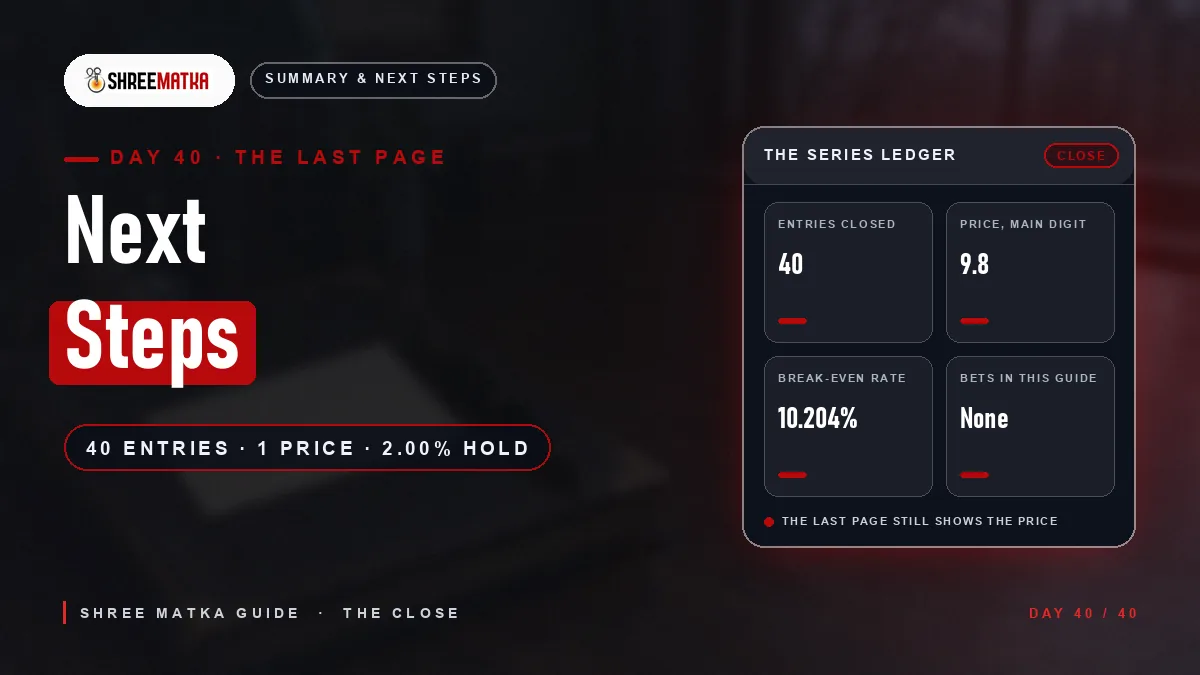
What Forty Guides Established
The series can be summarised in a page, which is the test of whether it said anything. Six facts survive every entry, and each one is either counting or arithmetic on this platform’s own rate: a digit has 10 values, a jodi has 100 pairs, the panels divide into 120 single, 90 double and 10 triple for 220 in total, a main digit pays 9.8 including the stake, the expected value of that bet is 0.98, and the hold is 2.00 percent of turnover. Nothing else in forty entries moved those numbers, because no chart, tip or story can move a rate that is fixed before the session.
The rest of the series was application. Being ahead needs 9.8w > n, so 4 wins of 30, 6 of 50, 11 of 100, 38 of 365 and 103 of 1,000 clear the line, while 41.7 percent of players are ahead after a hundred bets simply because a session sample is short, as the success-story audit shows in detail. Runs of losses are ordinary rather than unlucky: at least four in a row inside 30 bets has probability 99.9989 percent. A doubling ladder from Rs 100 commits Rs 3,100 by step five and Rs 51,100 by step nine, and reaches step six with probability 0.5905. The pricing is set out in the probability guide and the record-reading method in the historical data guide.
| Group | The question it settled | The number that settles it | Where the detail is |
|---|---|---|---|
| Rules | What is being counted | 10 / 100 / 220 | Glossary and bet types |
| Price | What a win and a loss are worth | 9.8 / 8.8 / 2.00% | Probability guide |
| Sample | What a short record can look like | 41.7% / 99.9989% | Historical data |
| Bankroll | What chasing a loss commits | 51,100 / 0.5905 | Risk management |
| Portal | What this site actually holds | 25 / 50 / 4 / 1 | Chart organization |
| Safety | Where the page has to stop | No operator, no draw | Legality and Scams |
9.88.810.982.00%The Questions That Decide Whether to Play
The first decision is not which market or which number. It is whether the activity has a place in a budget at all, and that question has four parts that can be answered before any session opens. Is the money being used one that is already owed to something else? Has a limit been written down for a single month, in rupees rather than in intentions? Is there a time limit that ends the session regardless of the result? Is there a person who knows the limit and will be told if it is crossed? A no to any of those is not a moral failure; it is information that the next step is to stop rather than to stake.
This is where a closing article usually becomes a sales page, and this page refuses that too. It does not call any form of play lawful, because the state-by-state legality guide shows that the answer depends on where a reader lives and this page names no jurisdiction as safe. It does not say that a particular operator is trustworthy, because it represents no operator and hosts no draw. It does not say that a system reduces the 2.00 percent hold, because the hold is the one number that does not move. What it can say is that a reader who cannot answer the four questions has a cheaper next step than a bet: a cap written down, a clock set, and a person told what the cap is.
None of those answers requires a chart. A chart tells a reader what happened; it cannot tell a reader whether the money is theirs to lose. The limits guide covers the practical side of setting a cap, including the difference between a limit that is decided in advance and one that is negotiated during a losing session. The difference is the whole point: a limit negotiated during a loss is not a limit.
Next Steps That Are Not Bets
The calendar asks for actionable next steps, and the honest ones cost nothing to take. Write the monthly cap on paper. Write the stop rule beside it, in the form "if the cap is gone, the session is over" rather than "if I feel bad, I will consider stopping". Pick one claim from this series and check it against the page that carries the detail. Open a result page and read its date before reading its digits. Read the legality page for the reader’s own state, not for a general impression. Each of these steps changes what a later session costs, and none of them requires a stake.
The arithmetic that makes the cap concrete is the hold. Two percent of turnover is small per bet and exact over a month: forty days at one Rs 100 bet is Rs 4,000 staked and Rs 80 of expected hold, and a year at the same rate is Rs 36,500 and Rs 730. The cap is therefore a decision about turnover, not about luck. A reader who caps turnover at Rs 3,000 a month has capped the expected cost at Rs 60, whatever the individual results do, and that is the only part of the month that can be fixed in advance.
| Next step | What it costs | What it proves | Where to start |
|---|---|---|---|
| Write the monthly cap | Rs 0 | The worst month has a number | Limits guide |
| Write the stop rule | Rs 0 | The rule binds before the session | Risk guide |
| Check one claim | Rs 0 | A figure can be reproduced | Probability guide |
| Read a result date | Rs 0 | A record is not a prediction | Date guide |
| Read the legality page | Rs 0 | The answer depends on the state | Legality |
| Set a time limit | Rs 0 | Sessions stop at a clock | Wellbeing guide |
40Rs 4,000Rs 805 of 40Rs 49 eachThe Resources Worth Keeping
A resources section is usually a list of places to spend money. This one is a list of pages that answer a question, and every entry is on this site, so nothing has to be bought and no account has to be opened. The rule for using them is simple: read the page that matches the question, then check whether the answer changes a number or only a feeling. A page that changes a number is worth keeping; a page that only changes a feeling is a story.
| If the question is | Open this | It contains |
|---|---|---|
| What does this word mean? | Terminology glossary | Plain definitions, no tips |
| Which bet covers what? | Single, jodi and pana | Combinations and denominators |
| What is on the panel board? | 220 patti list | All 220 panels, grouped |
| How is a chart organised? | Chart organization | Rows, columns and dates |
| Why do two sites differ? | Result differences | Timing and correction, explained |
| How do deposits move? | Payment guide | Rails, clocks and fees |
| How do I install the app? | App installation guide | Package, permissions, checks |
| How do I spot a scam? | Scam guide | Red flags and what to check |
| Where does the page stop? | Fifty-question FAQ | The limits, stated plainly |
The play guide walks through one round from start to finish and is the one page worth reading before the rest. After it, two pages matter more than the others: the glossary, because most arguments about this game are arguments about a word, and the date guide, because most arguments about a "wrong" result are arguments about which day a page is showing. The app guide is the only place this series discusses an installed package, and it makes the same point the download page does: the package is served from this site, and a copy from anywhere else has no reason to be trusted.
Community Without a Guru
The community part of this site is small on purpose. There are comments under each article, a display name of up to 100 characters and a comment of up to 1,000, and there is no direct message, no tip room and no place to trade numbers. That is a design choice rather than a missing feature: a comment field is a place to argue with an article, and a tip room is a place to be sold something. The community etiquette guide sets out what a useful comment looks like, and the tipster review explains why a paid tip is the wrong thing to buy even when it is honest.
The practical version is short. Address the article rather than the person. Do not treat a number posted in a comment as if it were a prediction, because nothing posted there has been checked. Do not send money to anyone who offers a service in a comment thread. If a reader wants to disagree with a figure on this page, the reply can show the arithmetic, and that is the kind of disagreement the series was built to have. The comments are not moderated for accuracy, so the only defence is the reader’s own check.
How to Test the Next Claim
Every claim a reader meets after this series will have one of three shapes: a number, a story or a promise. A number can be tested. Take the payout, multiply by the wins, compare with the stakes, and see whether the claim survives 9.8w > n. A story can be dated: ask when it happened, who recorded it and whether the record can be opened. A promise cannot be tested at all, which is why every promise in this subject is followed by a request for money or a request for a deposit.
The test takes a minute and needs no tools beyond the arithmetic already shown. If a page says a method wins most days, convert "most days" into wins and days and check the line. If a page says a chart predicts the next panel, ask which digit on the chart is the next panel and where that is written before the session. If a page says a result was corrected, read the publication date and the result-difference guide before treating the correction as a scandal. A claim that cannot be written as a number, a date or a source is not a claim yet.
| The claim | What to ask | What settles it |
|---|---|---|
| "This method wins most days" | How many wins of how many days? | 9.8w > n, by hand |
| "The chart shows the next panel" | Which panel, written before the session? | A dated prediction |
| "The result was changed" | Which date, and which record moved? | Two dated captures |
| "The tip is verified" | Who verified it, and can the record be opened? | A named record |
| "This offer is limited" | What happens after the deadline? | The same offer, later |
Responsible Play, Stated as Arithmetic
Responsible play is usually written as advice. Here it is written as a bill, because the bill is the part that can be checked. The hold is 2.00 percent of turnover: Rs 10 a bet for 30 days is Rs 300 staked and Rs 6 of expected hold; Rs 100 a bet for 30 days is Rs 3,000 and Rs 60; Rs 500 a bet for 30 days is Rs 15,000 and Rs 300. Over a year at one bet a day the same rates give Rs 73, Rs 730 and Rs 3,650. None of those figures depends on which number was chosen, which is exactly why they are the ones to plan with.
| Stake per bet | 30-day turnover | Expected hold | Yearly hold, one a day |
|---|---|---|---|
| Rs 10 | Rs 300 | Rs 6 | Rs 73 |
| Rs 50 | Rs 1,500 | Rs 30 | Rs 365 |
| Rs 100 | Rs 3,000 | Rs 60 | Rs 730 |
| Rs 500 | Rs 15,000 | Rs 300 | Rs 3,650 |
The stop rule is the other half. A limit that is set before a session and honoured without renegotiation turns an unknown loss into a known one: if the rule says Rs 500 and the stake is Rs 100, the worst case is five losses and the session ends. The doubling ladder is the opposite rule, because it answers a loss with a larger stake: by step six it has committed Rs 6,300 to recover Rs 100, and it reaches that step with probability 0.5905. A reader who wants the arithmetic of limits rather than the encouragement to keep going will find it in the limits guide and the risk guide. The same scale explains what a bankroll is: Rs 5,000 at Rs 100 a stake is 2,500 stakes of expected loss, or 6.8 years at one a day, and a thousand players at a hundred Rs 100 bets is Rs 10,000,000 of turnover and Rs 200,000 of expected hold.
Rs 500Rs 1005Rs 6,300 committed0.5905Where the Journey Actually Starts
The calendar title says the journey starts here, and the useful reading of that sentence is the one the series has argued for forty entries: what starts here is a decision, made with a price in view. The price is 9.8 including the stake, a 2.00 percent hold and a 10.204 percent break-even rate against a true 10 percent. A reader who accepts that price and writes a limit is making a decision about entertainment with a known cost. A reader who rejects it is making an equally valid decision, and this page will not pretend otherwise.
Nothing in this series was a prediction, and this last entry does not become one. It names no player and repeats no story about a real person, states no net worth and no earnings figure, and treats no individual as a model or role model. It gives no strategy recommendation and sells no system, cites no study, gives no diagnosis or medical advice, states no demographic figure, gives no legal or tax advice and names no jurisdiction as safe. It names no operator as a model, gives no financial or investment advice and recommends no form of play.
Shree Matka is an informational and analytics portal: it publishes no guaranteed numbers, sells no predictions, never solicits fees, represents no operator and hosts no draw. The portal holds 25 markets with a jodi and a pana chart each, four jackpot markets, one starline chart, a 100-character comment name and a 1,000-character comment, and an Android package served from this site. None of that is an invitation to stake money; all of it is a record that can be read. Nothing in this article is legal, financial or investment advice. Content intended for readers aged 18 and over.
255041100 / 1,000 charsFrequently Asked Questions
Is this guide telling me to start playing?
What is the single most useful next step?
Which page should I read next?
Does the site publish predictions or tips?
Do I need to install the app?
How can I tell whether a result page is genuine?
What if I want to stop altogether?
Why does every entry repeat the same price?
Download the Official Shree Matka App
Experience real-time live results, complete historic panel records, and 24x7 verified automated withdrawals on your Android smartphone.
Download App
Comments (0)
Loading comments...