Satta Matka FAQ: Answering 50 Most Common Questions
The calendar item for this guide is a FAQ, and a FAQ is the one article in this series that has to earn its length through usefulness rather than argument. Fifty questions are answered here in six groups - basic rules, strategy, legal and safety, technical, community and a short miscellaneous set - and every answer is written to be read on its own, in under a minute, without the surrounding chapters. The price that recurs is the one this series has used from the start: a main digit pays 9.8 including the stake, which is a profit of 8.8, a loss of 1, an expected value of 0.98 and a 2.00 percent hold, so break-even is 1 / 9.8 = 10.204 percent against a true 10 percent. It also refuses the two things a FAQ is most often used for: selling a system, and answering legal or medical questions this page has no standing to answer.
Abdul Rahaman•Full-Stack Developer & Marketing Expert••Updated November 13, 2026•16 min read
Download App
Live 1-second results • Verified panel charts
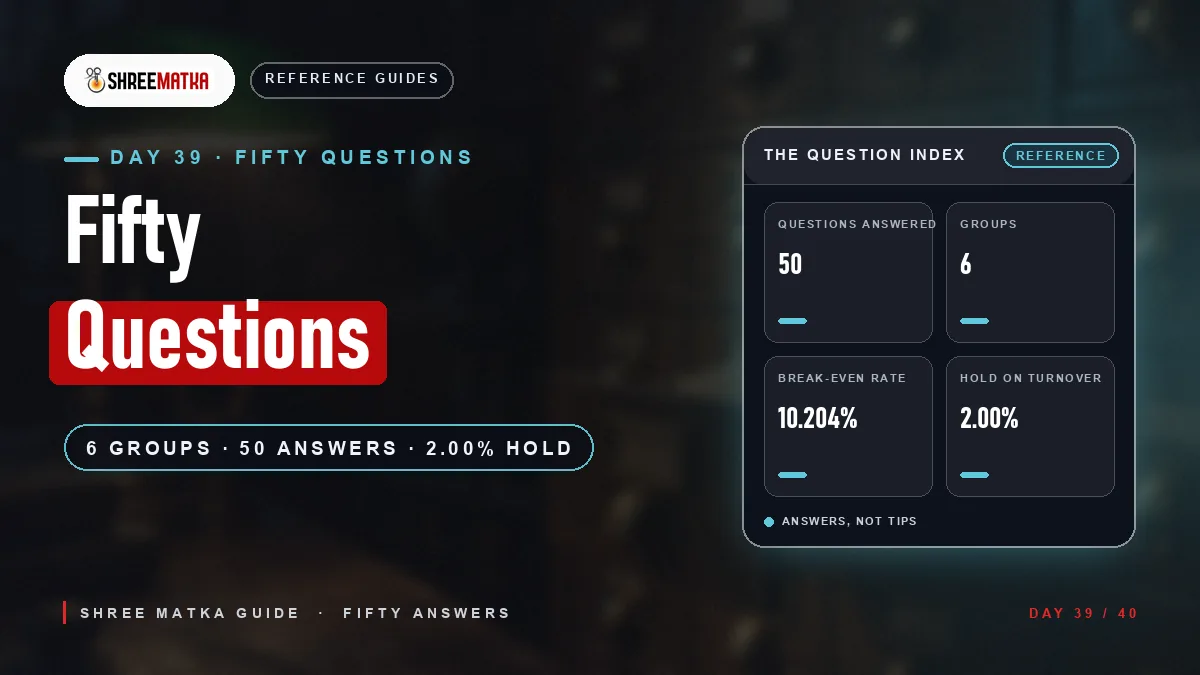
Figure 1: An index, not a record of wins. The cabinet is the shape of this article: fifty short answers filed under six headings, each one retrievable on its own. The cards are blank because nothing here is a prediction or a personal story; the labels are unreadable because the answers are in the text, where they can be checked. The one number every answer returns to is the price of a main digit, 9.8 including the stake, which is a 2.00 percent hold and a break-even rate of 10.204 percent.
Table of Contents
Fifty questions are answered here in six groups, and each answer is written to be read on its own in under a minute. The groups follow the calendar outline for this guide: basic rules, strategy, legal and safety, technical, community, and a short set of loose ends. Nothing in an answer depends on having read the chapter before it.
Where an answer depends on a price, it gives the price. A main digit pays 9.8 including the stake, which is a profit of 8.8 on a win, a cost of 1 on a loss, an expected value of 0.98 and a 2.00 percent hold. Break-even is therefore 1 / 9.8 = 10.204 percent of bets against a true 10 percent, and almost every strategy question below reduces to that line. The terminology guide fixes the vocabulary and the bet-type guide compares the families if a single answer leaves a term unexplained.
Two things the page will not do. It gives no strategy recommendation and sells no system, because a reference page that started coaching would be answering a different question. And it gives no legal, tax, financial or investment advice and no medical advice, because those questions belong to qualified professionals in your own jurisdiction. Where a question needs one of those, the answer says so and points to the guide that frames it.
Ten questions about what the game is. The answers use one vocabulary throughout: the panel is a panna or patti, the digit is an ank and the pair is a jodi. A round is four numbers - open panel, open ank, close panel, close ank - and every bet in this series is a stake on one of those numbers or on a combination of them. If the vocabulary is new, the how to play guide walks through one round from start to finish.
The arithmetic behind the group is counting, and it is worth keeping in view because it settles most of the strategy questions later. A digit has ten values, a pair has a hundred, and the three panel families add to 220. The 220-patti list prints every panel, the sangam comparison covers the composite formats, and the jodi chart guide shows how a weekly table is laid out.
Bet type
What you pick
Combinations
One correct pick in
Single ank
One digit, open or close
10
10
Jodi
Open ank + close ank
100
100
Single panna
Three different digits
120
120
Double panna
Exactly two digits the same
90
90
Triple panna
All three digits the same
10
10
Any panna
The panel, family unspecified
220
220
1. What is Satta Matka?
A number game with a fixed price per bet type. Each market publishes a three-digit panel for a session, the digits are added and the last digit of the sum is the ank; a jodi is the two anks read as a pair. You stake on a digit, a pair or a panel at a rate fixed before the session, so the payout cannot change after the result.
2. How does one round work, start to finish?
Four numbers: an open panel of three digits, an open ank equal to the digit sum mod 10, a close panel and a close ank. The jodi is the open ank followed by the close ank. Betting closes before each session, the result is published afterwards, and the chart keeps it date by date. This portal stores and displays that record; it hosts no draw.
3. What are open and close?
The two sessions of a market day. Open is the first and close is the second, and each has its own panel and ank. Markets differ: most publish both sessions, some publish only one. Each market page states the sessions it runs, and a jodi always uses the anks that market publishes.
4. What is an ank?
A single digit from 0 to 9. It is not drawn on its own: it is the last digit of the sum of the three panel digits, so a panel of 123 gives 1 + 2 + 3 = 6. Ten possible values means a single number covers one outcome in ten, which is the denominator every single-digit question in this page uses.
5. What is a jodi?
The open ank and the close ank written together as a two-digit number from 00 to 99. There are 100 jodis, so one jodi covers one outcome in a hundred. A jodi chart prints those pairs date by date, which is why it has one cell per day rather than three.
6. What is a panna?
The three-digit panel itself, also called a patti. There are 220 possible panels: 120 with three different digits, 90 with exactly two the same and 10 with all three the same. Those three families are the whole board, so a line printed from all of them has 220 entries.
7. What is the difference between single, double and triple panna?
Single panna uses three different digits and has 120 panels. Double panna has exactly two digits the same and has 90. Triple panna has all three the same and has 10. The counts add to 220, which is why a complete patti list is 220 lines long rather than three separate lists.
8. What is a sangam bet?
A bet that combines a panel from one session with a digit from the other. Because it spans both sessions it has more combinations than a single-session bet, and its rate is published separately. The sangam comparison linked above sets out the two formats with worked examples of the numbering.
9. What is the difference between half and full sangam?
A half sangam pairs one session panel with the other session ank, in either order, so it has two shapes. A full sangam pairs the open panel with the close panel, so it has one. Both are composite bets, which is why neither can be counted with the 220 panels of a single session.
10. What are SP, DP and TP?
Shorthand for single panna, double panna and triple panna: 120, 90 and 10 panels. A chart that prints 220 lines is printing all three families together. A page that labels all 220 lines single panna is using the term loosely, and the count is the way to notice.
Strategy Questions (11-19)
Nine questions, and the honest answer to most of them is a subtraction. A strategy is a pair: a stake and a rule for stopping. The price is not part of that pair. At a 9.8 payout the hold is 2.00 percent of turnover whether the stakes are flat, doubled, split across markets or stopped at a target.
So these questions are really about shape. A schedule changes how often you finish ahead and how large the exceptions are; it does not change the total expected loss. The success-stories audit reaches the same conclusion from the other end by asking what a winning record would have to look like, and the probability guide derives the spread that makes short samples look deceptively good.
Schedule
What it changes
What it cannot change
Flat staking
The turnover, nothing else
The 2.00% hold
Doubling after a loss
The spread of results and the stake size
The expected loss on a given turnover
Stop at a target
When a session ends and the shape of the record
The price paid in the next session
More markets
The number of separate lines played
The hold on each line
More numbers
The chance of catching one draw
The cost of the extra turnover
Worked: what doubling commits
Base stakeRs 100
Step 5 cumulativeRs 3,100
Step 6 stakeRs 3,200
Step 6 cumulativeRs 6,300
Step 9 cumulativeRs 51,100
Reach of step 6,0.5905
11. Is there a strategy that beats the 2.00 percent hold?
No schedule changes the price. A plan changes two things: how much you turn over, and how the results are spread. It cannot change the expected loss, which is 2.00 percent of turnover at a 9.8 payout. Doubling makes small wins more likely and the rare loss larger; it does not make the total cheaper.
12. Do chart patterns predict the next result?
A chart is a record of sessions that have already happened. Each session is independent under the published rules, so a pattern describes the past and does not compel the next draw. Reading a chart is useful for checking a record and spotting a transcription error; it is not a forecast, and a page that sells it as one is selling the pattern.
13. Do cut anks or opposite digits work?
They are conventions for reading and comparing digits, not probabilities. A digit called the opposite of another still has one chance in ten on a fresh line, and a run of one family says nothing about the next. The chart guides explain the conventions and, more usefully, where they stop being arithmetic.
14. Is doubling after a loss safe?
The arithmetic is against it. From a Rs 100 base the sixth stake is Rs 3,200 and Rs 6,300 has already been committed; the ninth stake is Rs 25,600 and the total committed is Rs 51,100. A Rs 5,000 bankroll funds five steps, and the sixth step is reached with probability 0.5905. The expected loss stays at 2.00 percent of turnover.
15. Does betting more markets improve my odds?
No. Each market is a separate ten-way line with the same hold, so two markets are two prices rather than one better price. Playing 25 markets multiplies turnover by 25 and multiplies expected loss by 25. The portal lists 25 markets with jodi and pana charts; that is a menu, not an edge.
16. Do final ank or jodi tricks work?
A final ank is a number somebody chose. Nothing in the published result depends on it, and no method can make a ten-way line pay more than it pays. If a trick is sold for a fee, the fee is the product being sold, and the number is the advertisement.
17. Can I cover every outcome for a guaranteed profit?
Covering all ten digits at a 9.8 payout means staking ten units to return 9.8, which is a 2 percent loss before the draw even happens. That is what the hold means: a full cover is a small certain loss. Covering more outcomes changes the spread of results, not the total.
18. Is there a best time of day to bet?
No. The clock changes which session you use, not the price of a digit. Session times matter for one reason only, which is the deadline: a missed close is a missed bet, not a better one. The schedule on each market page is there to be read before staking, not after.
19. How many numbers should a beginner pick?
As few as a limit set in advance allows. Every extra number adds turnover: ten numbers at Rs 100 is Rs 1,000 staked and Rs 20 of expected loss, against Rs 2 for one number. A count chosen to recover a loss is a different decision from a count chosen before play, and only the second is a plan.
Legal and Safety Questions (20-29)
Ten questions that mix law, fraud and personal safety. They are grouped because the answers share a shape: this page can describe the question and the checks, but the decision belongs to you, to your jurisdiction and, where the stakes are high, to a professional.
The site's own position is narrow and worth stating once. It is an informational portal, not an operator: it hosts no draw, represents no operator, sells no predictions and never solicits fees. That does not make any other platform safe. It only tells you what this page can and cannot vouch for, which is the useful part. The state-by-state legality guide and the scam guide carry the detail behind the answers below.
Signal
What it looks like
What a reader can check
A guaranteed number
A count or a "confirmed" ank for a future draw
Whether the draw has happened at all
An upfront fee
An activation, unlock or "VIP" payment before any result
What the fee buys that a fixed price cannot
A code request
A one-time code, a PIN or a screen share
Why a result page would need either
A missing date
A result with no market date or no session label
Whether other pages carry the same row
An inside claim
Advance access to a draw or a "leaked" panel
Whether anyone could hold it legitimately
20. Is online matka legal where I live?
That depends on your jurisdiction, on how the game is classified there and on who operates the platform. This page cannot give a legal opinion and names no jurisdiction as safe. The state-by-state guide linked above sets out the questions a lawyer would ask; the answer for your own case belongs to a qualified professional.
21. Is this site a betting operator?
No. Shree Matka is an informational and analytics portal. It publishes results, charts and articles, hosts no draw, represents no operator, sells no predictions and never solicits fees. Reading the site needs no account and no payment.
22. What are the warning signs of a scam site?
Guaranteed numbers, an upfront activation fee, a request for a one-time code or a screen share, results with no date, and a promise of inside access. None of those can be true of a fixed-price game. The scam guide linked above lists the checks in the order that catches most of them.
23. How do I check whether a result is genuine?
Read the same market and date on more than one independent page, confirm that the panel digits add up to the published ank, and check that the row carries a date. Keep your own copy of what you saw. Differences between sites are common and usually have a plain cause.
24. What does 18+ mean in practice?
It is a floor, not a test of suitability. The content here is written for adults, the footer states the 18+ rule, and nothing on the site is addressed to younger readers. Being old enough is the first condition, not the only one.
25. What should I do if a site asks for a guaranteed payment?
Treat the request itself as the answer. No fee can change a fixed payout, and no payment can secure a number that has not been drawn. Do not pay, do not share one-time codes, and do not install a remote-access tool that a stranger asks you to install.
26. Are leaked results real?
No. A result is a record of a completed session. Anyone who claims advance knowledge is either guessing or selling, because there is no version of a draw that circulates early. This portal hosts no draw, so there is nothing here that could be leaked.
27. What is self-exclusion and how does it work?
A block you ask a platform to place on your own account for a stated period, so deposits and bets are refused. It works because it removes access instead of relying on willpower on a bad day. Ask for written confirmation with start and end dates, and ask for marketing to stop as well.
28. Where can I get help if play stops being fun?
From a qualified professional: a doctor, a counsellor, or a recognised helpline in your country. This page gives no diagnosis and no medical advice. Chasing losses, borrowing to play, hiding play and losing sleep are the signs worth acting on early, and they are easier to discuss with someone trained to discuss them.
29. Does this site store my payment details?
There are no bets and no payments on this portal, so there are no card or bank details to store. Reading needs no account. If another site asks for payment details, read its privacy policy before entering anything, and treat a request for a payment PIN as a red flag.
Technical Questions (30-38)
Nine questions about how the portal behaves. The site is a set of pages over a results database: results, charts, guides, articles, a sitemap and a plain-language index for machines. It does not run a draw and it does not show a number it has not stored. The chart organization guide explains how a page is built from date and session.
The useful distinction is between a record and a live feed. A record carries a date and can be re-read; a feed claims to be current and cannot be checked afterwards. When a page and a screenshot disagree, the dated record is the one that can be audited. The date guide separates a result date from a publication date, and the comparison guide starts from the same idea.
The rest of the group is housekeeping. A wide pana chart needs landscape printing to keep all seven columns, which the print guide demonstrates; a page that will not refresh usually has a cache or a blocker behind it, which the browser-issues guide walks through; and the app is a separate download from a separate page, which the app installation guide covers.
What the portal contains
Markets with jodi + pana charts25
Chart pages in that index50
Jackpot markets4
Starline charts1
Comment limits100 / 1,000 chars
Draws hosted here,none
30. How often do results update here?
Each market page reads the stored result for its date from the site database and renders it as a chart row. The portal does not stream a draw in progress and does not publish a number it has not stored. If a market has no recorded history, the chart says so rather than inventing a row.
31. What does the date on a result mean?
It is the market date the result belongs to. That is not the same as the date an article about the market was published, which is when the text was written. Both dates are shown separately, and neither of them is a claim that a draw happens on the hour.
32. Why do two sites show different results for the same day?
Different sources, a transcription error, a different market code, or a date boundary in a different time zone. The most useful test is the panel: its digits must add to the published ank. When they do not, one of the two pages has a typo. The comparison guide linked above lists the causes in order.
33. What is the difference between a jodi chart and a pana chart?
A jodi chart lists the open and close anks as a pair for each date, so it has 100 possible cells. A pana chart lists the three-digit panels, so it has 220. Both record the same sessions, arranged for different questions: one for pairs, one for panels.
34. Why is the history shorter than I expected?
A chart holds the dates the site has recorded, and an archive starts where it starts. Gaps are missing entries, not zero results. The earliest date on the page tells you the length of the record; a shorter record does not change the price of the next line.
35. How do I find a specific market quickly?
Use the charts index rather than a search engine: it lists every market once and links to its jodi page and its pana page. This portal currently lists 25 markets that way, plus four jackpot markets and one starline chart. The find-a-market guide linked above shows the same route with screenshots.
36. Can I print or save a chart?
Yes. Use the browser print dialog and choose landscape for a wide pana chart, which needs the extra width for all seven weekday columns. Saving the page works too, but a saved copy shows the record as it stood on that date, which is exactly what a record should do.
37. Is there an app, and where do I get it?
The download page offers the Android package ShreeMatka.apk. Install it from that page rather than from a mirror, a forwarded file or a search advert. The app installation guide linked above covers the checks worth making before you open the file.
38. Why does a page look broken on my phone?
A stale cache, a script blocker, a font that failed to load, or a table wider than the screen are the usual causes. A hard refresh fixes the first, and turning off the blocker for one page usually fixes the others. The browser-issues guide linked above covers the rest.
Community Questions (39-45)
Seven questions about the part of the site where people talk to each other. The blog has comments and likes; it has no accounts, no direct messages and no place to trade numbers. That is a design choice rather than a limitation, because a comment field is a place to argue with an article, not a marketplace.
The etiquette is short. Address the article rather than the person, do not post a number as if it were a prediction, and do not ask for money or offer a service. The tipster review explains why a paid tip is the wrong thing to look for, and the responsible-play guide is where a limit question belongs.
39. Can I comment on posts here?
Yes. A comment needs a display name of up to 100 characters and text of up to 1,000, and no account: the form is on every article. Comments appear on the page as soon as they are saved, so the tone you set is the tone others read.
40. Why does this site not recommend a guru or a paid tipster?
Because a tip cannot change a fixed payout. The only money certain to move is the fee, which leaves the reader worse off before the draw. The tipster review linked above applies that test to the claims such accounts make.
41. What is a matka group, and what are the risks?
A chat group where numbers are shared. The risks are selection bias, because wins are posted and losses deleted; copy-trading without a limit; and a fee request hidden behind free advice. Nothing posted in a group can be checked against a draw.
42. Should I share my numbers with others?
Your numbers are a record of your own choices, not a secret method, so sharing them is a social act rather than a strategic one. Never share one-time codes, bank details or identity documents, whatever the group asks for and however familiar the group feels.
43. How should I talk to a friend whose play worries me?
Start with what you can see, such as borrowing, hiding or lost sleep, rather than with a judgement about their character. Offer to help them set a limit, and point them to a qualified professional. This page gives no diagnosis and no medical advice.
44. Are comments moderated?
Comments are saved and shown without an approval step before publication, so they appear immediately. The site stores a hashed IP address rather than the address itself and can remove an entry that breaks the rules. Keep replies about the article, not about a person.
45. Does the site accept guest posts or paid links?
This series is written in-house by Abdul Rahaman, with no guest posts, no sponsored placements and no paid links, and the site never solicits fees. A blog that sold placements would have a reason to praise an operator, which is exactly what this one declines to do.
Miscellaneous Questions (46-50)
Five questions that did not fit a group, and they turn out to be the arithmetic ones: the house edge, the bankroll, the monthly loss, the reason this site refuses to publish a number it cannot check, and where to read next. Each answer is a percentage of turnover or a division, which is why the table below is the shortest way into them.
Expected loss scales with turnover and nothing else, so the honest way to plan a month is to multiply the stake by the number of bets and take 2 percent. The probability guide shows the derivation, and the bet-type guide shows why the denominator changes with the bet while the hold does not.
Stake per bet
Expected loss per bet
100 bets
365 bets
1,000 bets
Rs 10
Rs 0.20
Rs 20
Rs 73
Rs 200
Rs 50
Rs 1
Rs 100
Rs 365
Rs 1,000
Rs 100
Rs 2
Rs 200
Rs 730
Rs 2,000
Rs 500
Rs 10
Rs 1,000
Rs 3,650
Rs 10,000
46. What is the house edge here, in one number?
2.00 percent of turnover. A main digit pays 9.8 including the stake, so a winning rupee returns 8.8 of profit and a losing rupee costs 1. The expected value of a rupee staked is 0.98, and that shortfall is the edge.
47. How big should a bankroll be?
Large enough for the longest loss run the stake can produce, and small enough that losing it changes nothing else. At Rs 100 a bet, Rs 5,000 covers 2,500 stakes of expected loss, which is 6.8 years at one bet a day; a doubling ladder from the same base needs Rs 3,200 by its sixth step.
48. What is the expected loss on a month of play?
Two percent of the turnover. At Rs 100 a day for thirty days that is Rs 3,000 staked and Rs 60 of expected loss; a hundred bets of Rs 100 is Rs 10,000 and Rs 200; a thousand players at that rate pay Rs 200,000 between them.
49. Why does the site publish no guaranteed numbers?
Because a guaranteed number would require control of the draw, and this portal hosts no draw. It publishes records and arithmetic instead: the payout, the hold, the break-even rate and the size of a loss run. Predictions are sold elsewhere, which is one reason to be careful there.
50. What should I read next?
Start with the glossary for vocabulary, the bet-type guide for formats and the probability guide for the arithmetic behind the price. If your question is about limits, the responsible-play guide is the one to open first; if it is about a result page you cannot trust, the comparison guide is.
Where These Answers Stop
A page of fifty answers can look like a complete map, and it is not. It answers what can be answered from a price and a record. It does not answer what a lawyer, a doctor or an accountant must answer, and it does not answer what nobody can: which number comes next. The historical data audit shows how far a record can take a question before it stops.
The refusals are the same as every guide in this series. This page names no player and repeats no story about a real person, states no net worth and no earnings figure, treats no individual as a model or role model, gives no strategy recommendation and sells no system, cites no study, gives no diagnosis or medical advice, states no demographic figure, gives no legal or tax advice, names no jurisdiction as safe, and names no operator as a model.
It also restates the site's own limits. Shree Matka is an informational and analytics portal: it publishes no guaranteed numbers, sells no predictions, never solicits fees, represents no operator and hosts no draw. Nothing here is legal, financial or investment advice, it recommends no form of play, and the tax question belongs to a qualified adviser in your own jurisdiction. The responsible-play guide is the next step for a question about limits.
What the page does offer is a way to check a claim you meet elsewhere. Find the payout, convert it into a hold, count the bets behind any record, and ask whether ordinary spread could have produced it. That test needs no expert, and it is the same test the previous guide in this series applies to a winning season. Content intended for readers aged 18 and over.

Comments (0)
Loading comments...