
What the Calendar Asks, and What This Article Will Not Diagnose
The calendar item for this guide is mental health and wellbeing while playing, and it lists six subheads: psychological risks, wellbeing maintenance, stress management, support systems, professional help and healthy habits. Five of those can be handled with the arithmetic this series already owns — the schedule, the hold and the clock — plus a list of behaviours a reader can watch in themselves. The sixth, professional help, is handled as a pointer to a qualified person, not as a treatment plan written by a website.
Three refusals shape the piece. It gives no medical advice and names no diagnosis, because a number market is not a clinical setting and this author is not a clinician. It cites no study and invents no prevalence figure, because the repository contains a schedule, a payout table and a result poller, and none of those can say how many people feel what. And it prints no phone number: services differ by state, they change, and a stale number on a blog is worse than no number at all. What it does instead is show the time and money the schedule asks for, name the behaviours that follow from those numbers, and leave the clinical questions to someone qualified to answer them.
| Subhead | What this article can say | What it cannot say |
|---|---|---|
| Psychological risks | The mechanisms that a fast cadence and a certain loss produce | That any one reader has a condition |
| Wellbeing maintenance | Rules that are written before a session and checked after | That a rule will work for everyone |
| Stress management | Where the time pressure comes from, to the minute | Which technique suits a person |
| Support systems | What a supporter can hold and what they cannot | That disclosure is safe in every household |
| Professional help | What to bring to a first appointment | What a clinician will conclude |
| Healthy habits | A weekly audit of four numbers | That a habit is a cure for anything |
The Time the Schedule Actually Takes
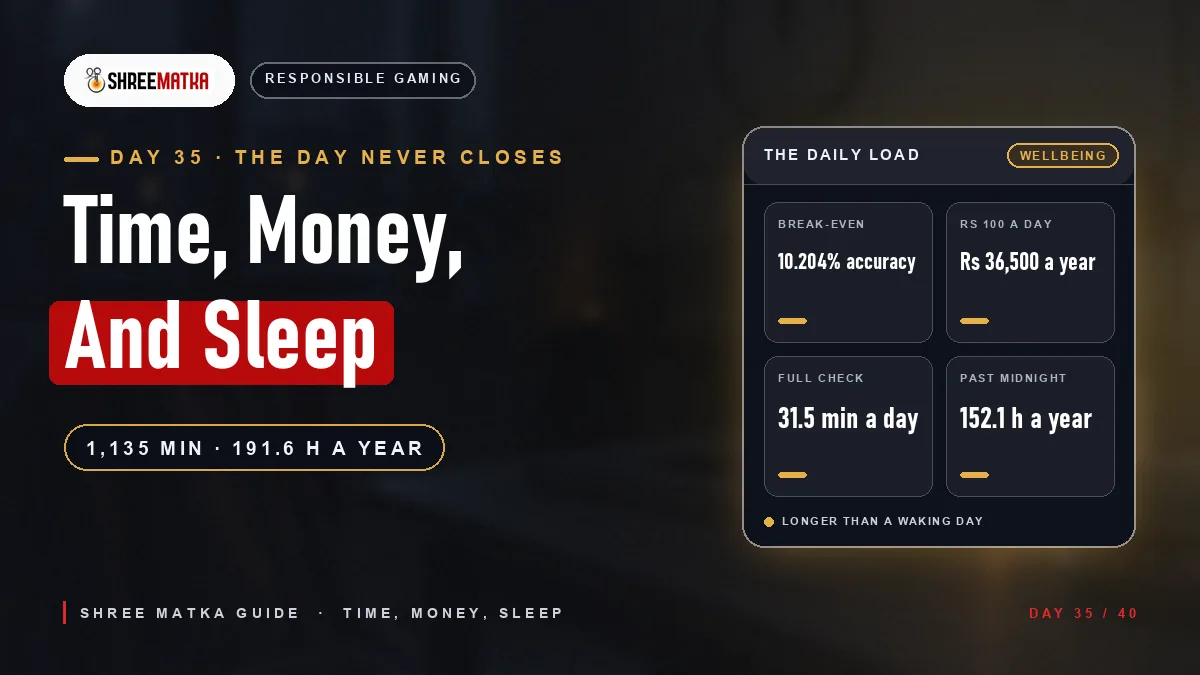
The schedule is the one part of this subject that is entirely visible. It opens at 05:00 and closes at 23:55, an eighteen-hour and fifty-five-minute window, which is 1,135 minutes. Across that window the platform declares sixty-three results a day: fifty from the twenty-five main markets that publish at open and close, and thirteen from the starline generator. That is about 22,995 declarations a year, and across 1,135 minutes the average spacing between them is 18.3 minutes. A result is always about twenty minutes away, which is precisely what makes the schedule hard to step out of. The terminology guide names the market types; what matters here is only the clock.
Compare that window with a waking day. Sixteen waking hours is 960 minutes, so the schedule runs 175 minutes longer than the day most readers are awake for. In practice that means the market is already open before a morning routine and still open at the hour a person would normally be winding down, and there is no natural gap in which the subject is simply closed.
The cost of following it can be counted in minutes. Sixty-three checks at thirty seconds each is 31.5 minutes a day, or 191.6 hours a year. A reader who follows only the thirteen starline slots spends 6.5 minutes a day, which is 39.5 hours a year. And the last close at 23:55 leaves five minutes to midnight; add a stated thirty-minute wind-down and the bedtime is 00:25, twenty-five minutes past midnight, which over a year is 152.1 hours spent after the day has formally ended. None of those figures is a clinical finding. They are the schedule read out loud, and they are the reason the time audit belongs next to this article.
05:00 to 23:5518 h 55 min = 1,13550 main + 13 starline = 631,135 / 62 = 18.3 min63 × 0.5 = 31.5 min30 min after 23:55 = 00:2525 × 365 = 152.1 h| Quantity | Figure | How it is derived |
|---|---|---|
| Open-to-close window | 1,135 minutes | 05:00 to 23:55 is 18 h 55 min |
| Declarations a day | 63 | 25 main × 2 + 13 starline |
| Declarations a year | 22,995 | 63 × 365 |
| Average spacing | 18.3 minutes | 1,135 / 62 intervals |
| Checking every result | 31.5 min a day | 63 checks at 30 seconds |
| Annual checking cost | 191.6 hours | 31.5 × 365 / 60 |
| Starline slots only | 39.5 hours a year | 13 checks at 30 seconds |
| Time past midnight | 152.1 hours a year | 25 minutes × 365 |
The Money Arithmetic That Feeds Stress
The second source of pressure is the price, and it is a fixed number. A single digit pays 9.8 against ten outcomes, so the break-even accuracy is 1 / 9.8, or 10.204 percent, and the hold is 2.00 percent at a fair ten percent. The pana tiers sit at about 4.00 percent, and the bet-type comparison shows why the price has the same shape at every tier. A reader staking Rs 100 a day turns over Rs 36,500 a year, and the expected loss on that turnover is Rs 730 a year, or Rs 60.83 a month. The outcome of any single evening is unknown; the direction of a year is not.
A session has the same shape at a smaller scale. Ten stakes of Rs 100 is Rs 1,000 of turnover and Rs 20 of expected loss; twenty stakes is Rs 2,000 and Rs 40. Doubling after a loss is the pattern that turns a small expected loss into a large realised one. Stake Rs 100, then Rs 200, Rs 400, Rs 800, Rs 1,600, Rs 3,200 and Rs 6,400, and the sum at risk after seven stakes is Rs 12,700. The arithmetic that makes the pattern feel safe is also the arithmetic that defeats it: with a 9.8 payout on a ten-outcome bet the chance of losing seven in a row is 0.9 to the seventh, or 47.83 percent, so a run of seven losses is close to a coin flip in any seven attempts. Fourteen losses in a row is 22.88 percent and thirty is 4.24 percent, which is small per attempt and close to certain across a year of daily play. The stake has to grow faster than the probability falls, and it cannot.
100 + 200 + 400 + 800 + 1,600 + 3,200 + 6,400Rs 12,7000.9^7 = 47.83%0.9^14 = 22.88%0.9^30 = 4.24%a bankroll that outgrows the oddsconverts a 2.00% hold into a large realised loss| Pattern | Turnover | Expected loss at 2.00% |
|---|---|---|
| 10 stakes of Rs 100 | Rs 1,000 | Rs 20 |
| 20 stakes of Rs 100 | Rs 2,000 | Rs 40 |
| Rs 100 a day for a year | Rs 36,500 | Rs 730 |
| Doubling to Rs 6,400 | Rs 12,700 at risk | not a recovery, a larger exposure |
| Seven losses in a row | 47.83% likely | a near certainty over a year |
Psychological Risks That Are Ordinary, Not Exotic
The mechanisms worth naming are ordinary, and each of them attaches to a number rather than to a personality. Loss-chasing is the decision to raise a stake after a loss; sunk cost is the belief that money already lost changes the next draw; near-miss is the feeling produced by a result that was almost right; fast cadence is the effect of a result every 18.3 minutes; sleep loss is what a 23:55 close does to a bedtime; and secrecy is what happens when a person stops telling anyone the stakes. None of these is a diagnosis. Each is a behaviour that can be observed, and each has a cost that can be counted in minutes or rupees.
The cadence deserves its own sentence, because it is the part of this schedule that is easy to underestimate. Sixty-three declarations a day is faster than most people check their messages, and a result that arrives every eighteen minutes does not give a person an evening to decide anything; it gives them dozens of small decisions in a row, each one made in the fatigue of the previous one. The psychology of emotional discipline covers the decision-making side of that, and the probability guide covers why a near miss is not evidence of anything. The historical data audit shows what an archive of past results can and cannot support, and an AI prediction claim does not change that answer.
The financial mechanism that binds these together is the hold. Money already staked is gone, and the 2.00 percent does not care whether the next stake is a small one made calmly or a large one made to recover the last. The risk-management guide treats the stake as the number that matters, and the responsible limits guide turns that into a written rule. This article adds only the time dimension: the same discipline that limits the stake also has to limit the evening.
| Mechanism | Observable behaviour | What it costs | What helps |
|---|---|---|---|
| Loss-chasing | Raising a stake right after a loss | The doubling table above | A limit written before the session |
| Sunk cost | Believing the next draw owes you | Stakes staked to recover stakes | Closing the app after a loss |
| Near-miss | Feeling close after a non-result | Repeated stakes on the same hunch | Reading the payout table |
| Fast cadence | Checking every one of 63 results | 31.5 min a day, 191.6 h a year | Two checks, at fixed hours |
| Sleep loss | Watching the 23:55 close | Time past midnight every night | A stop hour before the close |
| Secrecy | No one knows the stakes | No outside check on any limit | One person told the numbers |
Stress Management That Does Not Need a Clinic
The techniques that work on the time and money side are boring, written and early. A stake limit is worth more before the session than during it, because during it the last result is doing the negotiating. A session length is worth more written as a clock time than as a number of bets, because a clock does not care how the session is going. A stop hour before the close is worth more than a decision at the close, because at 23:55 the only thing left to decide is whether to watch, and the answer after a loss is always yes.
Time-boxing is the practical version of that. Thirty minutes at an 18.3-minute spacing covers about two results, so a thirty-minute box is small enough to keep and large enough to be honest. Ten stakes of Rs 100 is Rs 1,000 and Rs 20 of expected loss, which is a session a reader can name in advance. The rules that hold up are the ones with a delay built in: a cooling-off period of a day before any limit is raised, a no-borrowing rule that has no exceptions, and a device rule that keeps the phone out of the bedroom so the last close of the night cannot be watched from bed.
The working-professional guide covers the shift-work version of the same problem, and the community etiquette guide is where a reader finds people who keep the same rules. The play guide covers the mechanics for anyone who has not played yet, and reading it is a better use of an evening than watching a close. What none of these can do is make a 2.00 percent hold comfortable. The purpose of the rules is to keep the time and the money small enough that the mood of an evening is not carried by the result of a draw, because the draw is not going to cooperate with a plan.
written, in rupees, before the sessiona stop time that is not the 23:55 closeten stakes, Rs 20 of expected lossmoney that is not borrowedsomeone knows the limit existsthe session does not startSupport Systems: Who to Tell and What to Say
The support system that works is small and specific. One person, told the numbers rather than the feelings: the weekly stake limit, the stop hour, the last three months of turnover, and the number of nights the close was watched. Numbers are easier to say out loud than shame is, and they give the other person something to hold. A supporter who is told “it is fine” cannot help; a supporter who is told “Rs 100 a day and I stopped at 23:40 twice last week” can. The guide to the same price for every player documents the shared-phone problem, which is why the conversation has to be with someone who is not using the same device.
The second support that matters is the one with the bank statement. A weekly review of what actually left the account is a better instrument than a memory of what was intended, because the hold is invisible in a single evening and obvious across a month. The taxation guide is written for readers who need the paper trail for a filer, and the same statements serve the audit here. The scam guide is worth reading with a supporter, because a person under pressure is exactly who a recovery fraud targets, and the tipster audit applies the same test to anyone selling advice about the next result.
| Role | What they can do | What they cannot do |
|---|---|---|
| A friend | Ask for the numbers weekly and keep them | Make a limit hold on its own |
| A partner | Hold the card, agree the stop hour | Undo a loss already staked |
| A colleague | Notice the late nights and say so | Diagnose why the nights are late |
| A bank statement | Show the turnover and the hold | Show how the money felt |
| A clinician | Assess what is happening and what to do | Remove the 2.00% hold |
| A support group | Offer the experience of people who stopped | Guarantee the same route works |
Professional Help: What to Ask, and What Is Not Printed Here
This is the chapter where a website is most tempted to overreach, so it stops at the boundary. It names no diagnosis, recommends no treatment and prints no phone number. The reason for the last of those is practical: services are organised by state and by country, they change, and a number copied into a blog post can sit there for years after it has stopped working. The reader who needs help should look for a physician, a public health service or a licensed counsellor where they live, and should treat any page that promises a quick fix, including this one, with the same suspicion the scam guide recommends.
What a reader can do is arrive prepared. Twelve months of statements show the turnover and the expected loss without requiring a confession. A time log shows how many evenings were spent watching a close and how many ended after midnight. A short written list of the rules that were broken is more useful to a professional than a general account of feeling bad, because it turns a mood into a pattern. And if the distress is urgent — money taken from someone else, a debt that cannot be named, or a feeling that the reader is not safe — the right next step is local emergency care, not another article.
One limit should be stated plainly: professional help is not a way to keep playing on better terms. A clinician can help a person understand a pattern and change it; no clinician can change the 2.00 percent hold. The legality guide covers the legal position and the international regulation comparison covers why a licence does not move the price. The clinical question and the arithmetic question are separate, and neither one answers the other.
turnover and the hold, visibleevenings, closes watched, nights past midnightwhat was set and what was brokenwhat is owed and to whomone person who already knowslocal emergency care, if distress is acuteHealthy Habits and a Weekly Audit
Five habits carry everything above. A written limit, in rupees, replaced only after a day of cooling off. A stop hour that is not the 23:55 close. A device that is out of the bedroom before the last result. A weekly review of four numbers. And one person who knows all four. None of them requires a subscription, and all of them are checkable by a stranger, which is the only kind of habit that survives a good week.
The four numbers are turnover, expected loss, hours spent checking, and nights that ended after midnight. On Rs 100 a day the expected loss is Rs 730 a year, so the weekly figure is about Rs 14; sixty-three checks at thirty seconds is 31.5 minutes a day, so the weekly figure is about 3.7 hours; and a 23:55 close with a thirty-minute wind-down ends at 00:25, so every night it happens is one night on the audit. A review that computes those four numbers is a review of the schedule, not of the reader’s character, and that is why it can be repeated without turning into a verdict. The printed pana records are the archive this platform keeps, and that is the kind of evidence the audit is asking for: dated, kept and checkable.
This article names no person, cites no study and prints no phone number, and it gives no medical advice. Shree Matka is an informational and analytics portal: it publishes no guaranteed numbers, sells no predictions, never solicits fees, represents no operator and hosts no draw. Nothing in this article is medical, legal, financial or tax advice. If the numbers above describe a pattern a reader recognises, the useful next step is a qualified professional where they live, not another evening of watching the close. Content intended for readers aged 18 and over.
Frequently Asked Questions
Can playing Satta Matka affect mental health?
How much time does the Satta Matka schedule actually take?
Is it normal to feel stressed after a loss?
How do I set a limit I will actually keep?
Where can I find professional help?
Should I tell someone, and what should I tell them?
Does taking a break from playing work?
Does this site sell predictions or give medical advice?
Download the Official Shree Matka App
Experience real-time live results, complete historic panel records, and 24x7 verified automated withdrawals on your Android smartphone.
Download App
Comments (0)
Loading comments...