
What the Calendar Asks, and What a Model Can See
The calendar item for this guide is technology, and the version of that title which promises a machine that forecasts the next draw is the version this article will not write. It supplies no prediction method, ranks no prediction tool and offers no prompt for extracting numbers from a model. What the title can honestly support is an audit of two different claims that are usually sold together: that software has improved the way published results are collected, checked and explained, and that software can forecast which number comes next. The first is demonstrably true and useful. The second is the one this platform’s own arithmetic can test. Every figure below is either read out of this repository or derived from the published payout table, and the declaration means the same thing here as it does in the glossary.
The distinction matters because the vocabulary hides it. A model that reads a thousand scanned pana sheets is doing data recovery; a model that claims to know tomorrow’s digit is doing something else, and the word prediction is used for both. Everything in this chapter is therefore sorted by the data a model actually receives. Where the input is a published record, the output can be a description, a correction or a summary. Where the input is the same record and the output is a future draw, the claim needs evidence that no site in this niche has produced: an out-of-sample test, a stated sample size, and a return measured after the payout table, not before it.
| Task | Data the model receives | Honest verdict |
|---|---|---|
| Reading printed pana records | Scanned pages, OCR | Useful, and checkable against the original |
| De-duplicating stale entries | Timestamps, market ids | Useful, and it protects the archive |
| Flagging a changed result | Two snapshots of one page | Useful as a warning, not as a forecast |
| Summarising a chart week | Published rows only | Useful, provided it cites the rows |
| Forecasting the next digit | The same published rows | Unproven, and the price works against it |
| Scoring a tipster account | Screenshots, claims | Usually unverifiable, often staged |
| Choosing who sees a promotion | Signup and behaviour data | Real, common, and ethically fraught |
The standard used below is the one this series has used for every number: a claim is included only if it can be read out of this repository or derived from a published table, and any statement about outcomes is measured against the price the platform actually pays, which the play guide sets out in full. That price is the subject of chapter two, because it sets the bar a forecast would have to clear before it was worth anything at all.
The Implied Probability Line a Model Must Beat
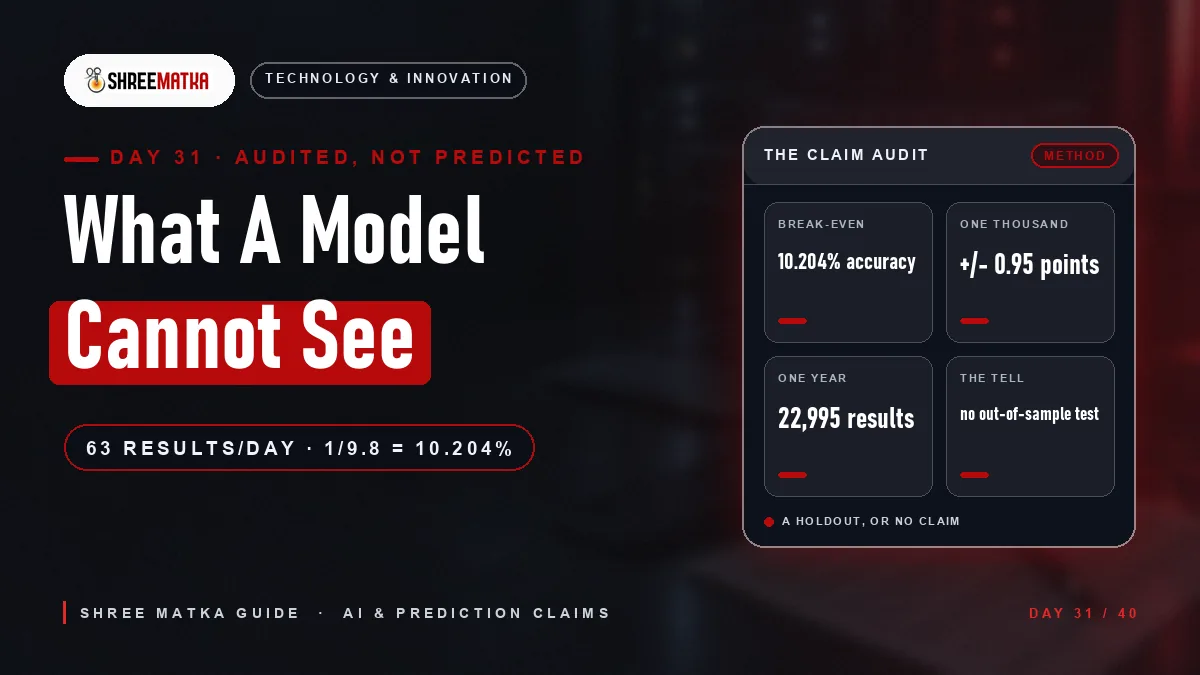
A single digit is one outcome in ten, and this platform pays 9.8 times the stake when it lands, stake included. The number 9.8 is therefore not a score for a model; it is a price. Divide one by it and the implied probability appears: 1 / 9.8 = 0.10204, or 10.204 percent. A player who wins exactly one time in ten receives 9.8 units for every ten staked, which is a return of 0.98 and a hold of 2.00 percent. That 2.00 percent is the distance between a fair game and this one, and it is also the distance a forecast has to cover before it starts to matter.
109.8x1 / 9.810.204%10.000%0.204 pointsPut a stake against that line and the arithmetic becomes concrete. A ten-rupee single digit pays ninety-eight rupees when it wins, so the expected value of the bet is 98p - 10 for a win probability p. At p equal to 10 percent the expectation is minus twenty paise, which is the two-percent hold on a ten-rupee stake. At p equal to 10.204 percent it is exactly zero. Only above that line does the sign change, and this is the line every prediction claim is really talking about even when the seller quotes a hit rate instead.
| Claimed accuracy | Expected value per Rs 10 | Expected value per Rs 100 staked | Reading |
|---|---|---|---|
| 10.000% | -0.20 | -2.00 | The fair-game baseline loses the hold |
| 10.204% | 0.00 | 0.00 | Break-even, before any cost of using the tool |
| 11.000% | +0.78 | +7.80 | A real edge, if the claim survives chapter four |
| 12.000% | +1.76 | +17.60 | Large enough to attract attention, and scrutiny |
| 15.000% | +4.70 | +47.00 | Not credible on a public draw |
The pana tiers repeat the structure at a higher bar. An all-different pana is one of about 166.7 ordered outcomes and pays 160 times the stake, which implies a break-even probability of about 0.625 percent against a true 0.6 percent, a hold near 4.00 percent. A model would need to clear 0.625 percent on that tier rather than 0.6, and it would need to do so after the cost of the tool, the time spent, and any subscription the seller charges. None of that changes the draw; it changes the accuracy required to make the claim interesting, which is the honest way to price a prediction. The bets guide sets out which tier pays what.
How a Matka Prediction Model Is Actually Built
A matka model is a small supervised-learning exercise wearing a large costume. The rows are published results, the features are derived from earlier rows - last digit, open and close sums, repetition distances, day of week, market identity - and the label is the digit that came next. Split the rows into a training window and a later test window, fit something simple, and score the held-out window. That is the whole method. The prediction-system guide walks through the same steps without promising an edge, and the historical-data guide shows where the rows come from.
The choices made before fitting decide the answer more than the algorithm does. Which window is training and which is test, whether overlapping draws are pooled, whether the rule was written before or after the test was seen, whether a stake is flat or doubled after a loss, and whether the score is hits or money after the payout. A backtest that tunes on the test window is not a forecast; it is a memory of that window, and its accuracy will not survive the next month. The published claims in this niche almost never state these choices, which is the first reason to discount them.
2025-11-05 to 2026-04-302026-05-01 to 2026-10-31Yes, with the threshold statedn, hits, accuracy, net after 9.8xTuning on the test window| Layer | What it does | What can go wrong | Checkable? |
|---|---|---|---|
| Collection | Reads published rows and timestamps | Scraper drift, duplicate rows | Yes, against the page |
| Features | Builds lags, sums and counts | Leakage from the label window | Yes, by inspecting one row |
| Validation | Splits train and test by date | Random split on time series | Yes, if the split is stated |
| Deployment | Scores a new row each declaration | Silent failure, stale model | Yes, by watching a week |
| Honest verdict | Compares net return to the hold | Reporting hits but not money | Yes, if both are shown |
What is left when the costume is removed is a descriptive tool. It can tell a reader that a market repeated a digit more often last week, which is true and already visible on the chart page. It can count how often an open digit matched the previous close, which is a fact about the archive rather than a property of the next draw. Those are legitimate products, and the data-tools guide covers the spreadsheet version of the same work. None of them changes the probability on the next declaration, and a guide that pretended otherwise would be selling the costume.
Why a Thousand Backtests Prove Nothing
Suppose a model reports a hit rate of eleven percent on a thousand held-out single-digit decisions. That sounds like an edge above the ten-percent baseline, and it is not distinguishable from luck. For a fair coin with p equal to 0.1, the standard deviation of the hit rate over n trials is the square root of p times one minus p divided by n. At n equal to 1,000 that is the square root of 0.1 times 0.9 divided by 1,000, which is 0.0095, or 0.95 percentage points. The ninety-five percent band around ten percent is therefore roughly 8.14 to 11.86, and eleven percent sits comfortably inside it.
| Held-out decisions | One standard deviation | 95% band around 10% | What an 11% score means |
|---|---|---|---|
| 100 | 3.00 points | 4.12 to 15.88 | Noise |
| 1,000 | 0.95 points | 8.14 to 11.86 | Ordinary |
| 10,000 | 0.30 points | 9.41 to 10.59 | Above the band, so worth a look |
| 100,000 | 0.09 points | 9.81 to 10.19 | A claim that needs a real mechanism |
| 22,995 (one year) | 0.20 points | 9.61 to 10.39 | The platform’s annual volume |
0.95 points8.14 to 11.860.30 points9.41 to 10.59Nothing at allThere is a second trap that is larger than the first. A seller who tests twenty rules at the five-percent level expects one of them to look significant by chance alone, and a seller who tests forty expects two. The one that survives is the one that gets posted, with no mention of the nineteen that failed. This is why a screenshot is not evidence: it is the selected survivor of a search nobody described. A real claim names the number of rules tried, the size of the holdout and the return after the payout, and it is willing for a stranger to rerun it.
Data volume does not rescue the argument. This platform declares sixty-three results a day, which is about 22,995 a year, so a patient researcher has a genuinely large archive. More rows narrow the band and make the estimate of ten percent more precise; they cannot manufacture a deviation that is not there. If the process has no signal, a larger sample produces a sharper picture of no signal, which is a useful result and a poor product to sell. The probability guide works the same arithmetic without the packaging.
The Data Work That Does Pay Off
None of the above means software is useless here. It means the useful work is at the collection layer rather than the forecast layer. Converting printed pana sheets into readable records is a real task, and the printed-records guide shows why the layout matters: a column that loses its heading changes the meaning of every number under it. Optical recognition plus a human check can recover that structure faster than retyping, and the result is verifiable against the scan.
The same is true of monitoring. This platform fetches results on a fixed sixty-second cycle, so every page carries a timestamp that can be compared with the declaration schedule. Software can watch that comparison and raise a flag when a market that closes at 05:00 still shows yesterday at seven, or when the 23:55 close has not appeared by ten past midnight, or when a corrected entry replaces an earlier one without a note. That is not prediction; it is bookkeeping at a speed no person can match, and it protects a reader from reading a stale row without knowing it.
The last honest use is explanation. A model can turn a week of rows into a sentence and a chart, translate a guide, or read a page aloud for someone who cannot see it. Each of those helps a reader understand what is already published. None of them moves the probability of the next declaration, and the difference between a summary and a forecast is exactly the difference this article has been drawing. The chart-pattern guide is the place to see how far a description can go before it starts pretending to be a system.
Algorithmic Trading: The Analogy and Where It Breaks
The trading analogy is the most persuasive thing a prediction seller has, and it is worth taking seriously enough to dismantle. Both activities build features, backtest rules and talk about drawdown, so the vocabulary transfers. What does not transfer is the source of return. A trader earns by finding a price that is wrong relative to information, and the counterparty on the other side of the trade supplies the difference. A fixed-odds number bet has no counterparty price to be wrong: the payout is a published table, and the only quantity that can be right or wrong is the player’s probability estimate.
| Question | Traded market | Fixed-odds number | Consequence |
|---|---|---|---|
| How is the price set? | By bids and offers | By a published payout table | No mispricing to find |
| Who is on the other side? | Another participant | The operator, by rule | No counterparty to outwit |
| Where does an edge come from? | Information and flow | Accuracy above the implied line | A higher and narrower bar |
| What changes the edge? | Liquidity, news, crowding | A configuration change by the operator | No gradual decay to model |
| Can the position be hedged? | Often yes | No | The stake is one-way |
| Honest verdict | A hard, competitive field | A negative-expectation product | The analogy sells courses |
There is also a mechanical difference that matters to anyone who has actually traded. A market position can be sized, hedged and exited, and its cost is visible in the spread. A number bet is a single one-way stake at a fixed price, settled by a draw, with no exit. The discipline a trader develops around risk can still be useful - the risk-management guide covers the part that transfers - but the research method does not, because there is no market to research. Borrowing the vocabulary is precisely how a course about a fixed-odds product comes to sound like a course about finance.
The Ethics of AI Tipsters and Synthetic Proof
The technology has made one part of this niche worse, and it is the part that manufactures confidence. A screenshot of a winning slip can now be generated in seconds, a testimonial can be voiced by a synthetic speaker, and a forum can be filled by accounts that never sleep. The etiquette guide describes why a thread with no verified identity is a weak place to look for evidence; an AI tipster makes that weakness industrial. The tell is not the production quality. It is the absence of a holdout, a sample size and a person who will answer for the claim.
The quieter harm is on the collection side. A signup form that gathers phone numbers and behaviour can train a model to choose who sees which promotion, and that model can learn to target the people whose play is already escalating. Nothing in the technology prevents this; only a policy does. The scams guide and the psychology guide both describe the sequences that such a model would be optimizing, which is why the ethics of personalization belongs in a technology article rather than only in a policy document.
This platform’s own position is deliberately narrow. It publishes no guaranteed numbers, sells no predictions, never solicits fees and hosts no draw. It will not rank AI tools, quote a hit rate as if a hit rate were money, or supply a prompt for extracting numbers from a language model. Readers who want help with their own play are pointed to the limits guide and to local support services, and nothing in this article is legal, financial or tax advice.
What Regulation and a Skeptical Reader Can Do
Regulation is moving, and it is worth being precise about what it can reach. The central online gaming legislation of 2025 and the rules that took effect on 1 May 2026 changed the position for online money games in India, and the legality guide owns the state-by-state detail. What no statute has done is create a licence for a scheduled number draw, so an AI claim attached to one is a claim about a product that no regulator supervises. That is the fact a reader should carry into any pitch, and it is not legal advice.
For the reader, the useful defence is a short audit rather than a longer argument. Five questions, asked in order, dispose of almost every AI prediction claim in circulation, and none of them requires technical knowledge. The answers are usually silence, a screenshot, or a change of subject, and a seller who cannot answer them is selling a costume rather than a method.
Was the test window untouched?Ask for n, not for a percentageHow many rules were discarded?Hits are not moneyA name, a date, a route to complainThat is the honest shape of the technology answer. Software has made the archive easier to read and the pitch harder to check, and it has changed nothing about the price of a repetition. A reader who understands the implied-probability line, the noise in a thousand decisions and the difference between a description and a forecast is immune to most of what the niche sells. The time audit measures what following results costs in hours, the comparison guide measures what the product costs in money, and this article measures what a prediction claim would have to prove. Three ledgers, one conclusion: the tools can be honest, and the numbers are still priced against the player.
Shree Matka is an informational and analytics portal: it publishes no guaranteed numbers, sells no predictions, never solicits fees, does not represent any operator and hosts no draw. Nothing in this article is legal, financial or tax advice, it recommends no form of gambling, and it is intended for readers aged 18 and over.
Frequently Asked Questions
Can AI predict Satta Matka numbers?
What would an honest prediction claim have to show?
Is machine learning used in gambling at all?
What is the difference between an AI tool and an AI tipster?
Are AI prediction apps legal in India?
Does a bigger archive make a model work?
Can AI detect a rigged or corrected result?
Will this site sell an AI prediction tool?
Download the Official Shree Matka App
Experience real-time live results, complete historic panel records, and 24x7 verified automated withdrawals on your Android smartphone.
Download App
Comments (0)
Loading comments...