
What the Calendar Asks, and What This Article Will Not Forecast
The calendar item for this guide asks for the future of Satta Matka and lists six subheads: technological advancements, regulatory evolution, player numbers, market consolidation, new game formats, and predictions for 2027 and beyond. Five of those can be answered with evidence the repository already holds - a migration that seeds the schedule, a config table that prices it, and a settlement service that decides what a bet was. The sixth, predictions, is where the genre usually stops being an article and becomes an advertisement for somebody's numbers; this version does the opposite.
Four refusals shape the piece. It gives no forecast of any result: not a draw, not a market, not a reader's evening. It cites no study and states no demographic figure, because the codebase contains a schedule, a payout table and a result poller, and none of those can say who a player is. It gives no legal advice, names no jurisdiction as safe and ranks no regulator, because the previous guide in this series already explained why a league table of countries would be either stale or an advertisement. And it gives no investment advice and names no operator as a leader, because a business a reader cannot inspect is not a business this site should promote.
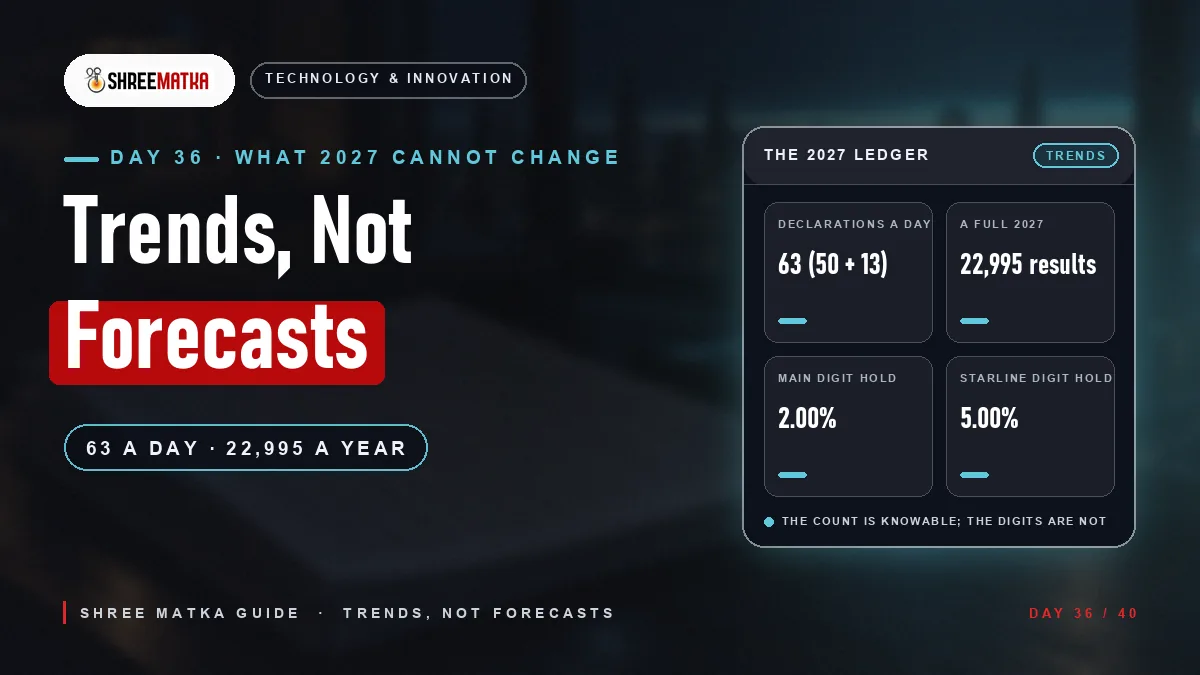
What remains is more than filler. The repository already contains the machinery a 2027 platform is usually described as about to invent: a schema that can accept an outside result and publish it automatically, a timestamp for the last time an account was seen, and a settlement path that runs off the request thread. It can also count a calendar exactly - the 52 days left in 2026 and the 22,995 declarations a full 2027 could hold - and compare two price lists that exist in the same database today. That is the article: what can be checked, what can be computed, and what will not be promised. The terminology guide fixes the vocabulary, and the analysis of AI prediction claims is the long version of the first refusal.
| Subhead | What this article can support | What it will not claim |
|---|---|---|
| Technological advances | Schema and service behaviour that is already in the code | That any technology will call a draw |
| Regulatory evolution | How a rule changes who may sell, not what a row pays | That any jurisdiction will be safe or open |
| Player numbers | That the schema stores no age, gender or address field | That any group behaves differently |
| Market consolidation | What a merger can and cannot move in a config table | That consolidation will or will not happen |
| New game formats | The two-number test that prices any format honestly | That a new format will be fairer |
| Predictions for 2027 | Conditional statements with a dated falsifier | Any digit, draw or outcome |
Technology That Is Already in the Code
The technology story that sells is artificial intelligence. The technology story that can be checked is ingestion and publication. V91 adds three columns to the markets table - external_market_id, is_api_market and auto_result_enabled - and a master switch in client config called market.auto_api_result.master_enabled that ships with the value false. Read plainly, that means the schema can store a result that arrived from outside the platform and can publish it without a human clicking, and the switch that would permit it is off by default. That is a configuration decision, not a prophecy, and a reader can ask any site which way its switch is set.
Three smaller changes point the same direction. V95 adds last_seen_at to the users table, which turns a login history into something a support desk can read. V96 creates blog interactions, which gives the editorial side a record of what was read and when. And AsyncPayoutService settles bets away from the request thread, which is an engineering choice about queues rather than a claim about odds. What all four change is latency and traceability. The printed pana records are the older version of the same idea; what none of them changes is the space a draw is settled in, because a declaration is still three digits and 1,000 ordered triples however quickly the page updates.
Latency is worth a number. A market that declares at 23:55 and publishes at 23:56 has a one-minute wait; a manual process that finishes at 00:10 makes it fifteen. The difference is fourteen minutes a night, which is 5,110 minutes a year, or 85.2 hours - real convenience for a reader and real cost removed for an operator. In the outcome space it is exactly nothing: the digits are the same whether the chart updated in sixty seconds or fifteen minutes, and a faster page does not make a losing stake win.
23:5523:56 (1 minute later)00:10 (15 minutes later)14 minutes a night14 x 365 = 5,110 minutes = 85.2 hthe wait between declaration and chartthe 1,000 ordered triples| Mechanism in the code | What it changes | What it does not change |
|---|---|---|
| V91 API market columns | Where a result can come from | What a result can be |
| Auto-result master switch | Whether a human must publish | What gets published |
| V95 last_seen_at | Who can audit an account | What the account is worth |
| V96 blog interactions | Which article was read when | The price of any bet |
| Async settlement | When a payout is processed | The hold the payout follows |
Regulation Evolving Without a Forecast
Regulatory evolution is the subhead where a prediction is least defensible, because regulation is a decision made by people this codebase cannot see. The stable part is structural, and it was already set out: a licence is issued to an operator, under the law of the jurisdiction that issues it, for a defined scope of products, and it says nothing about what a player may do where they are sitting. The comparison of regulatory models covers prohibition, state monopoly, licensed private markets and liberalised markets, and the state-by-state legality guide covers the position this series is actually written in. This article gives no legal advice and names no jurisdiction as safe.
Two mechanisms can move a price list, and both are visible only after the fact. A rule can remove a product, which shrinks the menu without changing the arithmetic of the rows that remain. Or an operator can reprice to absorb a compliance cost, which raises the hold on a row that used to be cheaper. A reader can see either one in a published rate table on the day it happens. Neither can be predicted from a codebase that contains no statute, and this article predicts neither. What it can say is that a rule changes who may sell and who can complain; it does not change a configured rate unless somebody edits the row.
The reader's check is small and repeatable. Find the rate row the site publishes, find the same family in the terms, and compare the two. If the site publishes no rate at all, that absence is the finding. A licence badge, a screenshot and a PDF are claims about an operator; the register is the check, and a complaint route with stages and a timeline is the second half of it. None of that requires a forecast about 2027: regulation can be audited when it lands, even though it cannot be called in advance.
Player Numbers the Schema Cannot See
The demographic subhead is the one most likely to be invented, and the schema is the reason to say so. The users table in the initial migration holds an id, a full name, a mobile number, a password, a wallet balance and a payout-method flag. Later migrations add active, is_admin, the two bonus flags and last_seen_at. Across the whole migration set there is no gender column, no birth-date column and no address column. A platform built on this schema therefore cannot know the age, gender or location of a player, and an article that claims otherwise is describing its own assumptions.
What the code can see is timing. A session has a start, an end and a last-seen stamp, so the honest version of a 2027 demographic story is a story about when people play rather than who they are. That is still useful: it is the observation that makes the 05:00 to 23:55 window a schedule problem, and the reason the time-management guide is written for people with shifts and deadlines. It is not a demographic claim, and this article states no demographic figure and makes no claim about any age group.
A reader can substitute three things the code genuinely offers. Their own timing, which a time log records in a week. Their own turnover, which the historical data audit teaches a person to read from records rather than memory. And the fact that the price is identical for every account, which is the whole argument of the one-price guide: the payout table has no field for who is betting. Those three are checkable. A claim that tomorrow's players will be different is not, at least not from anything in this repository.
Two Price Lists, and What Consolidation Can Change
The repository carries two price lists today, which is more interesting than most forecasts. The main markets are priced by client-config rows set in V88: a single digit at 9.8, a jodi at 98, single panna at 160, double panna at 320, triple panna at 1000, half sangam at 1000 and full sangam at 10000. The starline product is priced by its own table in V45: 9.50 for a digit, 140 for a single panna, 280 for a double and 700 for a triple. The names are the same. The rates are not. A reader who assumes one price list covers a brand has assumed something the schema does not say.
Once the space is fixed at 1,000 ordered triples, each rate becomes an expected value in one multiplication. On the main list: 9.8 gives 0.98 on a digit, 98 gives 0.98 on a jodi, 160 gives 0.16 on a single panna, 320 gives 0.32 on a double, 1000 gives 1.00 on a triple, 1000 gives 0.10 on a half sangam and 10000 gives 0.01 on a full sangam. On the starline list: 9.50 gives 0.95, 140 gives 0.14, 280 gives 0.28 and 700 gives 0.70. The holds are therefore 2.00 and 2.00 percent on the digit and jodi, 84.00, 68.00, 0.00, 90.00 and 99.00 percent on the main pana and sangam families, and 5.00, 86.00, 72.00 and 30.00 percent on the starline families. The probability guide derives the space; the bet-type comparison shows what each family asks of a player.
Consolidation enters exactly here. The price lives in a row keyed to a client, so a merged operator can run several lists side by side and still be one company. Two operators with identical lists produce identical arithmetic for a reader: Rs 100 a day is Rs 36,500 a year, and at 2.00 percent the expected loss is Rs 730. If the merged entity moved only the digit row from 9.8 to 9.50, the hold would become 5.00 percent and the annual expected loss Rs 1,825 - Rs 1,095 more, with no draw changed and no new product launched. That is the whole effect a merger can have on a price, and it is an edit, not an event.
What a merger can change is real: the terms, the complaint route, the app, the support queue, and the credibility of a brand that scammers will immediately imitate, which is the subject of the scam guide. What it cannot change is the arithmetic of the row a reader is already on. The comparison with other gambling forms makes the same point from the other side: a house edge is a property of a price list, not of the company collecting it.
| Family | Main rate (V88) | Main hold | Starline rate (V45) | Starline hold |
|---|---|---|---|---|
| Single digit | 9.8 | 2.00% | 9.50 | 5.00% |
| Jodi | 98 | 2.00% | not offered | not offered |
| Single panna | 160 | 84.00% | 140 | 86.00% |
| Double panna | 320 | 68.00% | 280 | 72.00% |
| Triple panna | 1000 | 0.00% | 700 | 30.00% |
| Half sangam | 1000 | 90.00% | not offered | not offered |
| Full sangam | 10000 | 99.00% | not offered | not offered |
9.8 x 0.10 = 0.989.50 x 0.10 = 0.951 - 0.98 = 2.00%1 - 0.95 = 5.00%Rs 730 of expected lossRs 1,825 of expected lossRs 1,095 a yearNew Formats and the Honesty Test
A new format is two numbers, not a mood. The first is the size of the space the bet is settled in; the second is the rate the operator pays. Everything else - the name, the animation, the leaderboard - is presentation. Once those two numbers are known, the expected value is the rate multiplied by the probability, and the hold is one minus that product. That is the entire test, and a reader can apply it to a format that has not been launched yet.
Take a format this platform does not offer: a bet on the exact sum of the three declared digits. The space is still 1,000 ordered triples, but the outcomes are the 28 possible sums from 0 to 27, and they are nowhere near equally likely. Exactly one triple sums to 0, and one sums to 27; 55 sum to 9; 75 sum to 13, and 75 also sum to 14. Price every sum at the same advertised 12x, and the single rate produces wildly different holds: 10.00 percent on 13, 34.00 percent on 9, and 98.80 percent on 0 or 27. A format that advertises one rate over a lumpy space is not one product; it is 28 products printed under one label. The mathematical guide shows the same fork for the pana families, where the folk 220-set frame and the 1,000-cell machine frame price the same ticket differently.
A fair design is simple: price each outcome at the reciprocal of its count. Seventy-five cells justify 1000 / 75, or 13.33x; a single cell justifies 1,000x. Then every outcome returns the same expected value and the format has one honest hold instead of 28 accidental ones. A reader does not need to demand that design; a reader only needs to ask which one is on offer. The bet-type guide covers the families that exist today, and the same three questions - what is the space, what is the rate, what is the resulting hold - work on all of them.
| Exact sum | Triples out of 1,000 | EV at a flat 12x | Hold at 12x |
|---|---|---|---|
| 0 or 27 | 1 | 0.012 | 98.80% |
| 9 or 18 | 55 | 0.66 | 34.00% |
| 11 or 16 | 69 | 0.828 | 17.20% |
| 13 or 14 | 75 | 0.90 | 10.00% |
How many outcomes can win?What does a win pay?p = winning outcomes / all outcomesEV = rate x phold = 1 - EVask for a price per outcomethe hold varies by the number you pickPredictions for 2027, Converted Into Checks
The calendar asks for predictions for 2027 and beyond. Here is what can be said instead: statements that a dated fact could prove wrong. The capacity of the schedule is one of them. The window runs 05:00 to 23:55, which is 1,135 minutes, and its 63 declarations average one every 18.3 minutes. From 10 November 2026 to 31 December inclusive is 52 days, and at 63 declarations a day that is 3,276 results before 2027 begins. A full 2027 is 365 days and 22,995 results, which is the same ceiling as any other year of this schedule. A reader who checks every one of the 3,276 remaining declarations at thirty seconds spends 27.3 hours on them before the year turns.
Four conditional statements follow, none of them requiring a crystal ball. If a 2027 site keeps 63 declarations a day, its ceiling is 22,995 results. If it adds a format, that format's hold is one minus its rate times its probability, and both numbers are countable before it launches. If a regulator acts, the price list moves only if a row moves. And if two operators merge, the row a reader is on is still the row that prices them. Each statement has a falsifier: a published schedule with a different count, a launch with a rate, a statute that changes a menu, or a price list that changes under a stable brand.
The evidence that would settle a claim about the future is boring, which is why predictions rarely contain it: a dated row change, a published rate, a schedule table or a register entry. It is not a chart pattern, and the tipster audit explains why - a claim that cannot be falsified is a sales script with a date on it. This article makes no prediction about any draw, any market's digits or any reader's outcome, because none of those is knowable from a schedule, a price list or a schema.
| Common 2027 claim | What would support it | What would falsify it |
|---|---|---|
| More results than ever | A schedule with more than 63 a day | The same 31 seeded rows |
| A faster, fairer experience | Published latency and rate tables | An unpublished rate |
| Consolidation everywhere | A dated ownership or terms change | A price list that does not move |
| AI that predicts draws | A model with out-of-sample accuracy above 10.204 percent | A held-out test that stays at chance |
| New formats that pay better | A per-outcome price with a single computed hold | One rate over an uneven space |
| Stricter regulation | A statute that changes a menu | No change to the rows or the terms |
52 (10 Nov to 31 Dec, inclusive)52 x 63 = 3,2763,276 x 30 = 98,280 s = 27.3 h365 x 63 = 22,995 declarations22,995 x 30 = 689,850 s = 191.6 hthe ceiling, not the winnersA 2027 Audit a Reader Can Run
Six checks cover everything this article can honestly recommend, and a reader can run all of them without an account. Count the declarations a day and compare them with the 63 this schedule produces. Find the published rates and check them against the families actually offered. Compute one hold by hand, using the space and the rate. Time one declaration from close to chart. Look for a complaint route with stages and a timeline. And tell one person the four numbers the responsible limits guide asks for, so that no limit depends on memory alone. The play guide covers the mechanics of each family.
The four numbers are turnover, expected loss, hours spent checking and nights that ended after midnight. On Rs 100 a day the annual turnover is Rs 36,500 and the expected loss is Rs 730, which is about Rs 14 a week; sixty-three checks at thirty seconds is 31.5 minutes a day, or about 3.7 hours a week at full attention. A review that computes those four numbers is a review of the schedule, not of the reader's character, and that is why it can be repeated without turning into a verdict. The wellbeing guide covers what to do when the numbers stop being small.
This article names no person, cites no study and states no demographic figure, and it gives no forecast of any result. Shree Matka is an informational and analytics portal: it publishes no guaranteed numbers, sells no predictions, never solicits fees, represents no operator and hosts no draw. Nothing in this article is legal, financial or investment advice, and it recommends no form of play. A trend that matters in 2027 is one a reader can check with a rate table, a schedule and a bank statement; everything else is a headline. Content intended for readers aged 18 and over.
Frequently Asked Questions
Will Satta Matka still exist in 2027?
Will AI be able to predict results by 2027?
Which technology from 2026 to 2027 actually matters?
Will new game formats be fairer to players?
Will consolidation change what I am paid?
Will regulation make it legal where I live?
What can I check myself in 2027?
Does this site sell predictions or give investment advice?
Download the Official Shree Matka App
Experience real-time live results, complete historic panel records, and 24x7 verified automated withdrawals on your Android smartphone.
Download App
Comments (0)
Loading comments...