
Main Bazar Market Overview: What The Schedule Row Actually Says
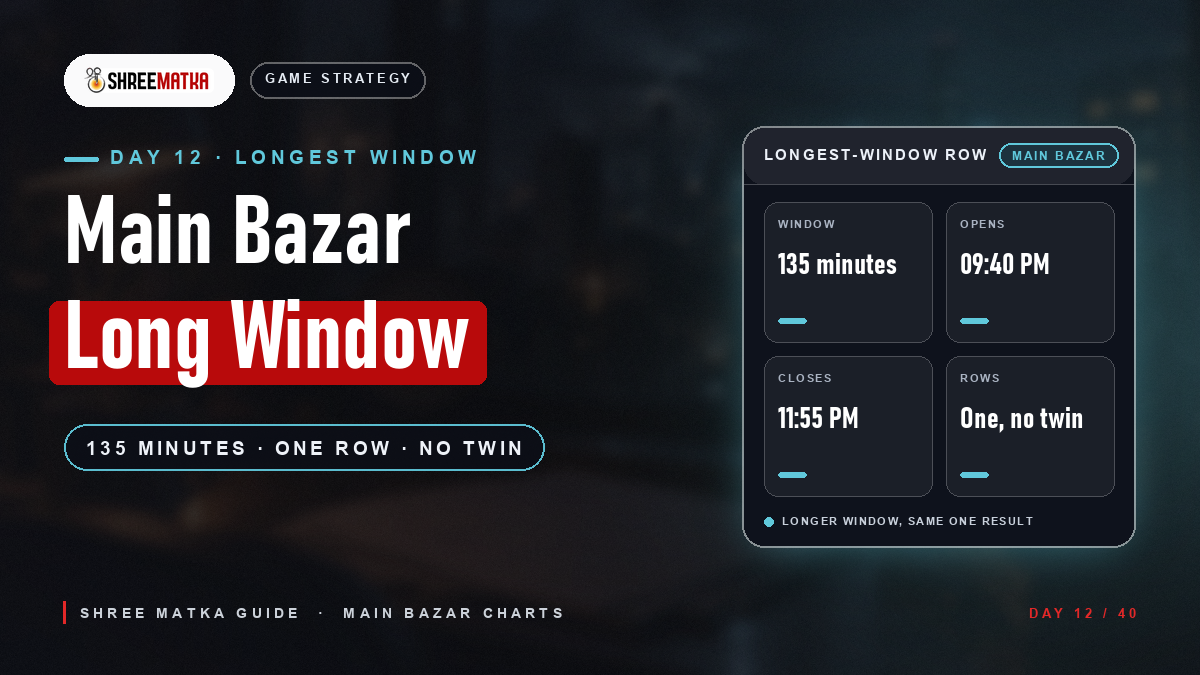
Main Bazar is the last market most readers look at on any given day, and the one almost all of them describe in terms the record does not support. So start from what is actually stored. The markets table inserts one row named Main Bazar, typed MAIN, with an open time of 21:40:00 and a close time of 23:55:00, marked active. That is the whole identity of the market: a name, a type, two clock times and a boolean. A market name is unique in the table, and a market day is keyed on market plus date, so Main Bazar produces exactly one open triple and one close triple per day and there is no second archive to average it against.
Two structural facts make this row unusual, and both are measurable rather than traditional. First, its live phase is 135 minutes, which is the only MAIN window on the schedule that exceeds 120; the median row runs 120 and the shortest, Gali, runs 55, so Main Bazar is 2.45 times the length of the briefest session on the board. Second, it closes in the final minute of the day: 23:55, the same minute as Gali, with no seeded market declaring after either of them.
| Field on the row | Stored value | What it controls |
|---|---|---|
| name | Main Bazar | The slug every chart route resolves by |
| type | MAIN | Which bet families the row accepts |
| open_time | 21:40:00 | The deadline for open-session bets |
| close_time | 23:55:00 | The deadline for close and jodi bets |
| active | true | Whether the row appears on the public pages |
| allow_pre_open_both_sessions | true | Nothing: no code path reads it |
That last line is worth stating plainly because it is the kind of detail strategy copy routinely invents. The column exists, every seeded row carries it as true, and the getter for it appears exactly once in the Java source — in its own definition. There is no branch anywhere that consults it, so it changes nothing about how pre-open betting behaves on Main Bazar or on any other market. The real gate is the session state machine, which is covered in the Milan market analysis and applied to the short-session case in the Time Bazar guide; it is not covered by a flag nobody reads.
Main, Bazar And The Words That Are Not Fields
Before any chart is opened, the name has to be dealt with, because “Main” is doing three unrelated jobs on this platform and readers keep collapsing them into one. It is a type label, it is part of two market names, and it is the display name of an entirely separate product vertical stored in different tables. Each is true and none implies the others.
| The word “Main” appears as | What it actually names | Record system |
|---|---|---|
| A market type | The label carried by 25 of 31 seeded rows | markets.type |
| Part of a name | Main Bazar, and separately Old Main Mumbai | markets.name |
| A game display name | Main Starline, an hourly-slot product | starline_games |
The consequences are practical. A reader searching for “main market results” may mean the type, in which case 25 rows are in scope and no single chart answers the question; or may mean Main Bazar, in which case the canonical address is /chart/jodi/main-bazar. And the starline case is sharper still: the six STARLINE rows inside the markets table are named Kalyan, Mumbai, Milan, Rajdhani, Supreme and Parel Starline, while the starline chart page on this site is served from a single seeded row in a different table whose display name is “Main Starline”. Two record systems use the word, share no foreign key, and produce different result shapes — the starline model has no jodi and no sangam at all, as the format comparison sets out.
“Bazar” is the mirror image of the same problem: a name fragment that looks like a family and is not one. Exactly two of the 31 seeded rows carry it, and they are the two ends of the window-length distribution rather than relatives. Time Bazar is a 60-minute afternoon row; Main Bazar is a 135-minute nighttime row. Nothing in the schema groups them: the markets table has no category, series or family column, so a market’s name is free text and its type is a three-value check constraint. Any strategy written as “how Bazar markets behave” is generalising across two rows that share a word.
25 of 312 (Main Bazar, Old Main Mumbai)1 (Main Starline)0Unique Chart Characteristics: Which Page To Open And What It Holds
Main Bazar’s charts are ordinary MAIN charts, which is the honest answer to “unique chart characteristics”. The jodi page at /chart/jodi/main-bazar and the panel page at /chart/pana/main-bazar resolve the market by canonical slug, pull a rolling 365-day window and render Monday-to-Sunday weeks newest-first; a legacy numeric identifier or a non-canonical spelling is redirected rather than rendering a second copy. The route mechanics and the empty state are worked through in the Rajdhani guide, and the site also carries a static Main Bazar jodi chart guide, which describes the same market rather than a second archive. What differs between Main Bazar and any other MAIN row is not the page but the clock it sits on.
| Main Bazar page | What each cell holds | What no page can show |
|---|---|---|
| /chart/jodi/main-bazar | One open ank and one close ank per date | Any date the row never declared |
| /chart/pana/main-bazar | The stored open and close triples | A running panel total, never displayed |
| Both | Weeks the market was open, newest first | A grouping of “Bazar” markets, which does not exist |
The vocabulary is fixed by the platform, not by custom: a three-digit triple is a pana, its digit sum reduced to one figure is the ank, the pair of anks is the jodi, and the panel sum is the unreduced total. Two of those three are computed for display and are not stored, which is why a chart column can be derived but never queried, and why the cut-number and panel-sum language that surrounds this market in tipster copy has no field behind it. The glossary keeps the canonical definitions and the Kalyan strategy guide shows what the collapse from a thousand declared panas to a hundred anks actually does to a “pattern”.
Historical Result Analysis: One Declaration Per Open Date
The denominator for Main Bazar history is dates, not hours. One market day per open date means roughly 365 declaration pairs a year and roughly 30 a month, exactly as it does for the 60-minute row discussed in the Time Bazar guide; the 135-minute window contributes nothing to that count. This is where long-session commentary usually goes wrong in the opposite direction from short-session commentary: a reader with twice the calendar time assumes a richer record, when the record is the same size and only the clock has moved.
One detail makes the ceiling firmer here than anywhere else in the series. A market can be closed on selected weekdays through a per-weekday settings table, but that table ships with no rows at all, and its documented rule is the inverse of an allow-list: an absent row means open, and only an explicit false closes a day. So on the seeded schedule every market, Main Bazar included, is available on all seven days, and a claim that a market “runs Monday to Friday” describes an operator’s habit rather than anything the platform stores. It is also the reason the weekday check exists in the bet path at all: it is a switch an operator can pull, not a fact about the market.
135 min120 min15 min5,475 min = 91.2 h0The Longest Window On The Schedule: What A Hundred And Thirty-Five Minutes Buys
So put the window to work where it genuinely is the variable. A market day has three states in Asia/Kolkata, and the length of the row sets how long the middle one lasts: pre-open, then the session running with the open declared and the close still open, then market-closed. Open-session bets are accepted only in the first state; close-session bets, which is also how new jodi bets are recorded, are accepted in the first two. Main Bazar’s middle state is the longest on the board, which means the span between knowing the open ank and committing to the close is 135 minutes rather than the median 120, and rather than 60 for Time Bazar.
| Row | Window | Minutes to decide the close leg | Share of daily MAIN minutes |
|---|---|---|---|
| Main Bazar | 21:40 to 23:55 | 135 | 5.21% |
| Median MAIN row | 120 typical | 120 | 4.63% |
| Time Bazar | 13:00 to 14:00 | 60 | 2.32% |
| Gali | 23:00 to 23:55 | 55 | 2.12% |
Across the 2,590 MAIN live minutes in a day, Main Bazar holds 5.21 per cent of them, which is the closest this market comes to a defensible superlative: it occupies more of the schedule’s clock than any other row. Read that as a statement about the reader rather than the draw. Time to decide is time to reconsider, and reconsideration at the end of a long evening is not a neutral activity. The beginner-mistakes guide works through what a loss-recovery decision looks like after a day of results; Main Bazar is where a day of results has already happened.
What the extra minutes do not buy is any additional information about the close triple. The open and close are stored as six digits on one row, and the relation between them is not a mechanism the platform models: the jodi is a pair of anks that happen to be recorded together, and the code that computes a jodi from a single result is explicitly deprecated for exactly that reason. Every “open-to-close” technique therefore operates on a coincidence, and the longest window in the schedule makes the coincidence no longer.
Pattern Recognition Techniques Inside A Night Session
Main Bazar’s live window contains more other-market activity than any other session on the board, and that is the one pattern-shaped fact worth handling carefully. Nineteen seeded markets declare before its 09:40 PM open, twelve declare while it is running, and none declare after its 11:55 PM close.
| Minute | Declarations landing then | Relation to Main Bazar |
|---|---|---|
| 21:20 to 21:40 | Kalyan Night, Old Main Mumbai, Rajdhani Night open | Before its open deadline |
| 22:00 to 23:00 | Ghaziabad, Worli Mumbai, Madhur Night, Supreme Night, Milan Night, Dadar Night, Kuber | Inside its live window |
| 23:20 to 23:35 | Kalyan Night, Old Main Mumbai, Rajdhani Night close | Inside its live window |
| 23:55 | Gali and Main Bazar | The day’s final minute |
1912031 rowsNone of those twelve results carries information into Main Bazar’s close triple. They are separate market days on separate rows, generated by separate declarations, and the only thing they share with it is the clock. What they do share is the reader, which is the point the Rajdhani guide makes about the evening cluster: outcomes are independent, decisions are not, because a single bankroll and a single attention budget sit through all of them. A Main Bazar bet placed at 23:20 is placed by someone who has watched ten results land in two hours, and that is a state of the reader, not a property of the draw.
Pattern claims on this row should therefore be tested the way every other pattern claim is tested, with the added caution that the sample is a year of one row. Fix the rule, count it over a stated number of declarations, compare against the range that many independent draws produce by chance, and write down the result that would make you stop. The five-step protocol and the two-sigma arithmetic are in the Kalyan strategy guide; the reason some market always looks hot by the end of an evening is the multiple-comparisons table in the Rajdhani guide. Both apply here unchanged, and the 135-minute window excuses neither.
Specialized Betting Approaches And The Risk Factors Specific To Main Bazar
The betting variables a reader actually controls on Main Bazar are the same four axes established in the Rajdhani guide — which row, which session leg, which bet family, which stake — and none of them has a Main Bazar variant. The bet families are the standard MAIN set, priced by the operator rather than by the platform, and the arithmetic behind those prices is in the odds and payouts guide. What is specific to this row is where it sits, and that makes two risks concrete.
The first is the open-leg deadline. Main Bazar opens at 21:40, and it is the fourth market to open in twenty minutes: Kalyan Night at 21:20, Old Main Mumbai at 21:30, Rajdhani Night at 21:35, Main Bazar at 21:40. Four open-session deadlines in a single twenty-minute band means four irreversible choices taken back to back, each of which stops being available the moment the clock passes it, and ten MAIN rows are already live at 21:40. If an open-leg position matters to a reader, it has to be decided before the evening starts, not during it.
The second is the close. Nothing on this schedule declares after 23:55, so Main Bazar and Gali are the last money of the day, and a bet placed at 23:40 is the final decision in a sequence that has been running since late morning. Note what this is not: it is not a statement that the market is looser, luckier or more predictable at that hour, because the draw does not know the time. It is a statement about the reader’s position in their own session, which is the only place on this page where risk is actually manipulable. The platform enforces no deposit limit, no loss limit, no cooling-off period and no self-exclusion anywhere in its code — the honest negative established in the website verification guide and it applies here in full.
| Risk specific to Main Bazar | Mechanism in the record | Written counter-rule |
|---|---|---|
| Four open deadlines in 20 minutes | 21:20, 21:30, 21:35, 21:40 opens | Open-leg stakes fixed before 21:00 |
| Twelve results inside one session | 19 declared earlier, 12 during | No re-stake after the third result of the night |
| Last decision of the day | Nothing declares after 23:55 | A hard stop written earlier in the evening |
| A long window invites revisiting | 135 open minutes | The close-leg stake is chosen before the open is declared |
Limits Of Main Bazar Analysis And The Written Spec
What this guide cannot do is tell a reader what Main Bazar will declare, and the reason is structural rather than modest. A market day stores six digits and two timestamps; the chart, the ank, the jodi and every pattern a reader can see are computed from those digits afterwards. Nothing flows the other way. The longest window on the schedule, the last close of the day and the two rows that share the word Bazar with it are all checkable facts about a record; a tendency, a hot phase, a formula or a family trait is not.
Two things follow from keeping to the record rather than the vocabulary. The reader gets a written account of their own decisions, which is the only dataset where their behaviour is measurable, and Main Bazar stays where the schema puts it — one row, one market type, two clock times, no family, no category and no flag that changes how betting behaves. That is the whole of what can honestly be called a Main Bazar strategy.
So the useful output is a spec, not a system. Before 21:40, write down which leg you are playing, the stake, the maximum you will have committed on this row when 23:55 arrives, and the single observation that would make you stop playing it. Score it after a hundred declarations rather than after a good night. Main Bazar offers more time than any other market on this board to do that thinking, which is the one genuine advantage in the whole of its schedule row — and it is an advantage in the reader’s calendar, not in the draw.
Frequently Asked Questions
What is Main Bazar in Satta Matka?
What time does Main Bazar betting close?
Is Main Bazar the same thing as the MAIN market type?
Does Main Bazar have chart pages on this site?
Why is the Main Bazar window described as long, and does it matter?
How much Main Bazar history can be analysed?
Can Main Bazar chart patterns predict the next result?
Is Main Bazar riskier because it closes last?
Download the Official Shree Matka App
Experience real-time live results, complete historic panel records, and 24x7 verified automated withdrawals on your Android smartphone.
Download App
Comments (0)
Loading comments...