
How Weekly Panel Chart Grids Organize 70+ Digits Into Every Single Row
Open a long Panel Chart on a budget smartphone for the first time and your eyes immediately freeze. Inside a single horizontal strip from Monday to Saturday sit more than 50, sometimes 70 digits squeezed shoulder to shoulder.
That dense grid was not invented to give beginners a headache. Newspaper printers in Mumbai designed that layout decades ago so a whole week's worth of Open, Jodi, and Close results fit inside two narrow inches of paper, and once your eye learns the three zones inside one box, reading any full-year table takes seconds.
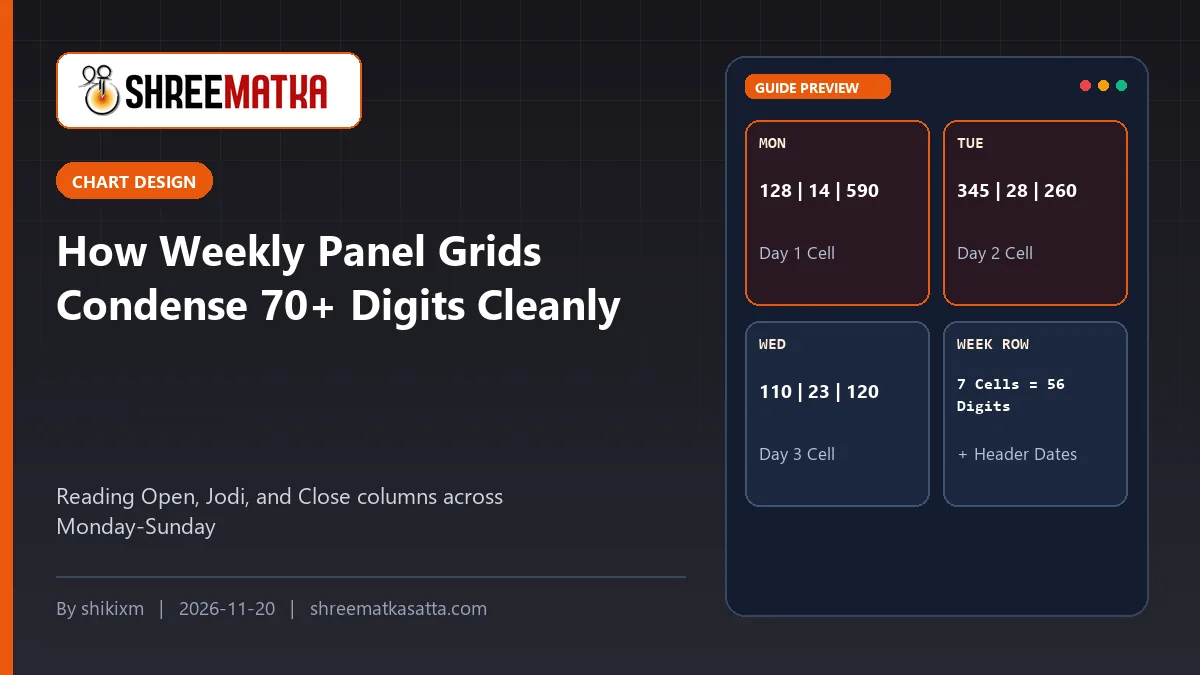
A weekly Panel Chart assigns one horizontal row per calendar week anchored by the Monday-to-Saturday date range on the far left. Each daily square breaks 8 digits into three visual pieces: Open Panna stacked top-to-bottom on the left, large bold 2-digit Jodi centered inside, and Close Panna stacked top-to-bottom on the right.
Table of Contents
- Why Side Pannas Stack Vertically Instead of Sitting Flat
- Anatomy of One Day Box Inside a Weekly Panel Grid
- Always Read Vertical Pannas Top-to-Bottom (Not Bottom-Up)
- Check Both Date Span and Weekday Column Header Every Single Time
- Frequently Asked Questions
- Master Chart Reading & Clean Archive Formats
Why Side Pannas Stack Vertically Instead of Sitting Flat
Try imagining seven straight lines of flat numbers printed edge to edge across a narrow mobile browser: 128-14-590 347-40-280 110-25-249 458-73-689.
Within three seconds every three-digit Panna blurs straight into its neighbor. You lose track of where Tuesday ended and Wednesday started!
Stacking the 3 Open digits vertically on the left side of the square (1 on top, 2 middle, 8 bottom), blowing up the 2-digit Jodi (14) right down the middle, and stacking the Close digits (5, 9, 0) vertically down the right acts like neat visual bookends. You spot the Jodi from arm's length and still verify both Pannas top-to-bottom whenever needed.
Anatomy of One Day Box Inside a Weekly Panel Grid
| Box Position | How It Looks Printed | What It Means | How the Digits Sum |
|---|---|---|---|
| Left Vertical Stack | 1 / 2 / 8 stacked top-down | Day's Open Panna (128) |
1+2+8 = 11 → 1 (First Jodi Digit) |
| Center Bold Font | 14 oversized in the middle |
Day's Complete Jodi (14) |
Open Ank 1 next to Close Ank 4 |
| Right Vertical Stack | 5 / 9 / 0 stacked top-down | Day's Close Panna (590) |
5+9+0 = 14 → 4 (Second Jodi Digit) |
| Far-Left Row Header | 16/11 to 21/11 |
Week Date Span | Anchors Monday-through-Saturday cells to calendar dates |
Always Read Vertical Pannas Top-to-Bottom (Not Bottom-Up)
Beginners sometimes read a vertical stack backwards from bottom to top, turning 1 / 2 / 8 into 821 instead of 128.
Remember the canonical zero-last ordering rule (1, 2, 3... 9, 0): Panel charts always stack Open and Close Pannas in ascending order strictly from top to bottom. Notice how 5 sits at the top, 9 in the middle, and 0 (zero last) always rests right at the bottom (590).
1, 2, 8 → Open Panna 128 (1+2+8=11 → Open Ank 1)
1 match left digit of 14? Yes (1)
5, 9, 0 → Close Panna 590 (5+9+0=14 → Close Ank 4) → Matches right digit 4
Check Both Date Span and Weekday Column Header Every Single Time
Looking across structured chart design guides, the far-left date column (Mon–Sat range) is just as important as the digits themselves.
Never rely on cropped screenshots missing weekday headings (Mon, Tue, Wed, Thu, Fri, Sat) or date labels, because one holiday gap or a 5-day vs 6-day market makes cropped cells line up under the wrong day completely.
When you only need two-digit patterns quickly on a small phone screen, switch to the lighter Jodi Chart view instead of pinching and zooming full weekly Panel tables.
Frequently Asked Questions
Do you read vertical Panel Pannas top-to-bottom or bottom-to-top?
Always read strictly top-to-bottom (top digit, middle digit, bottom digit), matching standard ascending order where 0 sits at the bottom.
Why is the center Jodi printed much larger and bolder than both side Pannas?
Visual hierarchy lets readers scan months of Jodi results at a glance while keeping smaller Panna digits nearby for arithmetic confirmation.
What do horizontal dashes (-- -- --) inside one Tuesday cell mean?
Dashes indicate that market observed a holiday or scheduled non-operating day while holding the Tuesday column properly aligned for the rest of that week.
Master Chart Reading & Clean Archive Formats
Once your eye breaks every box into Date Anchor → Top-Down Left Panna → Center Jodi → Top-Down Right Panna, even ten-year historical archives read smoothly.
Continue reading these table and chart guides: