
Time Bazar Market Characteristics: What One Schedule Row Holds
The honest starting point for a Time Bazar strategy is the schedule row itself, because almost every claim made about this market in circulating tipster copy is a claim about something the record does not contain. The markets table inserts one row named Time Bazar, typed MAIN, with an open time of 13:00:00 and a close time of 14:00:00, active, in Asia/Kolkata. That is the entire identity of the market. It generates one market day per open date, and a market day stores exactly one open triple and one close triple, plus timestamps. A market name is unique in the table and a market day is keyed on market plus date, so there is one archive and one result pair per day, and nothing to average across.
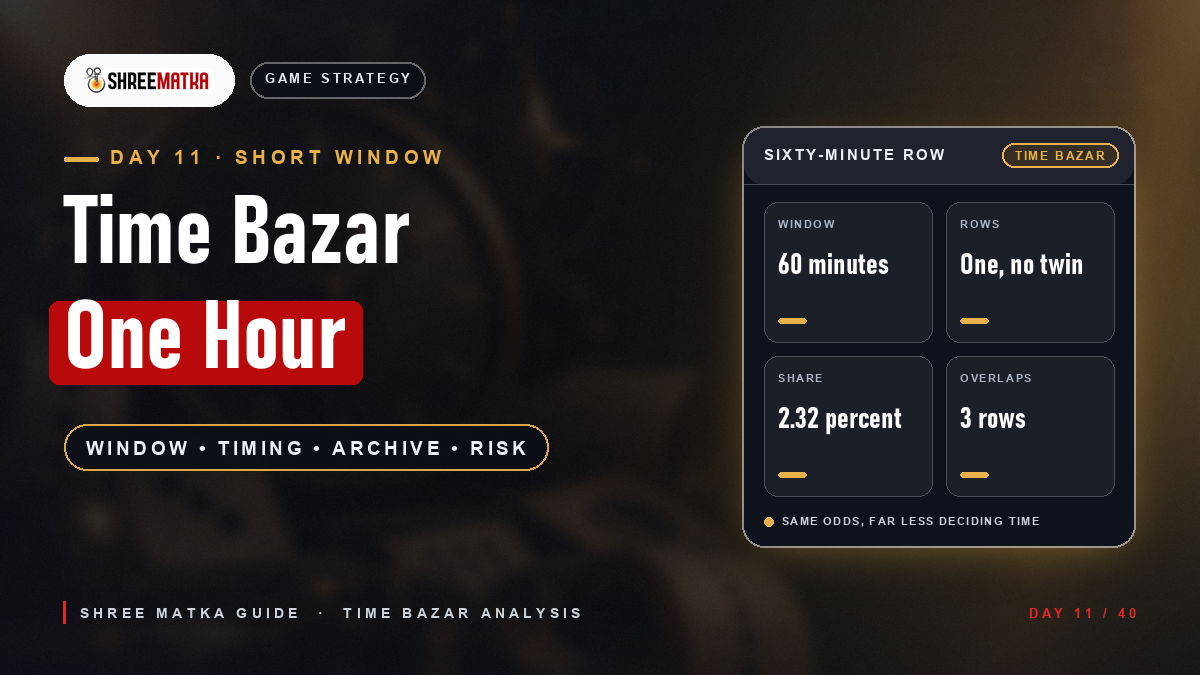
Two absences matter more than anything the row does contain. First, Time Bazar has no twin. Six market bases on this schedule are paired Day and Night — Dadar, Madhur, Milan, Parel, Rajdhani and Supreme — and those are the markets where a day-versus-night comparison is even a legitimate question, which is why the Milan and Rajdhani guides are structured the way they are. There is no Time Bazar Night row and no Time Bazar Starline row. Second, the row is one of only six MAIN markets with a 60-minute window, in a schedule whose median window is 120 minutes.
| MAIN window length | Rows on this schedule | Examples |
|---|---|---|
| 55 minutes | 1 | Gali (11:00 PM to 11:55 PM) |
| 60 minutes | 6 | Sridevi, Time Bazar, Madhur Day, Parel Day, Sridevi Night, Parel Night |
| 120 minutes | 17 | Kalyan, Milan Day, Rajdhani Day, Dadar Day, Supreme Night, Kuber |
| 135 minutes | 1 | Main Bazar (09:40 PM to 11:55 PM) |
Read the table carefully, because it is the only Time Bazar characteristic that is genuinely unusual. Twenty-five MAIN rows produce 2,590 minutes of live session in a day, and Time Bazar contributes 60 of them. What the table does not say is just as important: no row on this schedule crosses midnight, so the overnight branch of the session logic never fires here, and Time Bazar is not a “morning” market in any structural sense. It is an early-afternoon one, and the hour it occupies is shared with three other rows.
Timing Considerations: What A Sixty-Minute Window Actually Changes
Timing is where a short window does real work, and the mechanism is a three-state clock rather than a single closing bell. The session state is computed from the row’s open and close times against the current India Standard Time: before the open time the market is pre-open, between the open and close times the open session is closed but the market is still live, and after the close time the market is closed. Those three states map onto two different bet windows, which is the distinction most Time Bazar advice collapses.
| State at the clock | Open-session bets | Close-session and jodi bets | Why |
|---|---|---|---|
| 12:45 PM (pre-open) | Accepted | Accepted | Both legs sit inside the pre-open state |
| 01:05 PM (open session running) | Rejected | Accepted | The open leg ends the moment the state leaves pre-open |
| 02:05 PM (market closed) | Rejected | Rejected | Nothing is accepted for the date once the close time has passed |
| Any minute after publication | Rejected | Rejected | A published result overrides the clock in every state |
The asymmetry is the useful part. Bets on the open session are accepted for the whole of the morning — there is no scarcity there at all, because pre-open lasts until the first minute of the session. Bets on the close session are accepted in pre-open too, but the window in which a reader already knows the open ank and can still act on the close leg is exactly the session itself. For Time Bazar that is 60 minutes; for Kalyan, Milan Day and Rajdhani Day it is 120. The check that enforces this is not a display detail either: the rejection is recorded against the bet with a reason code, so an attempt to place an open bet at 01:05 PM leaves an audit trail rather than failing silently.
01:00 PM IST60 (until 02:00 PM)1202.32%One more timing fact has to be stated as an absence, because it is the one readers most often ask about. There is no scheduled auto-declaration attached to Time Bazar. An automatic polling job does exist and runs every 60 seconds, but it selects only markets flagged as external API markets with auto-result enabled, and the column that carries that flag was added later with a default of false, so the seeded rows are not eligible unless an operator changes them. The practical consequence is that the minute the Time Bazar result appears is an operational event, not a constant of the schedule — and since a published result overrides the clock, that event, not 02:00 PM, is the real end of betting on the close leg. Treat any guide’s promise of a publication minute as a claim about an operator, not about the market.
Chart Pattern Analysis: Which Page To Open And What It Can Show
Two pages carry the Time Bazar record, and both are reached by the same route the other MAIN markets use. The jodi chart at /chart/jodi/time-bazar and the panel chart at /chart/pana/time-bazar resolve the market by its canonical slug, pull a rolling 365-day window, and render it as Monday-to-Sunday weeks with the newest week first. A legacy numeric identifier or a non-canonical spelling is redirected to those addresses rather than rendering a second copy. The mechanics of those routes, including what happens when a name resolves to a row that has never declared, are worked through in the Rajdhani guide, so they are not repeated here.
What is worth repeating is what a Time Bazar chart can contain, given the row behind it. One market day per open date means one jodi cell per day, so a month of the chart is roughly 30 cells and a year roughly 365. That is the entire surface on which a Time Bazar pattern can be drawn. Dates with no declaration appear as stars rather than as zeros, and a reader who counts stars as misses is inflating their denominator — the same trap the Kalyan strategy guide sets out when it separates an empty cell from a declared one.
| Time Bazar page | What each cell holds | What the page cannot show |
|---|---|---|
| /chart/jodi/time-bazar | One open ank and one close ank per date | Any date the row never declared |
| /chart/pana/time-bazar | The stored open and close triples | A running panel total, which is never displayed |
| Both | Weeks the market was open, newest week first | The other five sixty-minute rows, which are separate markets |
The vocabulary on those pages is fixed by the platform rather than by custom, and it is worth naming once: a three-digit open or close triple is a pana, its digit sum reduced to a single figure is the ank, the pair of anks is the jodi, and the panel sum is the unreduced total of the three digits. Two of those three are computed for display and are not stored, which is why a chart column can be derived but never queried. The glossary keeps the canonical definitions, including the fact that no cut-number or panel-sum field exists anywhere in the schema.
Historical Trend Analysis: One Declaration Per Open Date
Historical analysis of Time Bazar has one denominator and it is not the clock. The number of declarations a reader can study is set by how many dates the market was open, not by how long each session ran, so the 60-minute window and a hypothetical 6-hour window would produce identical archives. This is where most short-session commentary goes wrong: it treats the compressed session as a compressed dataset, and then reads a 20-cell month as though it were a thin sample of a busy market rather than a full sample of a single-row one.
| Quantity | Changed by window length? | Set by |
|---|---|---|
| Declarations per year | No | One market day per open date |
| Chart cells available | No | The 365-day rolling window |
| Odds structure of a bet | No | The bet family, identical across MAIN rows |
| Minutes to decide a close bet | Yes | Open time to close time |
| Re-stake opportunities per hour | Yes | How many neighbours close nearby |
So the honest framing of Time Bazar history is this: it is a normal-sized record of an ordinary MAIN market, and the only thing its brevity changes is the reader. Sample-size discipline still applies with full force. Thirty declarations is a small number for any claim about a repeating figure, and a year of them is still only a year of one row. The counting rule — declarations, not days, and never two rows inside one sample — is established in the Milan market analysis, and the multiple-comparisons arithmetic that explains why some market always looks hot by the end of an evening is worked out in the Rajdhani guide. Both apply to Time Bazar unchanged, and neither needs re-deriving here.
Comparison With Other Markets: Time Bazar Against The Schedule
With no twin row, the only comparison that means anything for Time Bazar is against the rest of the schedule — which is also the comparison most readers never make, because the chart pages are opened one market at a time. Placed side by side, Time Bazar stops looking like a small market and starts looking like an extreme end of a distribution.
| Market row | Window | Close-leg minutes after the open is known | Twin rows |
|---|---|---|---|
| Time Bazar | 01:00 PM to 02:00 PM | 60 | None |
| Sridevi | 11:35 AM to 12:35 PM | 60 | Sridevi Night |
| Parel Day | 01:15 PM to 02:15 PM | 60 | Parel Night, plus a Starline row |
| Kalyan | 04:10 PM to 06:10 PM | 120 | Kalyan Night, plus a Starline row |
| Milan Day | 03:00 PM to 05:00 PM | 120 | Milan Night, plus a Starline row |
| Gali | 11:00 PM to 11:55 PM | 55 | None |
| Main Bazar | 09:40 PM to 11:55 PM | 135 | None |
Two things fall out of that table. The first is that Time Bazar is not an outlier at all: five other MAIN rows share its 60-minute shape, and one is shorter. The second is a naming trap worth an explicit line, because the schedule contains three rows whose names invite confusion. Time Bazar, Main Bazar and Old Main Mumbai are three unrelated rows with different windows, different archives and different closing minutes. “Bazar” is not a family here, and a chart opened for one is not evidence about another.
The genuinely distinctive fact about Time Bazar’s position on the clock is what shares its hour. Three other rows are live inside the 13:00 to 14:00 window: Rajdhani Starline occupies the identical 01:00 PM to 02:00 PM slot as a STARLINE row, Parel Day runs 01:15 PM to 02:15 PM and Madhur Day runs 01:30 PM to 02:30 PM. Six closes land between 01:00 PM and 03:00 PM, two of them at exactly 02:00 PM. Midday is therefore not a quiet period on this schedule; it is a small cluster, and it behaves like one.
02:00 PM IST02:15 PM IST02:30 PM IST3 rows in 90 minutes3 units committed before the afternoon settlesRisk Management Approaches: The Midday Chase Window
Risk management for a short-window market is mostly about the reader’s calendar, and Time Bazar is unusually easy to manage for one structural reason: it is over early. The whole live phase finishes at 02:00 PM, well before the evening block that the Rajdhani guide describes, so a decision made badly here can still be scored, written down and closed out inside the same afternoon. The exposure comes from the two rows that close fifteen and thirty minutes later, not from the market itself.
- Cap the block, not the row. A per-market limit is multiplied once for every market you touch, and the midday block offers three inside 90 minutes. One written afternoon figure, split before the first close, is the version that survives.
- Use the pre-open leg as a cooling-off period. Open-session bets are accepted all morning, so a stake decided at 10:00 AM and a stake decided at 01:05 PM are the same bet with different authors. Decide before the session and the sixty-minute squeeze never has to be your decision point.
- Treat 02:00 PM as a hard stop, not a formality. The state change is enforced in code and recorded with a rejection reason, which makes it one of the few boundaries on this platform that a reader does not have to police alone.
- Do not read a short session as an urgent one. Nothing about the 60-minute window changes a one-in-ten ank or a one-in-hundred jodi; urgency is a habit imported from tipster copy, not a property of the schedule.
A necessary honesty note, repeated because it is the limit of what the platform can do for you: no deposit-limit, loss-limit, cooling-off or self-exclusion feature exists anywhere in this codebase, so every cap described above is self-imposed and enforced only by the reader’s own written record. The verification angle on that is covered in how to choose a reliable website, and the behavioural failure modes in common beginner mistakes. Time Bazar is a number market; nothing here is a recommendation to play, and content on this site is intended for readers aged 18 and over.
Testing A Time Bazar Pattern Before You Trust It
A Time Bazar pattern can be tested, and the test is the same five-step protocol the Kalyan strategy guide sets out: state the rule as a falsifiable claim, fix the sample before looking at it, define what counts as a hit, compare against the range chance produces for that sample size, and write down a kill criterion. What the Time Bazar row changes is only the calendar cost of running it.
1about 100 daysroughly 3 to 4 monthsother Time Bazar dates onlyThat last line is the one people miss. Because Time Bazar produces a single declaration per day, a reader cannot accelerate a test by watching more of the session — there is no second leg, no twin and no starline row to harvest. The temptation a compressed window creates is to declare a pattern on twenty cells because twenty cells arrived in a month, when the honest equivalent for any other MAIN market is the same twenty cells in a month. Sample discipline is not a Time Bazar problem; it is a reader problem that Time Bazar makes visible.
Limits Of Time Bazar Analysis And The Written Spec
Everything above is a description of a record, and it is worth being blunt about the boundary. A Time Bazar market day stores six digits and two timestamps; the ank, the jodi, the panel sum and every chart column are computed from those six digits afterwards. Nothing in the archive constrains the next declaration, so no cut rule, hot-number count or open-to-close reading moves a one-in-ten chance to a one-in-nine. A “strategy” for this market is a written decision process about four things — which row, which session leg, which bet family, how much — and about nothing else.
What Time Bazar does offer is a clean case for that discipline, precisely because its interesting properties are structural and checkable. One row, no twin, 60 minutes, one declaration per day, three neighbours closing inside 90 minutes. Each of those can be verified against the schedule in a minute, which is more than can be said for any forecast. Write the spec before the session, score it after 02:00 PM, and let the window’s brevity work for the record rather than against the reader.
Frequently Asked Questions
What is Time Bazar in Satta Matka?
What time does Time Bazar betting close?
Is Time Bazar a day market or a night market?
Does Time Bazar have chart pages on this site?
Why is the Time Bazar window considered short?
How much Time Bazar history can be analysed?
Can Time Bazar chart patterns predict the next result?
Is a short-window market riskier than a long one?
Download the Official Shree Matka App
Experience real-time live results, complete historic panel records, and 24x7 verified automated withdrawals on your Android smartphone.
Download App
Comments (0)
Loading comments...