
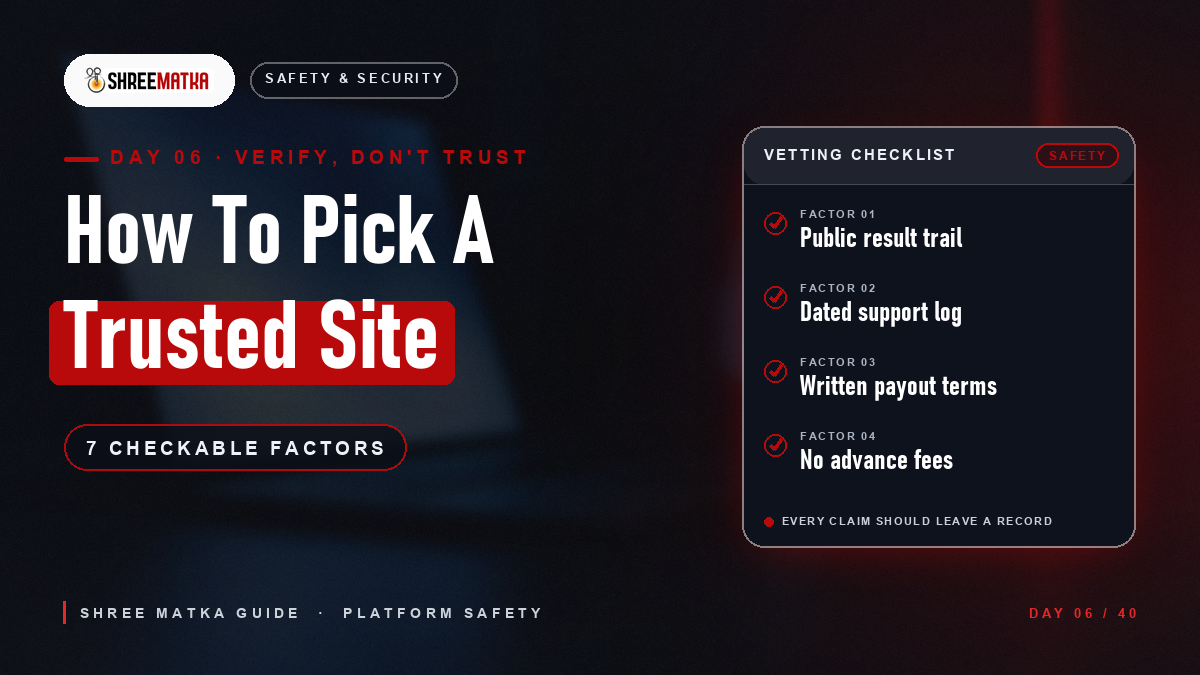
Claims Are Cheap: Judge Artefacts, Not Adjectives
The reason “choose a reliable website” advice usually fails is that it lists properties a site can assert. Oldest, genuine, fast payment, verified — every one of those costs nothing to write, and the sites that will not honour them are the most enthusiastic about all three. So this framework uses a different test for every factor: does a record exist that a third party could inspect later? A claim that leaves a trace is worth checking. A claim that leaves nothing is not a claim, it is marketing.
The seven factors below are ordered by how much they narrow the field in this particular market, not by how impressive they sound. The mapping is fixed for the rest of the article:
| Factor | What you are really testing | Artefact that answers it |
|---|---|---|
| 1. Licensing | Whether any regulator can be pointed to at all | A named licence number you can look up on the issuer’s own register |
| 2. Payment controls | Whether money movement is a process or a favour | Stated rates, deposit and withdrawal rules, a ledger entry per transaction |
| 3. Support | Whether an answer can be produced after the fact | Published channels and hours, reference numbers, a dispute queue |
| 4. Result transparency | Whether the record is fixed once published | A dated archive whose jodis can be recomputed from its own panas |
| 5. Product experience | Whether the thing behaves the same twice | Versioned app, matching domain, consistent schedules and layouts |
| 6. Safer-play signals | Whether harm is treated as a design problem | Age policy, limits or self-exclusion, a real privacy page |
| 7. Reputation | Whether the story holds over time | Mentions that predate your interest in it, and complaints with outcomes |
add the open pana digits → keep the unit digit → repeat for close
derived 1 and 3 → site must show jodi 13
if either is missing, factors 2 and 4 already fail
record the reply time and whether a reference exists
Four of those five steps are arithmetic and record-keeping, which is the point: most of the trust decision is available to a reader with a calculator and ten minutes. The vocabulary those steps use is defined in the A to Z terminology glossary, and the reason a jodi can be recomputed at all is the derivation rule explained in the chart reading guide.
Factor 1: Licensing and Regulation — the Honest Check
This is where an honest guide has to disappoint the reader, and it is also why the factor belongs first. In most of the world’s jurisdictions, and across India in particular, there is no licence for a Matka website to hold: online money games of chance are restricted rather than regulated, and the operators in this space overwhelmingly run without any regulator’s name attached. So the check is not “is it licensed?” but “can it be pointed at a register?”
- A licence claim you cannot look up is not a licence. Curaçao, Kahnawake and Gibraltar numbers can all be verified on the issuer’s own site in under a minute. A badge with no number, or a number that returns nothing, is decoration.
- A foreign licence governs very little of your risk. It may mean a dispute route exists against a tribunal in that jurisdiction. It does not mean an Indian reader can use it, and it certainly does not make a local payment channel lawful.
- Regulation of this market is recent and unsettled. India’s central framework on online money games changed the picture after this site began publishing, and state-level treatment still differs. The practical consequence for a reader is that no regulatory body is currently positioned to arbitrate a withheld withdrawal, so the legal background in the beginner’s guide matters more than any badge in a footer.
Weight the factor accordingly. Licensing is a strong disqualifier when a site lies about it, and almost uninformative when a site is simply silent and honest about being silent. The remaining six factors are where the evidence lives — which is why this article spends the rest of its length there.
Factor 2: Payment Security and Money Controls
Money handling is the factor with the most concrete artefacts, because a platform that moves funds has to keep records to move them at all. What you are testing is whether deposits and withdrawals behave like a process — with states, timestamps and a queue — or like a favour granted by whoever is holding the phone.
| Check | Good signal | Bad signal |
|---|---|---|
| Rates | A published table, per market, with the session it applies to | “Best rates, ask on WhatsApp” |
| Deposit path | Named methods with limits and a request you can see pending | Any personal account number or a private UPI id |
| Withdrawal path | Stated minimum, window and processing time, with a status | “Contact us” and no queue at all |
| Ledger | One entry per event: bet, result, settlement, adjustment | A single balance figure that changes without a row |
| Corrections | Reversible actions logged with a reason | Silent balance edits, no explanation offered |
Two technical notes, because they are the parts readers are most often reassured about for the wrong reason. Encryption is a floor, not a credential: a padlock says your password crossed the network safely and says nothing about whether the operator will pay you. And a payment gateway is only as trustworthy as the settlement rules behind it — the gateway moves money, while it is the platform’s own ledger that decides how much. Ask for the ledger.
The rate half of this factor has its own arithmetic: what a published multiple is actually worth per rupee is computed in the odds & payouts guide, and a site that will not commit to numbers in writing has removed itself from that comparison entirely.
Factor 3: Customer Support That Leaves a Record
Support quality is usually described in adjectives — fast, polite, 24×7 — and it is actually measurable in three numbers: how many channels exist, whether their hours are published, and whether an exchange can be retrieved later. The third is the one that protects you, because a support system that produces no artefact produces no accountability either.
- Count the channels, then read the hours. A platform that publishes support timings and a fallback route has told you something checkable. “Always available” has told you nothing, and is the phrase most often paired with a single personal number.
- Ask for a reference number in your first message. If a ticket id exists, the conversation has a place to live. If it does not, the reply is a chat message that will be denied in a week.
- Check whether disputes are a feature. Serious platforms model complaints as records with a state and a resolution time, typically attached to the specific bet or withdrawal in question. A dispute queue is one of the strongest single trust signals in this market, because it means someone else can see the case.
- Test before you need it. Send one factual question — a session cut-off, a rate, a market schedule — and time the answer. A pre-deposit test costs nothing and predicts the post-deposit experience almost exactly.
This is also where the scam vocabulary from the glossary’s final section becomes practical: “sure shot” and “leak” sellers never survive a support test, because the service they promise is the thing they cannot document.
Official Shree Matka Mobile Application
Access live 1-second results, historic panel charts, and verified game rate tables directly on your Android phone.
Factor 4: Result Transparency You Can Verify Yourself
This is the factor a Matka reader can test without trusting anyone, and it is worth more than every badge in a footer combined. A published result is a record; a record has two obligations — it must be internally consistent, and it must not change quietly afterwards.
Consistency first. Every result line carries its own proof. The jodi in the middle is derived from the two panas printed beside it, so a correct line recomputes to itself and a corrupted one does not. A handful of rows is enough to characterise a source, and the arithmetic takes under a minute once you know the reduction rule. When a site’s jodi disagrees with its own pana, you have found the answer to a question you were going to ask later.
Then permanence. The failure mode that matters is not a wrong number but a number that changes after people have settled against it. Two behaviours separate honest archives from casual ones: a declared result is never re-declared, and where a correction genuinely has to happen, it is logged with a reason, a timestamp and a record of what was reverted and refunded. A platform’s own data model usually keeps these traces — result-deletion logs, bet-revert logs and admin action logs exist precisely so that a change is not invisible — and being able to describe them is a reasonable thing to ask of any operator you are about to hand money to.
Then provenance. Most sites copy each other, so one transcription error appears on ten charts at once and looks like agreement. The check is not how many sites show a result but whether you can trace it to an archive that maintains its own history — the failure pattern is documented in why Matka results look different across websites, and the maintained archives sit in the charts section.
Factor 5: Product and Mobile Experience
Consistency of behaviour is a trust signal in its own right, and it is the easiest factor to test because you are the one doing the testing.
- Does the same session show the same thing twice? Reload a live page after a declaration and compare. Values that drift between loads are a caching or integrity problem, not a display preference.
- Do schedules hold? A market that publishes a cut-off and then accepts or declares outside it has told you the schedule is decorative.
- Is the app identified, not just advertised? A named package, a version, and a download served from the same domain as the information site are all checkable. An APK link on a third-party host is how a genuine product becomes a modified one.
- Does the mobile experience match the desktop record? Same numbers, same labels, same timestamps. Differences between the two are usually a sync lag, and sometimes something worse.
- Is the site engineered at all? Small things read as competence: sensible rate limiting on its own APIs, a privacy page that matches the data it actually collects, and headers that do something. Presence alone is weak evidence — a security header that permits everything is still a permissive policy — so read what a control allows, not merely that it exists.
For the install-side decisions specifically, the app safety and installation guide covers verifying a build before trusting it with anything.
Factor 6: Responsible Gaming and Safer-Play Signals
This factor is the most useful discriminator in the list, because it costs an operator real revenue to implement and nothing at all to claim.
What counts as an artefact: an age policy that is enforced rather than asserted; deposit, loss or session limits a player can set in advance; self-exclusion that survives a support request; reality checks on time spent; and a privacy page that states what is collected and who it is shared with. Each of these is a feature that can be opened, screenshotted and tested. Each is also a feature that reduces short-term income, which is exactly why its presence is evidence.
What does not count: an 18+ line in a footer, a slogan about responsible play, or a support message that appears only after a loss. In this market the honest position is uncomfortable — many Matka platforms, including informational ones, publish age notices and privacy policies but offer no account-level controls at all. Absence of limits does not make a site fraudulent; it does mean the entire safeguard is the budget you set before you open anything, and that you should not expect the platform to protect you from yourself.
Where a site does provide the artefacts, use them as written: a limit you set in advance is a decision made by the version of you that was thinking clearly, and it is worth keeping even if it feels unnecessary now.
Factor 7: Reputation, Read Correctly
Reputation is the last factor because it is the easiest to fake and the easiest to misread. Used well, it is a check on the other six rather than a substitute for them.
- Read the recent negatives, not the aggregate score. A rating averages over years and builds; a complaint from last week describes the service you would receive tomorrow.
- Look for outcomes, not sentiment. A complaint that shows a reference number and a resolution tells you more than fifty stars. What matters is not that problems happen but that they close.
- Check the age of the story. Mentions that predate your interest in the site are hard to manufacture. A reputation that appeared fully formed inside a month is a purchased one.
- Expect mirrors. In this market one operation often runs several near-identical domains. That is not automatically dishonest, but it does mean three “independent” recommendations can be one site recommending itself.
- Test the claim against the artefact. “Oldest Matka site” is a date, and dates can be checked against archives, registrations and the record layer described in factors 2 and 4.
Run all seven and you will find that very few sites in this space clear every bar — which is the correct and useful conclusion. The decision is not between a trustworthy operator and an untrustworthy one so much as between a set of verifiable behaviours you can hold someone to and a set of adjectives you cannot.
Frequently Asked Questions
How do I know if a Satta Matka website is real or a scam?
Do Satta Matka websites need a licence?
Is HTTPS enough to trust a Matka site?
What should I do if a website refuses my withdrawal?
Can I trust app store reviews for a Matka app?
What are red flags in customer support?
Is there a self-exclusion or deposit limit on Matka sites?
Does an 'official' or verified badge mean anything?
Download the Official Shree Matka App
Experience real-time live results, complete historic panel records, and 24x7 verified automated withdrawals on your Android smartphone.
Download App
Comments (0)
Loading comments...