
Article Publication Date vs Result Date: Which Date Are You Actually Reading?
When browsing Matka analysis articles, discussion boards, or chart directories, readers frequently spot two completely different dates on the same screen: an editorial date beside the author’s byline (e.g., 21 October 2026) and a historical chart date attached to a table row (e.g., 15 October 2026). Confusing these two timestamps leads to flawed record analysis, false verification assumptions, and misread market trends.
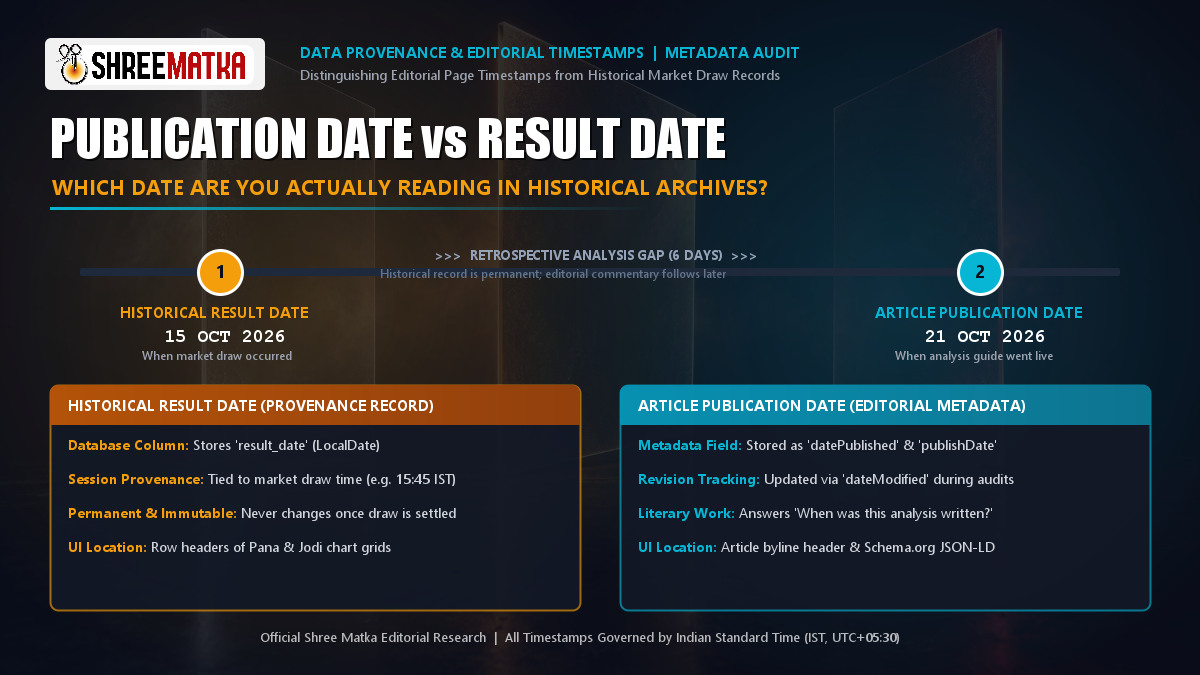
Table of Contents
- 1. The Core Distinction: What Each Date Identifies
- 2. Why Two Distinct Dates Coexist on the Same Page
- 3. Illustrative Timeline: 21 October Editorial vs 15 October Draw
- 4. How Shree Matka Handles Dates in Backend Code
- 5. datePublished vs dateModified: Understanding Revision Metadata
- 6. Four Verification Checks Before Trusting a Number’s Date
- 7. Frequently Asked Questions (FAQ)
1. The Core Distinction: What Each Date Identifies
The difference between an Article Publication Date and a Historical Result Date boils down to two entirely distinct domains of information:
Article Publication Date
Answers: “When was this article written and deployed to the web?”
- Assigned by the content management system or editorial registry.
- Stored in HTML meta tags and Schema.org
datePublished. - Applies to the commentary, analysis, or guide as a literary work.
- Does not reflect the occurrence time of historical events discussed within.
Historical Result Date
Answers: “On which calendar day was this specific number drawn?”
- Assigned by the market operator upon declaring official draw outcomes.
- Stored in database columns like
result_dateandslot_time. - Bound strictly to market sessions (e.g. Kalyan Day Open at 15:45 IST).
- Permanently fixed and immutable across all historical archives.
2. Why Two Distinct Dates Coexist on the Same Page
Modern publishing platforms frequently cite historical records within educational or technical articles. For example, in our research on why copying number tables without headings changes their meaning, we cited an illustrative row containing open and close panars.
When an analyst publishes a guide on 21 October 2026 reviewing chart movements from the previous week, the page naturally contains:
- The byline date (21 Oct 2026) showing when the author completed their prose.
- The table dates (e.g., 15 Oct, 16 Oct, 17 Oct 2026) identifying the specific historical drawing days analyzed in the charts.
A novice reader glancing casually at the top of the page might mistakenly believe that the numbers shown in the table occurred on 21 October, creating confusion when looking up official market logs.
3. Illustrative Timeline: 21 October Editorial vs 15 October Draw
To demonstrate this relationship chronologically, examine the hypothetical timeline below:
15 October 2026 — Market Draw Event
The Kalyan Day market declares its official draw numbers: Open Pana 247, Jodi 38, Close Pana 179. The record is permanently logged in the database under result_date = 2026-10-15.
16–20 October 2026 — Statistical Aggregation
Analysts track the weekly cycle, comparing patterns across seven days of trading.
21 October 2026 — Editorial Guide Published
An educational breakdown is authored and deployed. The web page header displays Published: 21 Oct 2026, while its embedded table specifically references the 15-10-2026 record.
4. How Shree Matka Handles Dates in Backend Code
Our audit of the Spring Boot backend revealed strict segregation between editorial timestamps and transactional result dates:
| Entity Domain | Backend Field | Data Type | Timezone / Format |
|---|---|---|---|
| Editorial Blog Article | publishDate | LocalDate |
IST / MMM d, yyyy (e.g., Oct 21, 2026) |
| Article Schema.org | datePublished | String (ISO-8601) |
2026-10-21T09:00:00+05:30 |
| Historical Market Draw | resultDate | LocalDate |
IST / dd-MM-yyyy (e.g., 15-10-2026) |
| Starline Slot Time | slotTime | LocalTime |
IST 24-hr (e.g., 14:00:00) |
In PublicPageController.java, all date queries enforce timezone consistency using ZoneId.of("Asia/Kolkata"), guaranteeing that a draw occurring late in the evening is not miscataloged into the subsequent UTC calendar date.
5. datePublished vs dateModified: Understanding Revision Metadata
In addition to the draw date, articles feature two distinct editorial timestamps:
- datePublished (Initial Release): The immutable timestamp marking when the article first went live. In search engine result pages (SERPs), this timestamp establishes the foundational authorship age.
- dateModified (Last Updated): A dynamically updated timestamp modified whenever an editor corrects typographical errors, updates internal references, or refreshes data tables.
dateModified changes to 25 October, but its datePublished remains 21 October, and the historical records within it still reflect their original draw dates.
6. Four Verification Checks Before Trusting a Number’s Date
Whenever you read a number cited on any website, execute these four quick checks to verify which date you are actually reading:
1. Check Row Labels, Not Byline Dates
Look for the date printed on the exact row containing the number. Never assume the author's byline applies to the data.
2. Verify Market Identity First
Ensure the date corresponds to the specific market you are researching (e.g. Kalyan vs Milan Night).
3. Cross-Check with the Official Chart Archive
Confirm the record against the canonical Shree Matka Chart Directory rather than trusting standalone blog citations.
4. Beware of Simulated Backdating
Legitimate editorial articles analyze past events. Any platform claiming an article analyzed a draw before it occurred is fabricating its timeline.
Frequently Asked Questions (FAQ)
datePublished represents the original timestamp when the article was first deployed to the web. dateModified represents the timestamp of the most recent editorial update, correction, or audit. Search engines and readers use dateModified to evaluate freshness.
ZoneId.of("Asia/Kolkata").