
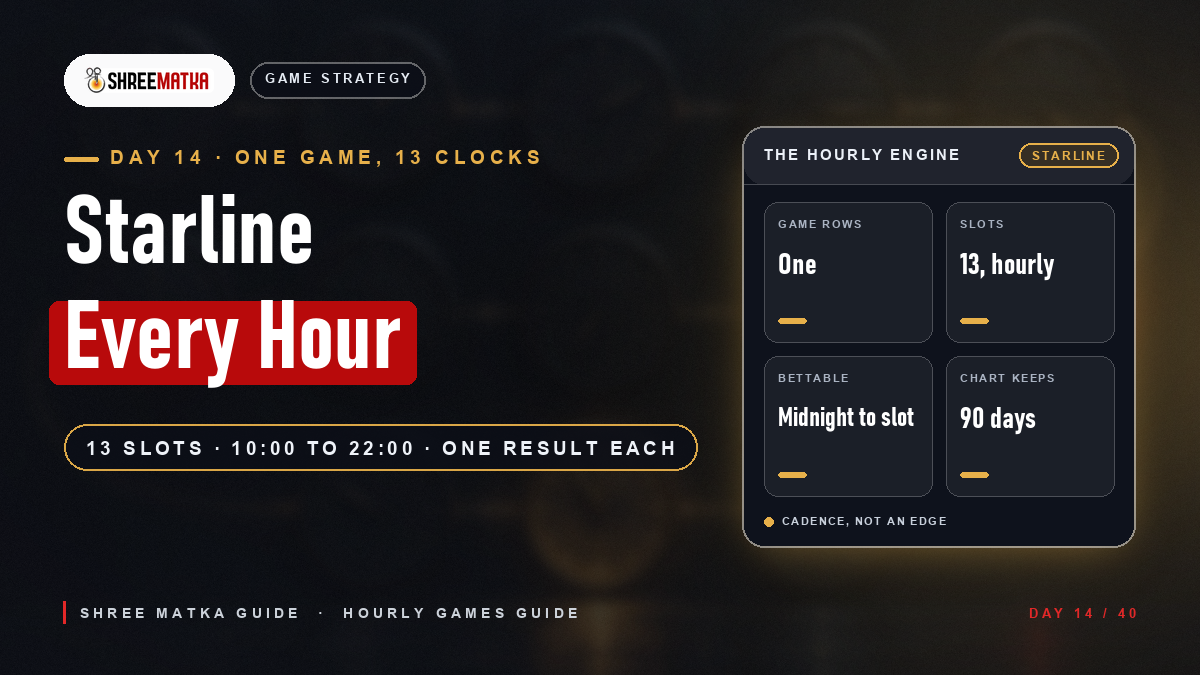
Starline Game Structure: One Game Row, Thirteen Clocks
Start with the schema, because Starline is the only part of this platform that lives in its own tables. Where the main schedule is one markets table holding 25 typed-MAIN rows, the hourly vertical has its own game table, and that table holds exactly one active row: game_name MAIN_STARLINE, displayed as Main Starline. The hour grid is not thirteen authored markets. It is thirteen child rows in a slot table, inserted by the seed as a single hourly series running from 10:00 to 22:00 inclusive. The vertical’s entire daily output is capped by a unique constraint on game, slot and result date: at most one declaration per slot per day, thirteen declarations a day from one game configuration.
@1 (MAIN_STARLINE, active)@13, hourly 10:00 to 22:00@at most 1, by unique constraint@25, each with its own name and archiveThe public address follows the game row, not the display name. The chart route resolves a game by comparing the path segment against the shared slug of the stored game_name, so MAIN_STARLINE becomes /chart/starline/main-starline — the internal name, lower-cased and hyphenated, is the URL a reader gets. On the lobby, the Starline card’s displayed open and close times are computed from the first and last slot times (10:00 AM and 10:00 PM), not from any betting-window column — both details matter when a URL or a schedule is reconstructed from marketing vocabulary.
One disambiguation belongs up front, because the word is used three ways on this site. Six rows inside the 31-market schedule are typed STARLINE (Kalyan Starline, Mumbai Starline and four more) and belong to the main chart system; the hourly vertical described here is a separate system with separate tables. Day 12 owns the naming disentanglement and the format comparison piece owns how the record layouts differ; this post is about the hourly engine only.
The Betting Window The Code Actually Enforces
The slot rows carry two window columns, and the story of this section is that neither one does anything. The seed wrote betting_open_time as the slot minus 55 minutes and betting_close_time as the slot minus 5 minutes — a classic pre-close window. A later migration then rewrote every betting_open_time in the table to 00:00:00 (and every jackpot market’s open time with it) while leaving the close columns untouched. So the stored window is already internally inconsistent: opens at midnight, closes five minutes before each slot.
None of that reaches a bet. Placement calls the slot’s own isBettingOpen method, whose entire time logic is one comparison: the current time is before the slot time. The stored columns are never consulted. Three repository queries that do filter on the close column exist in the code and have zero callers, and the slot’s separate declaration-time helper has none either. The window on record is documentation; the window in force is midnight to the slot itself.
| Slot | Bettable from | Bettable until | Minutes | Note |
|---|---|---|---|---|
| 10:00 AM | 00:00 | 09:59 | 600 | Shortest window; closes before the first MAIN market opens |
| 11:00 AM | 00:00 | 10:59 | 660 | |
| 12:00 PM | 00:00 | 11:59 | 720 | |
| 01:00 PM | 00:00 | 12:59 | 780 | |
| 02:00 PM | 00:00 | 13:59 | 840 | |
| 03:00 PM | 00:00 | 14:59 | 900 | |
| 04:00 PM | 00:00 | 15:59 | 960 | |
| 05:00 PM | 00:00 | 16:59 | 1020 | |
| 06:00 PM | 00:00 | 17:59 | 1080 | |
| 07:00 PM | 00:00 | 18:59 | 1140 | |
| 08:00 PM | 00:00 | 19:59 | 1200 | |
| 09:00 PM | 00:00 | 20:59 | 1260 | |
| 10:00 PM | 00:00 | 21:59 | 1320 | Longest window; 22 hours of it before any result exists |
Add the last column and the grid totals 12,480 bet-slot minutes a day, 4.8 times the 2,590 minutes the 25 MAIN rows are live. It also explains the lobby badge: the card reads Open whenever any slot is still bettable, which is true from 00:00 to 21:59 — 22 of 24 hours — and Closed only for the two hours after the last slot passes.
@00:00:00 (rewritten by the timing migration)@slot minus 5 min (never updated)@only: current time before slot time@3 defined, 0 callers@00:00 to 21:59, 22 of 24 hoursHourly Result Patterns: What One Declaration Consists Of
A result is one thing, declared once: a three-digit panna between 000 and 999. The single digit that sits beside it on every result line is not a second declaration — it is computed at read time as the digit sum of the panna modulo 10, so a declared panna 382 carries the digit 3 everywhere it appears. Declarations are staged in two steps: an admin saves a draft, which the platform validates for the three-digit shape and hides from the app (result numbers are nulled until the row is settled), and only the declare step settles bets, evicts the landing-page cache and broadcasts a notification.
| Property of the number space | Value | What follows for a bet |
|---|---|---|
| Possible pannas | 1,000 (000 to 999) | A specific panna is a 1-in-1,000 call |
| Single pannas (all digits distinct) | 720 | Largest class; same 1-in-1,000 per number |
| Double pannas (exactly two digits same) | 270 | Same 1-in-1,000 per number |
| Triple pannas (all digits same) | 10 | Rarest class; same 1-in-1,000 per number |
| Pannas carrying each single digit 0 to 9 | exactly 100 each | A digit bet is 1-in-10 under a uniform draw |
The last row is the one worth internalising: every digit from 0 to 9 is carried by exactly 100 of the 1,000 pannas, so a digit bet wins on 100 of 1,000 equally likely outcomes. The class sizes 720, 270 and 10 describe how the space is shaped; they do not change any single number’s odds, because settlement matches the number exactly. Day 05 defines the bet families and Day 03 works the multiplier arithmetic; here the point is only the shape.
One settlement detail deserves a plain statement, because it looks like a rule and behaves like none. The matcher requires a single-panna bet’s declared panna to be a single, a double to be a double, and so on — but if a bet’s number equals the declared number, the two are necessarily in the same class. Checking all 1,000 possible pannas against all 1,000 possible results finds zero pairs where the numbers match and the classes differ. The class gate can never veto an exact match; in force, settlement is exact match, and the hour in which a panna was drawn carries no information about it.
Rapid Analysis Techniques That Survive Scrutiny
What the hourly cadence genuinely buys is volume, and the volume is countable. Thirteen slots a day against a MAIN market’s two sessions means a 90-day chart window holds up to 1,170 result cells for this vertical, where the same window on a main market holds 90. A full year of Starline would be 4,745 declarations — the only place on the platform that produces many observations of one identical mechanism.
What survives scrutiny is counting against the fixed denominators in the table above. Digit frequency has a stable denominator (100 of 1,000 per draw under a uniform assumption), class counting has 720, 270 and 10, and slot-to-slot independence means the thirteen clocks are thirteen separate samples — nothing in the record links one slot’s panna to the next hour’s. The five-step falsifiability protocol lives in Day 08; the only change for this vertical is that the observations arrive thirteen at a time.
What does not survive is hour-of-day folklore. “The 4 PM slot runs high” requires a mechanism linking clock position to drawn digits, and the record stores a slot time and a result with nothing between them. Any hour effect must first survive the same test as any other pattern: a stated rule, a stated number of declarations, and a count against the range that independent draws produce by chance.
The cadence also changes what re-staking means, and the platform has one relevant guard. A bet identical to an existing one — same user, slot, date, type and number — is rejected as a duplicate, so a “system” that re-places the same bet on the same slot is throttled by the platform itself. Varying the number by one digit gets past that check, but it is the same 1-in-1,000 call wearing a different label — the move Day 07 names for what it is.
Specialized Chart Reading: The Hourly Archive Has Its Own Rules
The hourly chart lives at /chart/starline/main-starline and it keeps its own rules, which differ from every other chart family on the site. The window is 90 days, against 365 for the MAIN jodi and pana charts and no window at all on the jackpot chart. The vertical with the most events per day gets the shortest viewer — an inversion worth knowing before assuming more data means more visible data.
| Surface | History window | What is stored behind it | The gap |
|---|---|---|---|
| Starline chart | 90 days | Settled results kept 180 days | Results between day 90 and 180 exist but are not rendered |
| MAIN jodi / pana charts | 365 days | Settled market days kept 180 days | The viewer is shorter than the archive |
| Jackpot chart | No window | Results retained | Unbounded on screen |
| Bet records (Starline) | — | Settled bets kept 45 days | The wagers behind chart columns older than 45 days are already pruned |
Two rendering rules shape what the grid actually shows. A date row exists only if at least one of that date’s slots declared, and within a present date a slot without a result renders as stars. A sparse grid therefore means “no result stored”, whatever the reason — nothing declared, a slot added later, or simply a quiet archive on a fresh database. Reading stars as skipped draws is an interpretation the page does not license.
The second rule concerns drafts. The chart page renders any stored result number without checking the settled flag, and builds its columns from all slots regardless of the active flag; the app dashboard does the opposite on both counts, showing only settled numbers from active slots. In the staged window between save and declare, the web chart can briefly display a number the app does not — a surface difference, not a discrepancy in the record, and the reason this guide reads results from settled rows only.
The retention table closes the loop. Settled results survive 180 days for dispute purposes, settled bets only 45, and the settlement log 30; the cleanup job prunes daily at 03:30 IST. Counts on recent columns can be audited against the bets that produced them; counts on columns older than 45 days rest on a record whose wagers no longer exist. Day 07’s advice to score a rule while the receipts exist has a literal deadline here.
Time-Sensitive Betting, Honestly Stated
Because every slot is bettable from midnight, the day does not open a market at a time — it opens all of them at once and drains one per hour. Between 00:00 and 09:59 all thirteen slots are bettable simultaneously. At 10:00 the first slot closes and twelve remain; at 15:00, seven; at 20:00, two; at 22:00, none. The practical decision is never “which slot is best” but “how many of today’s thirteen I participate in”, and the answer shrinks by one every hour whether or not the reader acts.
| Time (IST) | Slots still bettable | Next slot to close | Hours of board left |
|---|---|---|---|
| 00:00 to 09:59 | 13 (all) | 10:00 | the whole grid, up to 10 hours of it |
| 11:00 | 11 | 12:00 | 11 slots, 11 hours |
| 15:00 | 7 | 16:00 | just over half the board |
| 20:00 | 2 | 21:00 | the last three hours |
| 22:00 | 0 | — (first: tomorrow 10:00) | day over; nothing bettable until midnight |
Betting far ahead is the other edge of the same fact: the 10:00 PM slot is bettable 22 hours before its result. What changes with early placement? The payout multiplier is locked onto the bet at placement time, the outcome distribution does not depend on the hour, and no information arrives in between that the record carries — nothing links earlier slots’ results to a later slot’s draw. The only real difference between staking a slot at 00:05 and at 21:55 is the reader’s own liquidity timing, which is why Day 10’s allocation arithmetic applies to the day, not the market.
Two boundary mechanics complete the picture. Once a slot’s result is settled, betting on it is refused; between declaration and settlement the gate stays open, because the code checks the settled flag rather than the declared one — a mechanic to know, not a loophole. And around midnight, date handling differs across layers: the services compute today in Asia/Kolkata while the public REST controller builds several date defaults from the server’s own zone, so a script polling date-keyed endpoints in the 00:00 hour can ask about a different day than the app does. Treat that hour as a boundary deserving a second look, not as part of any slot’s window.
Managing A Thirteen-Round Session
Exposure multiplies by cadence. A MAIN market offers two sessions a day; this vertical offers thirteen placements, each with its own stake ceiling. The caps are configuration rows per game: a minimum of 10 and maxima that shrink as the payout grows, a control against one large bet on a long-shot family. Summed, the four maxima allow 67,000 staked on a single slot — thirteen times over a day.
| Bet family | Seeded multiplier | Min stake | Max stake per slot |
|---|---|---|---|
| Single digit | 9.50 | 10 | 50,000 |
| Single panna | 140.00 | 10 | 10,000 |
| Double panna | 280.00 | 10 | 5,000 |
| Triple panna | 700.00 | 10 | 2,000 |
Those multipliers are also where the guide has to be blunt about configuration. The seeded payout rows read 9.50, 140, 280 and 700; the static marketing guide page currently prints 160 and 320 for the single and double panna families. Both surfaces are published, they disagree, and payouts are per-game configuration rows rather than constants — so the in-app rate card, the one wired to settlement, is the only version worth acting on. Confirm it before staking.
The session discipline follows from the arithmetic. The platform enforces no per-day, per-session or per-vertical limit — the same absence Day 07 and Day 12 documented for the main schedule — so a thirteen-round day gives a runaway session thirteen restarts unless the cap is written down first, as its own line rather than a share of a MAIN cap.
@one Starline cap for the day, separate from any MAIN cap@which of the 13 slots, decided before 00:00, not slot by slot@in-app rate card confirmed at placement time@stated per bet family, on a stated number of slots@cap spent, or 22:00 when the board empties, whichever firstCross-Surface Checklist Before You Bet
Four surfaces publish Starline truth, and they compute it differently enough to be worth a checklist. The app dashboard shows active slots with their status — Open, Closed or Resulted — and only ever displays settled result numbers. The web chart shows 90 days from all slots regardless of active flags and renders any stored number, drafts included. The lobby card computes one Open or Closed badge from whether any slot is bettable. The marketing guide publishes fixed rates wired to nothing.
- Slot time: read it from the app, not from a remembered schedule; the grid is configuration and the stored window columns are decorative.
- Rate: confirm the family multiplier in-app before staking; the guide page has already drifted from the seeded rows once.
- Result: read from the app or from settled chart rows; during the staged window the web chart can show a number the app withholds.
- Pattern: treat every count as a fraction with a fixed denominator — 100 of 1,000 for a digit, 720, 270 or 10 for a panna class — and score it with Day 08’s protocol before believing it.
- Cap: written before the first slot, own line, thirteen rounds accounted for.
The conclusion the record supports is narrow and stable. Hourly is a cadence, not an edge: thirteen independent exact-match draws a day, a betting window that runs to the slot itself, an archive that shows 90 of the 180 days it keeps, and rates that are configuration. A reader can know all of it — and none of it, at any of the thirteen hours, changes what the next three digits will be.
Frequently Asked Questions
How many Starline draws happen per day?
When exactly can I bet on a Starline slot?
Why does the Starline card show Open almost all day?
What does a Starline result actually consist of?
Do double and triple panna bets need the result to be in the same class?
Why do Starline rates differ between the guide page and the app?
How far back does the Starline chart go?
Can hourly patterns predict the next slot’s result?
Download the Official Shree Matka App
Experience real-time live results, complete historic panel records, and 24x7 verified automated withdrawals on your Android smartphone.
Download App
Comments (0)
Loading comments...