
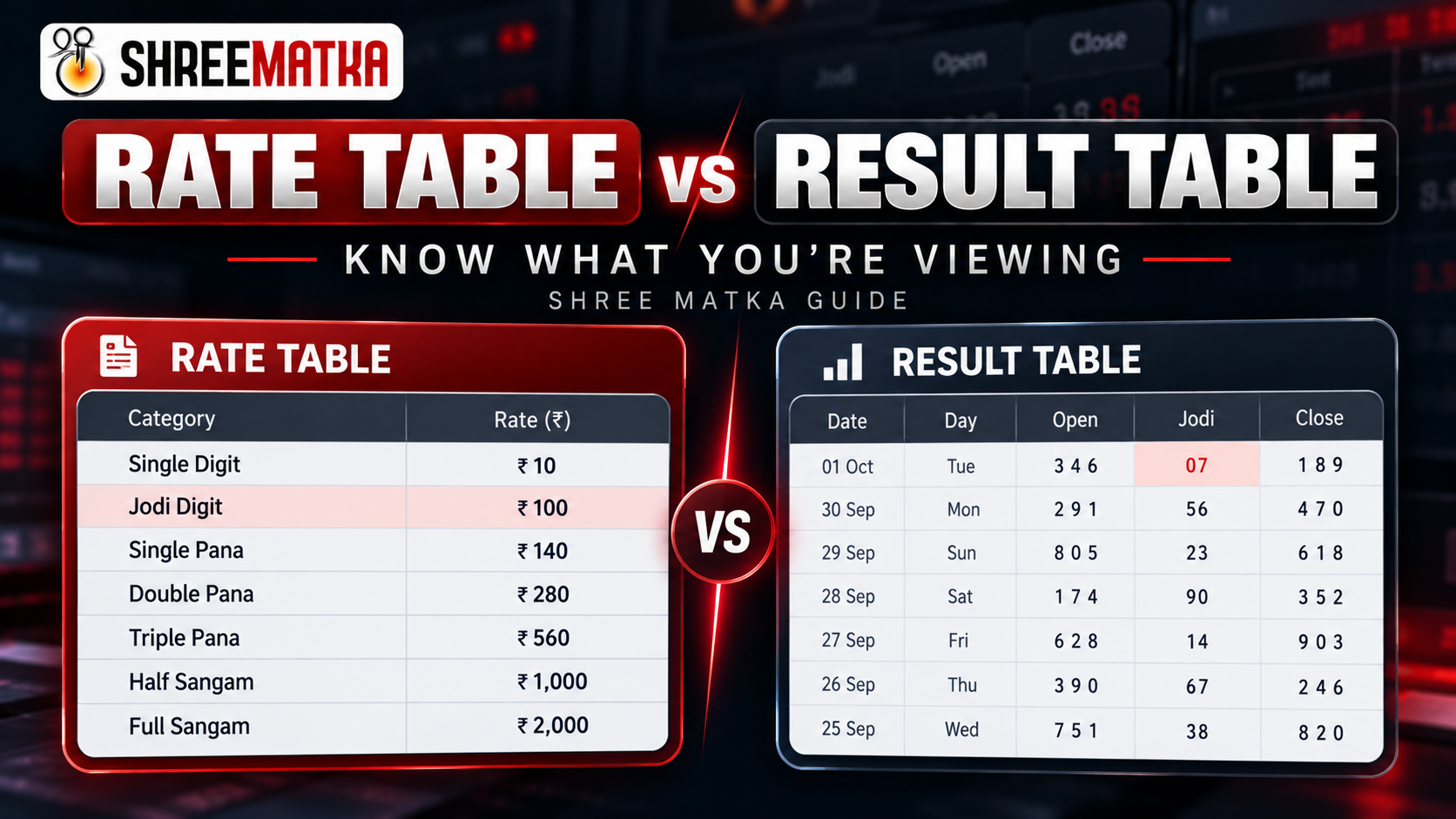
A rate table displays stated multiplier information that establishes the platform's nominal payout ratio per unit stake under valid winning conditions (e.g., ₹ 1 KA ₹ 98 for Jodi Digit). A result table records or presents declared numerical draw outcomes generated by live market sessions (e.g., 560-14-347). They are completely distinct operational data types: rate tables define platform settlement ratios, while result tables record historical game events.
When navigating online Matka platforms like Shree Matka, users encounter multiple tables, grids, and numerical figures. Because both displays feature numeric digits, category names such as Jodi or Pana, and bordered cells, newcomers frequently confuse them. A user might glance at the rate table, spot the number "98", and wonder whether 98 was the declared winning number for the day. Conversely, another reader might see a result record like "14" and assume the market payout multiplier dropped to 14.
To avoid costly misreadings, it is vital to recognize what type of information you are viewing before interpreting any numerical value on screen. This guide examines the actual codebase implementation behind Shree Matka's homepage rates, market cards, and historical chart archives.
What Is a Rate Table on Shree Matka?
On the Shree Matka website, the rate table is located directly on the homepage under the dedicated section anchor #rates. The section is officially titled "Game Win Rates" with the explanatory subheader "We have Best Game Rates for you".
In technical terms, the rate table is not a dynamic database of player wagers or drawn numbers. Instead, it is an administrative presentation layer populated by backend configuration services (specifically LandingPageCacheService drawing from ConfigService.getPayoutMultipliers()). It presents the nominal payout multipliers applicable to each distinct betting variation supported by the software.
On Shree Matka, the rate table is organized into structured rows and cards highlighting standard Matka bet variations:
- Single Digit: Nominal multiplier for selecting the single open or close ank (digits 0 through 9).
- Jodi Digit: Nominal multiplier for correctly matching the complete 2-digit combination (00 through 99).
- Red Bracket: Multiplier for specific matching double or half-red Jodi combinations.
- Single Pana: Multiplier for 3-digit panels containing three distinct ascending digits (e.g., 123, 560).
- Double Pana: Multiplier for 3-digit panels containing one pair of repeating digits (e.g., 112, 334).
- Triple Pana: Multiplier for 3-digit panels containing three identical digits (e.g., 111, 777).
- Half Sangam: Multiplier for matching one Pana panel combined with the opposite Ank.
- Full Sangam: Multiplier for matching both the 3-digit Open Pana and 3-digit Close Pana simultaneously.
What the Rate Table Communicates: The rate table answers one specific question: "If a participant places a valid wager on this category and that wager meets the winning condition, what mathematical multiplier will the software apply to calculate the gross nominal payout?"
What the Rate Table Does Not Establish: The rate table does not establish outcome certainty, does not indicate game difficulty or probability, does not represent personal profit, and does not promise that any participant will achieve a return. Displayed rates must be interpreted strictly in accordance with the platform's published terms of service and applicable administrative rules.
What Is a Result Table?
A result table on Shree Matka presents empirical, chronological outcome data produced by designated market draw cycles. Rather than communicating hypothetical payout ratios, result displays record what actually happened during an official session.
Shree Matka implements result presentations across two distinct interface components:
1. The Live Market Card (Homepage Grid)
On the primary landing page, active markets are rendered as dynamic cards. Each card represents a discrete market entity (such as Kalyan, Main Bazar, or Milan Night) and contains several verified fields:
- Market Name: The official label identifying the draw pool.
- Market Status Badge: Real-time operational badges computed against Indian Standard Time (IST):
- Betting Open — Current time is before the market's configured Open time. Wagers on both Open and Close sessions remain active.
- Running — Current time has passed the Open time but is earlier than the Close time. Open session betting has closed, while the Close session draw is pending.
- Closed for Today — The market's operating hours have fully elapsed, or the market is scheduled off for that specific calendar weekday.
- Displayed Schedule: The configured opening and closing time thresholds (e.g., Open: 03:45 PM | Close: 05:45 PM IST).
- Live Result Display: The visual tripartite string formatted as
Open Panna - Jodi - Close Panna. For example, during active sessions, this field displays asterisks for pending draws (***-**-***), partial declarations during running status (e.g.,560-1*-***), or completed draw combinations (e.g.,560-14-347). - Navigation Links: Direct anchor links routing users to the market's deep historical archives: the Jodi Chart and Panel Chart.
2. Historical Chart Archives (Jodi & Panel Grids)
When a user clicks into Shree Matka's Chart Hub, they access persistent historical databases. Unlike the single-row status card on the homepage, these archives are organized into full tabular grids:
- Jodi Chart Tables: Render a 7-day weekly matrix across Monday through Sunday. Each cell records the official 2-digit Jodi result declared for that calendar date.
- Pana / Panel Chart Tables: Render a comprehensive tripartite breakdown across each calendar date, recording the 3-digit Open Pana, the central 2-digit Jodi, and the 3-digit Close Pana.
Rate Table vs Result Table — Key Differences
To maintain clarity, the operational differences between these two data representations are summarized in the comparison table below. Note that their fundamental distinction lies in their purpose: rate tables specify contractual multiplier rules, while result tables log chronological draw events.
| Comparison Dimension | Rate Table (Game Win Rates) | Result Table (Market Cards & Charts) |
|---|---|---|
| Primary Objective | Communicates stated nominal payout multipliers per unit stake under valid settlement rules. | Records and publishes empirical, verified numerical draw outcomes from official market cycles. |
| Section & Heading Labels | Game Win Rates, We have Best Game Rates for you. | Market title (e.g., Main Bazar, Kalyan), Jodi Chart, Panel Chart. |
| Typical Row / Column Keys | Game variations: Single Digit, Jodi Digit, Single Pana, Double Pana, Sangam. | Dates, weekdays (Mon–Sun), session markers (Open, Close), and status badges. |
| Numerical Format | Currency-prefixed multiplier notation: ₹ 1 KA ₹ 9.8, ₹ 1 KA ₹ 98, ₹ 1 KA ₹ 150. |
Hyphenated draw records: 560-14-347, 2-digit Jodis: 14, or placeholders: ***-**-***. |
| Temporal Context | Static administrative configuration; changes only when platform rules are formally revised. | Time-dependent and chronological; tied to specific draw sessions, dates, and IST schedules. |
| Core Question Answered | "What is the stated gross payout ratio if a selection wins?" | "What specific digits were officially drawn during this market session?" |
| What It Does Not Establish | Does not indicate winning probability, financial return, or guarantee of settlement. | Does not establish future draw predictability or guarantee mathematical repetition. |
How to Recognize Which Table You're Viewing
When scanning through Shree Matka or any associated mobile screen, use this 6-point verification checklist to instantly identify whether you are inspecting a rate table or a result table:
₹) paired with the "KA" preposition (e.g., ₹ 1 KA ₹ 98). Result tables never use currency symbols next to draw numbers; they present raw numeric digits.
560-14-347 or standalone 2-digit pairs like 14 under a weekday column, you are inspecting a result record.
Understanding the ₹1 KA Display
One of the most common user inquiries on Shree Matka pertains to the phrasing used in the rate table: "₹ 1 KA ₹ [Multiplier]" (for instance, ₹ 1 KA ₹ 9.8 or ₹ 1 KA ₹ 98).
In the context of the Hindi-speaking regional origin of Matka games, the word "KA" (का) functions as a relational preposition translating to "for" or "per". Thus, the expression "₹ 1 KA ₹ 98" translates grammatically to:
"For every ₹1 base stake wagered, a valid winning ticket receives a gross nominal payout of ₹98."
This notation communicates the proportional multiplier configured inside the platform's backend engine:
- Single Digit (₹ 1 KA ₹ 9.8): A base stake of ₹10 yields a nominal gross return of ₹98 on a matching single digit.
- Jodi Digit (₹ 1 KA ₹ 98): A base stake of ₹10 yields a nominal gross return of ₹980 on a matching 2-digit pair.
- Single Pana (₹ 1 KA ₹ 150): A base stake of ₹10 yields a nominal gross return of ₹1,500 on a matching 3-digit panel.
Critical Distinction: Nominal Multiplier vs Realized Return: Stating that a game pays ₹ 1 KA ₹ 98 does not imply that a player makes an investment profit or that winning is guaranteed. In probability terms, the mathematical likelihood of selecting the correct Jodi from the 100 possible pairs (00 to 99) is exactly 1 in 100 (1%), while the nominal payout pays at a ratio of 98 to 1. This 2% mathematical discrepancy represents the house edge inherent in the game's payout structure. Readers should understand that displayed rates represent formal contractual rules, not realized profits.
How Rate Information and Results Relate to Other Chart Pages
While rate tables and result tables serve distinct functions, they operate cooperatively within the complete Shree Matka ecosystem. Understanding how they interconnect helps users navigate the site efficiently:
- The Rate Table Informs the Rule Set: Before inspecting results, users review the Game Win Rates section to verify the payout multiplier applicable to the specific game variation they are analyzing.
-
The Market Card Confirms Daily Declarations: Once draw times arrive, users consult the homepage market card to verify the live draw string (such as
560-1*-***during a running market status, or560-14-347once fully closed). - The Chart Archives Provide Permanent Auditing: Declared results from market cards are subsequently indexed into persistent historical tables. Users researching past patterns consult dedicated pages such as the Main Bazar Jodi Chart or the Main Bazar Panel Chart. For a thorough walkthrough of chart structures, review our Satta Matka Jodi & Panel Chart Guide.
- Alternative Market Variations: Different draw categories utilize customized result layouts. For example, hourly draws follow single-panel formats as explained in our Starline vs Main Market Result Format Guide, while non-standard listings follow distinct grouping rules covered in our Jackpot Section Breakdown.
Common Mistakes When Reading Rate and Result Tables
Misinterpreting data tables on online portals leads to widespread confusion. Below are the most frequent errors observed among readers:
1. Treating a Rate Multiplier as a Declared Result
Because the Jodi Digit rate displays 98 and Jodi draw results are two-digit numbers between 00 and 99, beginners often glance at the rate table and report that 98 was today's winning number. Always verify that the section header indicates an actual market name rather than "Game Win Rates".
2. Mistaking a Result Record for a Payout Multiplier
If a market declares a winning Jodi of 14, misinformed users occasionally assume that the platform's payout rate has dropped from 98 down to 14. Payout rates do not fluctuate based on the specific numerical value of the drawn numbers.
3. Confusing Market Status with Result Availability
When a market card displays the status badge Running, it indicates that the Open session betting window has concluded, but the Close session draw is still pending. At this stage, the card might display 560-1*-***. Readers who expect a complete 8-digit string often misinterpret the asterisks as a display glitch or server error, when in reality they are standard placeholders indicating that the Close draw has not yet occurred.
4. Committing the Gambler's Fallacy with Chart Archives
A widespread misconception among Matka enthusiasts is the belief that historical result tables reveal "due numbers" or predictable patterns. In probability theory, each draw is an independent event with stationary odds. The fact that a specific Jodi has not appeared over consecutive weeks does not increase its probability of appearing in the subsequent session.
Frequently Asked Questions
Conclusion & Key Takeaways
Recognizing the difference between rate tables and result tables is essential for accurately interpreting data on Shree Matka. To recap:
- Rate Tables (Game Win Rates) define the platform's contractual multipliers per ₹1 unit stake under winning conditions. They are static administrative parameters and do not represent winning numbers or financial guarantees.
- Result Tables (Market Cards & Charts) record empirical draw outcomes produced by verified market sessions. They are time-stamped, organized by calendar date, and formatted in tripartite or 2-digit numeric strings.
Whenever you view numerical data on Shree Matka, make it a habit to check the section header, look for currency symbols, and verify the presence of status badges before drawing conclusions.
Editorial & Responsible Information Notice: This article is published exclusively for informational and interface education purposes. Shree Matka does not offer financial guarantees, prediction formulas, or wagering advice. Real-money gaming carries financial risk and may not be legally permitted in all jurisdictions. Users must be 18 years of age or older.