
How Satta Matka Payout Structures Work
A Matka payout is quoted as a multiple: the amount a winning ₹1 stake returns. When a rate card says a jodi pays 98, it means a winning ₹1 jodi ticket comes back as ₹98. That single number is the most visible figure in the game and the least informative one on its own, because it describes only the winning side of the transaction.
Three inputs determine what any bet is actually worth:
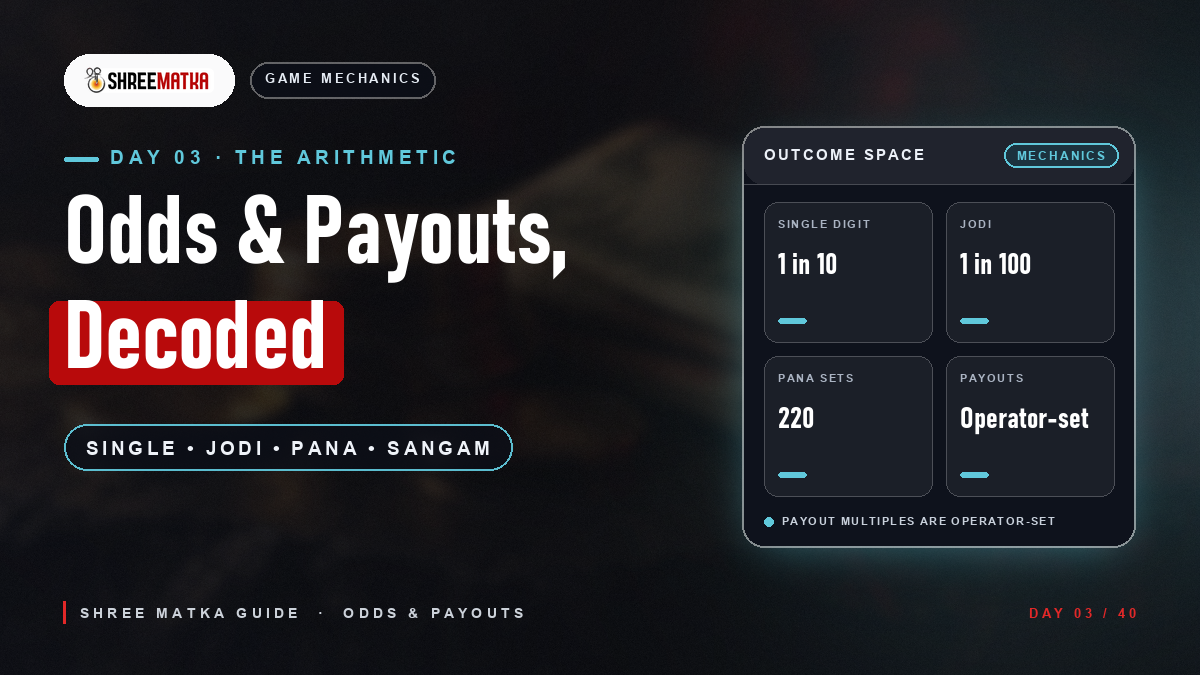
- The outcome space: how many distinct results the bet has to match — 10 digits for an ank, 100 pairs for a jodi, 220 panas for a named pana.
- The construction: whether the bet is a single selection or a combination of two declarations (pana families, sangam pairs), which multiplies the outcome space.
- The operator's rate card: the multiple that market chose to publish, which is a commercial decision and not a law of mathematics.
One convention needs flagging before the numbers start: some rate cards quote the total return including the stake, others quote the profit on top of it. The difference is one unit of stake per ₹1, small on a single ticket and material across a session. This guide quotes total return, and every table below is written so you can re-run the arithmetic against whatever convention your own source uses. The bet types themselves are defined in the beginner's guide to rules and terminology, and the declared results they settle against live in the chart archive.
Finally, a scope note: rates are published by each market and each operator, they differ between platforms, and they change over time. The multiples used below are the ones most commonly quoted in public Matka literature. Treat them as worked examples of the method, never as a current price from any specific operator.
Single Digit (Ank) Payout: ₹1 → ₹9.8
The ank, or single digit bet, is the simplest priced wager in Matka. You choose one digit from 0 to 9 and match it against a declared session digit — the open digit derived from the day's open pana, or the close digit derived from the close pana. Ten possible digits, one winner, so the probability of any named digit is exactly 1 in 10.
The rate most often quoted for that bet is ₹9.8 returned per ₹1 staked, with published figures elsewhere in the 9.5–10 band. Run the comparison that matters:
| Measure | Single Digit (Ank) | Why It Is What It Is |
|---|---|---|
| Outcome space | 10 digits | 0–9, one declared winner per session. |
| Probability | 1 / 10 = 10% | Ten equally possible digits. |
| Commonly quoted rate | 9.8 : 1 | Market convention, not mathematics. |
| Expected return per ₹1 | 0.98 | 9.8 × 0.1 — a ~2% hold. |
That last row is the whole story of the ank bet. A rate of 10.0 would be a break-even price for the operator, so 9.8 keeps roughly two paise of every rupee wagered across a large sample of tickets. Nothing about that figure is dishonest — it is the price of running the book — but it does mean the arithmetic average outcome of repeated play is a slow, steady loss, and no selection technique removes it.
Jodi Payout: ₹1 → ₹98
The jodi joins the open digit to the close digit into one two-digit pair, which expands the outcome space from 10 to 100 possibilities (00 through 99). A named pair therefore wins once in 100 draws, and the rate most commonly published for it is ₹98 per ₹1.
Note what has happened between the two sections. The outcome space grew tenfold, the quoted multiple grew almost exactly tenfold, and the expected return stayed at 0.98. That is not a coincidence: the jodi rate is derived from the same hold structure as the ank rate, scaled to a bigger denominator. It is also why the pair of figures in this article's headings — ₹9.8 and ₹98 — are worth memorising as a relationship rather than as two numbers.
Two reading habits make jodi pricing useful in practice:
- Convert every quoted rate into expected return before comparing it with another bet. A 98-multiple is not twice as good as a 49-multiple unless the outcome spaces match.
- Ignore colour and presentation. Red-marked pairs on professional charts are an annotation device; a red jodi pays the same published rate and carries the same 1-in-100 chance as any other pair. The pair-level reading techniques are covered in the jodi & panel chart guide and the jodi chart walkthrough.
Pana Variations Explained
The pana is the three-digit engine behind every result line, and pricing it requires the single most misunderstood fact in Matka mathematics: a named pana is a 1-in-220 bet, not a 1-in-1000 bet. Because panas are recorded in ascending digit order, the thousand raw permutations collapse into 220 distinct panas — and only those 220 can ever be declared.
| Pana Family | Digit Pattern | Combinations | Share of the 220 | Example |
|---|---|---|---|---|
| Single Pana (SP) | All three digits distinct | 120 | 54.5% | 128 |
| Double Pana (DP) | Exactly two digits equal | 90 | 40.9% | 122 |
| Triple Pana (TP) | All three digits equal | 10 | 4.5% | 555 |
That table exposes two entirely different products that share the word “pana”. A named pana bet asks for one of 220 combinations — a 0.45% chance, for which a zero-hold price would be 220:1. A family bet asks only whether the declared pana is single, double or triple, which is a high-frequency question with a small fair multiple: 1.83:1 for single, 2.44:1 for double, 22:1 for triple.
Published multiples for named panas vary far more between markets than ank and jodi rates do, precisely because the 220-outcome space gives operators more room to price. This is where the arithmetic earns its keep: divide the quoted multiple by 220 and you know instantly what that particular market is charging. The complete family-by-family catalog is maintained in the 220 Patti chart list.
Sangam Bet Calculations
Sangam bets price a combination of the day's two sessions, and their mathematics is simply multiplication of independent outcome spaces. Half sangam pairs the open pana with the close digit; full sangam pairs the open pana with the close pana.
| Bet | Components | Outcome Space | Probability | Zero-Hold Rate |
|---|---|---|---|---|
| Half Sangam | Open pana + close digit | 220 × 10 | 1 / 2,200 | 2,200 : 1 |
| Full Sangam | Open pana + close pana | 220 × 220 | 1 / 48,400 | 48,400 : 1 |
The structural point is worth stating plainly: sangam multiples look enormous because the outcome space is enormous, not because the bet is generous. A full sangam needs both a specific 1-in-220 open pana and a specific 1-in-220 close pana in the same session. Quoted sangam rates also vary more between markets than any other figure on the card, which makes the zero-hold column above the most useful number in this table — compare any published multiple against it and the gap tells you the price.
The construction of these combinations, including which digit of each pana is used, is worked through in the half sangam vs full sangam guide.
Official Shree Matka Mobile Application
Access live 1-second results, historic panel charts, and verified game rate tables directly on your Android phone.
The Probability Behind Every Rate
Everything above reduces to one formula. Take the payout multiple, multiply it by the probability of winning, and the result is the expected return per rupee wagered. Subtract it from 1 and you have the hold — the percentage the book keeps across a large sample.
Expected return = payout multiple × probability • Hold = 1 − expected return
| Bet | Probability | Commonly Quoted Rate | Expected Return | Implied Hold |
|---|---|---|---|---|
| Single digit (ank) | 1 / 10 | 9.8 | 0.98 | ~2% |
| Jodi | 1 / 100 | 98 | 0.98 | ~2% |
| Named pana | 1 / 220 | varies widely | rate ÷ 220 | check the card |
| Half sangam | 1 / 2,200 | varies widely | rate ÷ 2,200 | check the card |
| Full sangam | 1 / 48,400 | varies widely | rate ÷ 48,400 | check the card |
Two conclusions follow, and they are the practical payload of this article. First, the simple bets are priced consistently: a ~2% hold on both ank and jodi means the operator earns the same fraction regardless of which of the two you prefer. Second, as bets get more specific the spread of quoted rates widens dramatically — and with it the risk of accepting a bad price. A pana quoted at 150 returns 0.68 per rupee (a 32% hold); the same pana at 200 returns 0.91 (9%). Both are the same bet with the same 1-in-220 chance. Only the price changed.
The other thing this formula predicts is variance. A 1-in-48,400 bet that wins is a genuine outlier event; losing streaks are not a sign that a win is owed, they are the expected shape of a low-probability wager. Anyone offering a “guaranteed” rate, leak or sure-shot jodi is selling something the arithmetic above already disproves.
Worked Payout Examples
Here is the method applied end to end, using a ₹100 stake and the commonly quoted multiples for the two simple bets plus two illustrative multiples for the exotic ones. These are teaching figures, not offers.
return 980 • probability 1/10 • EV 0.98
return 9,800 • probability 1/100 • EV 0.98
return 15,000 • probability 1/220 • EV 0.68
return 200,000 • probability 1/2,200 • EV 0.91
Read the last column, not the first. The pana ticket prints the biggest headline number of the four and is the worst price on the card, because 150 divided by 220 gives back only 68 paise per rupee. The jodi, whose multiple looks modest next to it, returns 98. This is exactly the comparison a rate card is designed to discourage — and it is the one calculation worth learning.
The same discipline applies when you move from rates to records: a result line only means anything once you can verify it, which is what the Kalyan chart reading guide and our note on why results differ between websites are for.
Managing Your Bankroll Responsibly
Every table in this guide points the same direction: the arithmetic average of repeated play is negative, and it stays negative whatever the stake size. That is not an argument for clever staking systems — doubling after a loss changes the shape of the downside, never its average. What bankroll management can do is cap the damage and keep the activity inside its intended box.
- Set an entertainment budget in advance, in an amount whose complete loss changes nothing in your life. That figure, not winnings, is the bankroll.
- Size decisions against the budget, not against the odds. A common guardrail is a small single-digit percentage of the budget per session, with a hard stop once it is spent.
- Never borrow to play and never chase. Both convert a bounded entertainment expense into an unbounded liability.
- Treat any win as a return of the budget, not as income, and set a time limit before you start — session length is the variable most people forget to budget.
If you do use platforms to check rates or records, verify the source first — the checklist in our app verification & safe-install guide covers how to confirm a package is genuine rather than a cloned lookalike.
Frequently Asked Questions
What does a Satta Matka payout rate mean?
What is the single digit payout rate?
How much does a jodi pay?
Why are pana odds 1 in 220 and not 1 in 1000?
What are half and full Sangam payouts?
Do higher payout rates mean better bets?
Are payout rates the same across all Matka markets?
Can knowing the odds improve my chances of winning?
Download the Official Shree Matka App
Experience real-time live results, complete historic panel records, and 24x7 verified automated withdrawals on your Android smartphone.
Download App
Comments (0)
Loading comments...