
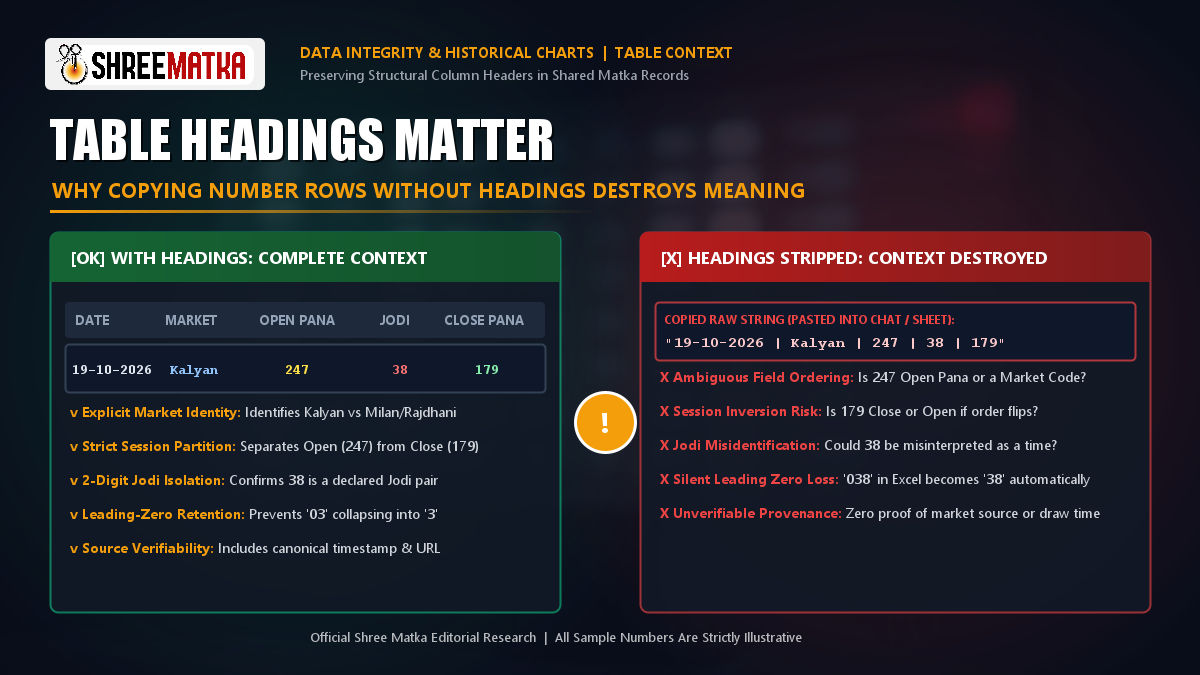
1. Why Table Headings Are Part of the Information
In digital record keeping, there is an important distinction between raw data and information. A sequence of numbers such as 247, 38, and 179 is raw data. By themselves, those three numbers could represent telephone prefixes, financial indices, serial codes, or lottery outcomes. They only become useful information when framed inside a table with unambiguous column headers: Open Panel, Jodi, and Close Panel.
When users browse historical archives on the Shree Matka chart directory, the browser displays complete tables where every column header establishes the operational role of each cell. The header row is not merely a visual design choice; it is the dictionary that translates positional digits into verified market records.
When someone highlights only the middle cells of a webpage and copies them into a chat message, notes app, or spreadsheet without the accompanying column headings, the dictionary is discarded. The receiver of that snippet is forced to make assumptions about what each number represents—and in numerical tracking, assumptions lead directly to false conclusions.
2. How Context Disappears When a Row Is Copied
To understand how easily data context evaporates, consider what happens in a standard copy-and-paste action. A user viewing a Kalyan chart sees:
| Date | Market | Open Panel | Jodi | Close Panel |
|---|---|---|---|---|
| 19-10-2026 | Kalyan | 247 | 38 | 179 |
In this original table, every value is crystal clear:
19-10-2026is the specific calendar draw date.Kalyanidentifies the operational market.247is the three-digit opening patti.38is the two-digit central jodi.179is the three-digit closing patti.
Now consider what happens when the user pastes only the row values into a message:
Or worse, without delimiters:
While the person who copied the text may temporarily remember the column order, anyone reading the message hours later—or reviewing a forwarded note—lacks that context. If the market name is accidentally trimmed, the snippet reduces to 247 38 179, completely unmoored from time, market, and structure.
3. Why Order, Date, and Session Labels Matter
The Satta Matka chart system is fundamentally chronological and positional. Changing the order of fields changes the meaning of the record completely:
1. Open Panel vs Close Panel Reversal
In Satta Matka, both the Open Pana and Close Pana are selected from the identical pool of 220 standard Patti combinations (120 Single Panas, 90 Double Panas, and 10 Triple Panas). There is no mathematical marker inside the number 247 that says "I am an Open Pana," nor is there anything inside 179 that says "I am a Close Pana."
If an unlabelled snippet is pasted as 179 | 38 | 247, an analyst who relies on positional reading will falsely conclude that 179 opened the market and 247 closed it. This creates completely inverted chart patterns and invalidates any subsequent cycle analysis.
2. Incomplete vs Completed Sessions
Unlike many traditional lottery draws where all winning numbers are published at once, Main Matka markets operate across separated daily time windows. The Open session concludes in the afternoon, while the Close session concludes in the evening.
During the interim afternoon window, the live table displays an Open Pana (e.g. 247) and Open Digit (3), while the Close section displays pending placeholders (***) or a "Running" market badge.
If an observer copies 247 - 3* - *** into plain text without headers indicating session status, readers who encounter that text later may assume the draw was voided, misinterpret the asterisk, or fail to recognize that the final evening close has not yet occurred.
4. How Missing Labels Create Ambiguity
Beyond swapping open and close panels, removing table headings introduces four distinct classes of data distortion:
A. Single Digit vs Jodi Confusion
When numbers are pasted into applications that auto-format numeric strings (such as spreadsheet software or chat auto-formatters), leading zeros are routinely stripped. As detailed in our technical study on why a Jodi like 03 must keep its leading zero, a Jodi pair representing 03 becomes the single digit 3 when treated as a raw integer.
If column headings are present, the label Jodi immediately alerts the reader that 3 is a corrupted representation of 03. But without the column header, the reader has no way of knowing whether the number was originally an Open Single Digit (3) or a truncated two-digit Jodi (03).
B. Loss of Market Identity
India's market landscape comprises dozens of distinct regular markets, Starline schedules, and Jackpot draws. A sequence like 345 - 2 could represent:
- An afternoon draw of Kalyan Night.
- A 02:00 PM slot result from Kalyan Starline (where slots declare single patti and ank).
- An open-session snippet from Milan Day.
Without an explicit Market column header, historical entries lose their parent identity. Number strings from completely different markets get mixed together in research notes, leading to flawed statistical conclusions.
C. Rate Table vs Result Table Confusion
A particularly hazardous confusion occurs when numbers from a game-rate table are copied without column labels. A rate table lists nominal multiplier ratios (such as "₹1 Ka ₹ 98" for Jodi Digit). If a row is copied as Jodi | 98 without the header Payout Multiplier, a reader skimming the text might mistake 98 for yesterday's winning Jodi draw outcome!
5. A Before-and-After Demonstration
To visualize how removing headings degrades information, examine this direct before-and-after comparison:
| Date | Market | Open | Jodi | Close |
|---|---|---|---|---|
| 19-Oct | Kalyan | 247 | 38 | 179 |
Result: Unambiguous. Every reader knows the date, the market, which 3-digit number opened, which closed, and the resulting 2-digit Jodi.
Ambiguity Introduced: Which number is Open Pana? Is 38 the Jodi or an Open+Close single digit? What happens if pasted into Excel and 38 becomes 38 but a Jodi of 08 becomes 8?
6. How to Copy or Share a Table Responsibly
When extracting historical chart entries from Shree Matka for personal research or archiving, following these four best practices guarantees that your records remain clean and unambiguous:
-
Always Include the Header Row: When highlighting table cells with your cursor, start your selection at the column headers (
Date | Market | Open Pana | Jodi | Close Pana) rather than starting on the first data row. -
Use Markdown or Delimited Plain Text: If sharing in chat applications or forums that do not support rich HTML tables, format your text using markdown syntax or clear pipe delimiters:
| Date | Market | Open Pana | Jodi | Close Pana | |------------|--------|-----------|------|------------| | 19-10-2026 | Kalyan | 247 | 38 | 179 | -
Format Cells as Text in Spreadsheets: If pasting numbers into Microsoft Excel or Google Sheets, pre-format the destination columns as Plain Text (not "General" or "Number"). This ensures that leading zeros (e.g.
03,045) are preserved exactly as displayed. -
Append the Canonical Source URL: Include a direct link back to the verified page (e.g.
https://shreematkasatta.com/chart/pana/kalyan). This allows any recipient to cross-reference the numbers against the live database at any time.
7. How to Preserve the Source and Original Formatting
If you frequently archive historical chart records, rely on direct page printing or PDF export rather than manual copy-pasting. Using your browser's print dialog (Ctrl + P) to save a chart as a PDF automatically preserves:
- The complete 7-day weekly column structure.
- Repeated header rows on every page break.
- Red Jodi cell color indicators.
- The official market title, timestamps, and canonical URL in the header and footer margins.
For detailed instructions on configuring page layout and scaling for clean chart printing, consult our comprehensive guide on How to Print a Long Pana Chart Without Cutting Off Its Column Headings.
Frequently Asked Questions
Why are table column headings considered essential data rather than just labels?
What is the biggest risk when copying Matka numbers into a spreadsheet without headers?
How does copying a partial result table lead to false historical records?
Can you distinguish between an Open Pana and a Close Pana without column headings?
What is the best way to share a chart row without creating ambiguity?
Access Verified Result Tables in Real Time
Download the official Shree Matka Android app for clean, fully labelled market records, verified panel tables, and instant automated updates.
Download App
Comments (0)
Loading comments...