
Sridevi Market Overview: Two Rows, And Only One Is Named Night
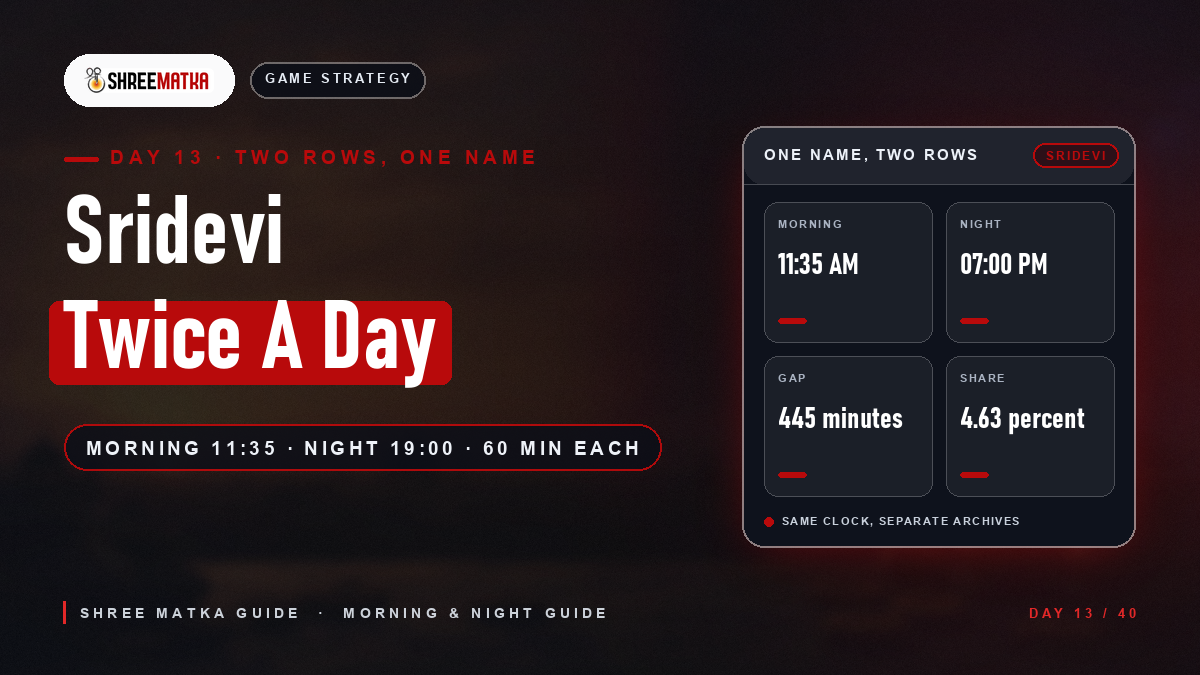
Start with what is stored, because the vocabulary a reader brings to Sridevi is ahead of the record. The markets table inserts two rows whose names begin with the word: Sridevi, typed MAIN, opening at 11:35:00 and closing at 12:35:00, and Sridevi Night, typed MAIN, opening at 19:00:00 and closing at 20:00:00. Both are active. There is no row called Sridevi Morning and no row linking the two: no series column, no pair key, nothing in the schema that says these markets belong together. The pairing is a fact about the names, and the reader has to hold it.
Everything else follows from that: two market-day records, two chart archives, two deadline sets and two different neighbourhoods on the day’s clock. It also makes “Sridevi result” ambiguous in a way “Time Bazar result” is not — Time Bazar is one row, Sridevi is two.
| Row | Type | Opens (IST) | Closes (IST) | Window | Session word in the name |
|---|---|---|---|---|---|
| Sridevi | MAIN | 11:35 AM | 12:35 PM | 60 min | No — the bare name is the morning row |
| Sridevi Night | MAIN | 07:00 PM | 08:00 PM | 60 min | Yes — Night |
| Sridevi Morning | — | — | — | — | This row does not exist |
| Sridevi Starline | — | — | — | — | No Starline row carries the name; the 6 seeded Starline rows are Kalyan, Mumbai, Milan, Rajdhani, Supreme, Parel |
The equal windows are worth noticing early. Of the 25 MAIN rows only 6 have a 60-minute live phase, and Sridevi supplies two; the other four are Time Bazar, Parel Day, Madhur Day and Parel Night. The pair is live 120 minutes a day, 4.63 percent of the 2,590 MAIN minutes this schedule opens — exactly the share a single median-length row takes. So the pair buys no extra deciding time; it buys a second, separate set of the same sixty minutes.
Which URL Is The Morning Session: The Slug Is A Function Of The Name
Ask a practical question and the answer is a URL: which page is the morning session? The chart routes do not read a session field, because there is not one to read. They take the path segment, normalise it, and compare it against the normalised name of every market. One shared utility does that normalisation for routing, canonical tags, sitemap entries, internal links and redirects, and its rules are short: trim, strip accents, lower-case, replace any run of non-alphanumeric characters with one hyphen, collapse hyphens, trim both ends.
Sridevi@srideviSridevi Night@sridevi-nightSridevi Morning@sridevi-morning -> no market matchesTwo consequences matter the first time a link misbehaves. The route is forgiving about spelling and strict about identity: a request to /chart/jodi/Sridevi is normalised, matched, and answered with a permanent redirect to the canonical lower-case form. A request to /chart/jodi/sridevi-morning is normalised just as happily, finds no match, and returns a not-found page — the route never guesses that a reader who typed Morning wanted the row without the word.
The second consequence is a property of the schema rather than the routing. The uniqueness constraint sits on the raw name, not on the slug, and the slug function is lossy: two names differing only in punctuation would be two storable rows and one indistinguishable URL, with the lookup taking the first match it finds. Nothing in the current 31-row seed collides — all 31 names give 31 different slugs — but the guarantee comes from the data, not the model, which is a reason to treat a market name as an address rather than a description.
| Naming shape | Bases | Count | What the morning URL looks like |
|---|---|---|---|
| “X Day” plus “X Night” | Dadar, Madhur, Milan, Parel, Rajdhani, Supreme | 6 | x-day — the session word is in the URL |
| Bare “X” plus “X Night” | Kalyan, Sridevi | 2 | x — the session word is nowhere |
| One row, no partner | Disawar, Faridabad, Gali, Ghaziabad, Kuber, Main Bazar, Old Main Mumbai, Time Bazar, Worli Mumbai | 9 | x — and there is no second page to confuse it with |
Sridevi Chart Analysis: Two Archives That Never Meet
Both chart pages exist for each row, because the routes are parameterised by market and by chart type rather than by session — which gives four Sridevi pages in total. They are structurally identical: same query, same weekly grouping, same rolling window, and nothing on the site merges them into one view.
| Page | What each cell holds | What the page cannot show |
|---|---|---|
| /chart/jodi/sridevi | One row per open date of the morning market: open triple, close triple and the jodi formed from their last digits | Anything from the night row, or any sign that a partner market exists |
| /chart/jodi/sridevi-night | The same three values for the evening row | The morning row’s results, even for the same date |
| /chart/pana/sridevi and /chart/pana/sridevi-night | The full three-digit pannas for whichever single row the slug resolves to | A combined Sridevi panel across both sessions |
The archive is the rolling 365-day window every market on the site uses: the controller takes today in the India timezone, steps back a year, queries that market’s market-day rows newest first, groups them into Monday-to-Sunday weeks and renders missing dates as stars. Day 11 and Day 12 cover what that horizon contains; the part that changes for a two-row market is that it is per row, not per name. Comparing the morning chart against the evening chart therefore compares two 365-day windows that overlap almost completely in calendar terms.
One honest note about emptiness. The migrations seed the 31 markets and nothing else — no insert into the market-day table exists in any of them — so on a freshly built database all four Sridevi pages render as empty grids, as does every other market page. A reader checking any claim in this series against a live page should confirm rows are present before reading anything into their absence.
Historical Trend Analysis: Same Dates, Two Series, One Grid Each
The historical question the outline asks is the right one to answer badly by accident, because two series that share a name invite pooling. Both rows declare on every date the platform runs them, so the morning and evening series are aligned date for date: for any date there is at most one morning record and exactly one evening record to match it. That alignment is a statistical asset, and it is also why the tempting move is wrong.
The tempting move is to append the two archives into one “Sridevi” series and count 730 observations a year. Day 10 makes the case against pooling for the Rajdhani pair, and the argument carries over unchanged: two separate markets with separate draws treated as one sample of double the size understates the spread a single row produces by chance. What the alignment allows is the honest alternative — keep the samples separate and compare them as pairs.
@365 (one per open date)@365@pool into one series, n = 730@paired difference per date, n = 365@the spread looks ~1.41x tighter than it isA paired framing matters here more than for the other couples, because the two Sridevi sessions are the closest to interchangeable on this schedule: same type, same 60-minute window, same bet families, same odds structure, same archive rules. The variables that differ are the clock position and the traffic around it. So any difference found between the two series is noise unless it survives a paired test with the date held fixed — there is no structural difference left to blame.
The trend question therefore has a dull answer worth more than an interesting one. A fortnight of high cut numbers in the morning row and low ones in the evening row is not two findings; it is one window of calendar time observed twice. A pattern has to be stated for one row at a time, on a stated number of declarations, with the other row as the control rather than as extra evidence.
Timing Strategies: Seven And A Quarter Hours Apart
Timing is where the two rows genuinely part company, and the arithmetic is wider than the labels suggest. Their opens are 445 minutes apart — seven hours and twenty-five minutes — and between the morning row’s close at 12:35 PM and the night row’s open at 07:00 PM there are 385 minutes in which neither market exists as a live session. Compare the Rajdhani couple, whose sessions sit inside one evening block: the phrase “morning versus night” starts to look less like a session comparison and more like two markets that share a word.
| Session | Rows live during it | Declarations within 40 min of its close | Rows still to declare after it |
|---|---|---|---|
| Sridevi, 11:35 AM to 12:35 PM | 2 (Mumbai Starline, Milan Starline) | 2 (Mumbai Starline -35 min, Milan Starline +25 min) | 27 |
| Sridevi Night, 07:00 PM to 08:00 PM | 1 (Faridabad) | 1 (Faridabad +15 min) | 14 |
Read the last column first, because it is the one that changes behaviour. A reader who finishes with the morning row at 12:35 PM has a full day left: 27 declarations still land, starting with Milan Starline at 13:00. A reader who finishes with the night row at 08:00 PM is not finishing the day at all — they are at the front of the evening’s fourteen remaining declarations, ahead of Faridabad at 20:15, Parel Night at 21:15, Ghaziabad and Worli Mumbai at 22:00, and the cluster that runs to the shared 23:55 close of Main Bazar and Gali.
The middle column says something different again. The morning declaration is bracketed by two Starline results inside 40 minutes on either side, so four declarations land between 11:00 AM and 1:00 PM; the night close has one neighbour and sits at the head of a quieter stretch, with only two declarations between 6:30 PM and 8:30 PM. Neither fact informs the other row’s numbers, since the draws are independent, but they change what a reader is exposed to, which is what timing strategies operate on.
The deadlines themselves are the ordinary pair every MAIN row carries, and Day 09 owns the session-state mechanism, so the short form: open-session bets on the morning row stop at 11:35 AM, close-session bets including jodi stop at 12:35 PM or when the result publishes; 07:00 PM and 08:00 PM for the night row. Since a published result overrides the clock, the practical difference between the two rows is not the length of the deadline but how much of the day’s other activity is running down beside it.
Morning Versus Night Patterns: Identical Windows, Different Company
What, then, is a “morning versus night pattern” in a market where both sessions have identical windows, bet types and archive rules? The phrase has one legitimate meaning and one that does not survive contact with the record.
The legitimate meaning is about the reader’s own behaviour, and it is measurable. Write one rule for the morning row and the same rule for the night row, and the two series give 365 aligned observations of whether it holds in each. A rule that works on one series and not the other has failed a control that costs nothing to run, and the rows’ structural identity makes that control sharp: no window-length or format difference is left to explain the disagreement.
The meaning that does not survive is the one where the session word carries predictive content — where “it is the morning draw” is treated as a property of the numbers. Nothing in the record supports that. A market day stores six digits and two timestamps; the type field says MAIN for both rows; the only difference between them is a pair of clock times. Those times decide when a bet can be placed and nothing else, and the odds structure is the same across MAIN rows, as Day 03 works out.
| Claim a reader might make | What would have to be true | What the record supports |
|---|---|---|
| Morning results run higher than evening ones | A mechanism linking session time to the drawn digits | Two independent series; a paired difference test on stated dates |
| The night row is “the real” Sridevi | A primary/secondary flag on the market row | No such field; both rows are typed MAIN and both are active |
| A pattern seen in both rows is confirmed | Two independent confirmations | One calendar window observed twice; the rows share their dates |
One absence belongs in the list even though no claim asks for it: six Starline markets exist on this schedule and Sridevi is not one of them, so the pair has exactly two members and no third archive to cross-check against. Day 05 and the Starline versus Main piece cover why a Starline result cannot be read as a Sridevi result; here the point is only that no such page exists to open.
Bankroll Management For A Two-Row Market And The Risks Specific To Sridevi
Bankroll management for a two-row market has one advantage and one trap, and they are the same fact seen from two sides. The advantage is symmetry: both windows are 60 minutes and both rows declare once a day, so an allocation rule has no obvious reason to weight one session over the other, and a reader who wants a simple discipline can state one — a fixed cap per market per day, applied twice — without modelling anything. Day 10 does the allocation arithmetic for a pair with unequal spacing; here there is less to trade off.
The trap is that the evening row is not the end of a reader’s day, it is the beginning of the busiest block on the schedule. Fourteen declarations land after 08:00 PM, and twelve markets open sessions between 08:00 PM and 09:40 PM, all in front of the 11:55 PM close. A cap written per session survives that; a cap written as “one market a day” does not, because Sridevi Night is the row readers finish with and then keep going past. Days 07 and 12 put it plainly: the seeded schema enforces no per-day, per-session or per-market limit, so the only stop that exists is the one written down in advance.
@Sridevi and Sridevi Night, named as two markets@one fixed amount per row per day, set before the first session@stated for one row only, on a stated number of dates@the same rule on the other row, same dates@either cap spent, or 08:00 PM, whichever comes firstThe remaining risk factors specific to Sridevi are small and worth listing rather than inflating. The naming asymmetry is a real operational risk for a reader keeping their own records: a spreadsheet column headed “Sridevi” is ambiguous unless each row is identified by its market, and the cheapest fix is to write the two names out in full, since only one of them contains a session word. The 385-minute dead stretch between the sessions means no in-between reading exists; a decision taken at 3:00 PM belongs to neither market.
Limits Of Sridevi Analysis And The Written Spec
What Sridevi analysis cannot reach is now specific enough to state without hedging. It cannot reach a forecast, because both archives are records of completed draws and the schema stores nothing that constrains a future one. It cannot reach a combined Sridevi statistic, because no combined record exists and pooling two aligned series manufactures a sample size rather than information. It cannot reach a session effect, because the two rows differ in nothing but their clock times, and a difference found between them with everything else held fixed is the definition of noise. And it cannot reach a third view through Starline, because there is no Sridevi Starline row.
What it can reach is equally specific, and it is the list the rest of this series keeps arriving at: two markets whose structure is now known, four chart pages whose contents are known, 730 declarations a year that are really 365 pairs, traffic that treats the morning row as mid-day and the evening row as the start of the busiest block on the board, and a naming convention that makes one of the two URLs ambiguous. Write the spec before the first session, score it after 08:00 PM, and keep the two rows in separate columns.
Frequently Asked Questions
What is Sridevi in Satta Matka?
Is there a market called Sridevi Morning?
What time does Sridevi betting close?
Are the morning and night sessions the same length?
How far apart are the two Sridevi sessions?
How much Sridevi history can be analysed?
Can Sridevi chart patterns predict the next result?
Is Sridevi Night riskier than the morning row?
Download the Official Shree Matka App
Experience real-time live results, complete historic panel records, and 24x7 verified automated withdrawals on your Android smartphone.
Download App
Comments (0)
Loading comments...