
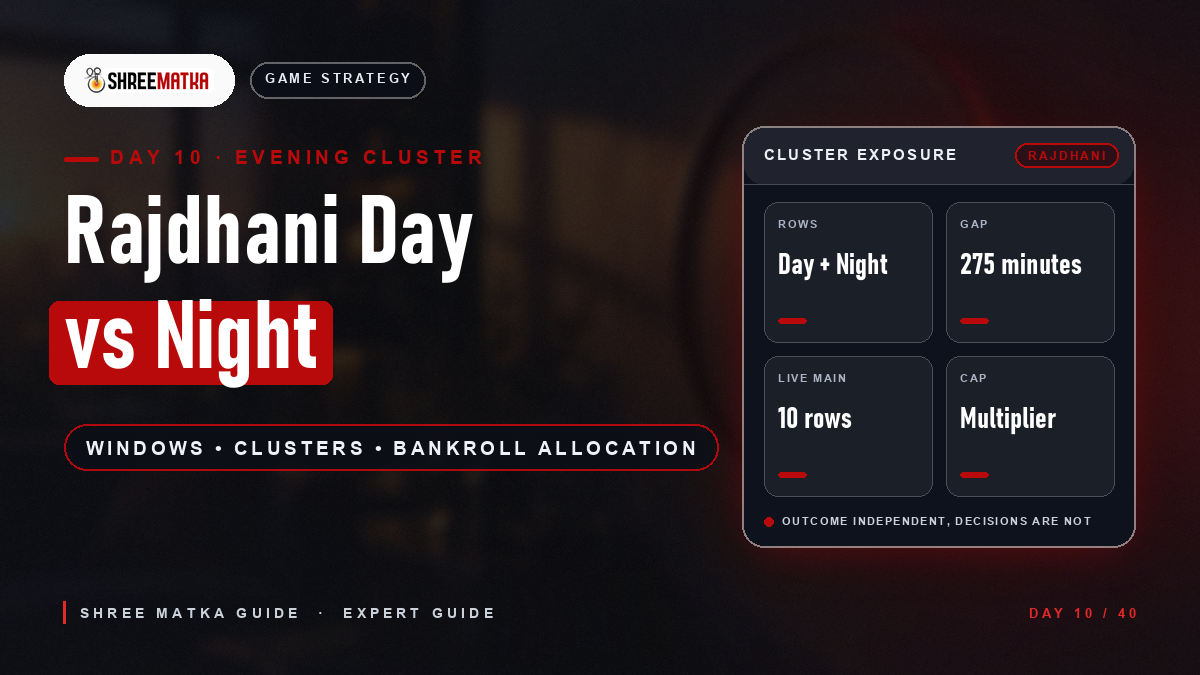
Rajdhani Market Overview: What The Schedule Actually Says
The word “Rajdhani” on this platform is not one market. The schedule seed inserts three rows sharing the prefix, the markets table enforces a unique name per row, and nothing in the schema groups them under a parent. Reading the rows instead of the label is the first analytic move, because two of the three behave in materially different ways.
| Market row | Type | Opens | Closes | Window | Bet families |
|---|---|---|---|---|---|
| Rajdhani Day | MAIN | 03:00 PM | 05:00 PM | 2 hours | ank, jodi, three panna families, sangam |
| Rajdhani Night | MAIN | 09:35 PM | 11:35 PM | 2 hours | ank, jodi, three panna families, sangam |
| Rajdhani Starline | STARLINE | 01:00 PM | 02:00 PM | 1 hour | ank and three panna families only |
Two facts fall out of that table immediately. The first is that Rajdhani Day shares its window with Milan Day to the minute — both open at 03:00 PM and close at 05:00 PM — and four other MAIN rows plus one Starline row overlap that block, so an afternoon “Rajdhani read” is made in the same hour as five other decisions. The second is that the night row is not merely a later copy: it opens at 09:35 PM into a window where ten MAIN markets are already live, and its close at 11:35 PM is one of twelve declarations that land in the hundred and forty minutes after it opens.
Rajdhani Starline is the odd row, and the one most guides get wrong. A STARLINE-type market carries the ank digit and the three panna families but no jodi and no sangam, so a cut-pair rule written for Rajdhani Day has no object there. It is also not the same object as a Starline game record, which lives in its own table with its own hourly slots and its own chart page. Three names, two record systems, and only two of the three rows surfaced on the public charts hub.
- Fixed by the market row. The open and close times, the type, and therefore which bet families exist at all.
- Fixed by the daily record. One row per market per date, holding an open triple and a close triple, each with its own declaration timestamp and settlement flag.
- Not fixed by anything. Any property a tipster attributes to “Rajdhani” as a market personality. Digits are entered per session, not per name.
Rajdhani Day vs Night Result Patterns: What The Record Holds
Once the mechanics are the same, the honest Day-versus-Night comparison shrinks to structure, and it is worth writing down because most Rajdhani content is framed as though the two rows behaved differently in their numbers.
| Attribute | Rajdhani Day | Rajdhani Night |
|---|---|---|
| Session window | 03:00 PM to 05:00 PM | 09:35 PM to 11:35 PM |
| Last moment for an open bet | 03:00 PM | 09:35 PM |
| Last moment for a close or jodi bet | 05:00 PM | 11:35 PM |
| Declarations stored per date | 1 open + 1 close | 1 open + 1 close |
| Archive | separate market id | separate market id |
| Rows open when it starts | 3 MAIN markets | 10 MAIN markets |
| Gap to the other Rajdhani session | 4 h 35 m to the night open | 15 h 25 m to the next day open |
The first difference is clock position, and it matters operationally rather than mathematically. The afternoon row sits inside a busy but shallow block; the night row sits inside the deepest one on the schedule. That clustering changes no draw — nothing about 09:35 PM makes a digit more likely — but it decides how many separate commitments a reader arrives at inside one hour, which is the thing a bankroll is exposed to.
The second is independence. Each market day is keyed on market plus date, so the two Rajdhani records cannot share state, and there is no mechanism behind “the day set the tone for the night”. The claim remains testable: count the dates on which the two jodis match, against the 1-in-100 expectation, and the answer lands inside the noise band. The Milan day-and-night comparison works through the identical structure, so it is not repeated here.
The third is sample size, and it is the difference most Rajdhani analysis quietly ignores. Each MAIN row produces at most one jodi per date, so a year of either row is roughly 365 observations, not 730. Pooling the two to double the sample destroys the market identity being studied — and pooling three, including a Starline row that has no jodi at all, produces a chart of something that does not exist.
Rajdhani Chart Interpretation: Which Page To Open First
The public chart routes resolve a market by canonical slug, so the two Rajdhani MAIN markets each get a jodi page and a panel page: /chart/jodi/rajdhani-day, /chart/pana/rajdhani-day, /chart/jodi/rajdhani-night and /chart/pana/rajdhani-night. A name that is not the exact slug is 301-redirected, an unknown identifier returns a chart error page rather than an empty grid, and both page types read a rolling 365-day window grouped Monday-to-Sunday, newest first.
- The jodi page answers pair questions. Each cell is the open ank followed by the close ank of the same market day, so it is the grid for anything phrased about jodis, red marks or day-level pairs.
- The panel page answers three-digit questions. It prints the declared panas, where single, double and triple panna claims have to be tested, because the family is a property of the stored digits and not of the reduced ank.
- Neither page holds the Starline row. The charts hub builds its panna and jodi buttons from MAIN-type rows only, so Rajdhani Starline is not listed there even though the schedule carries it. The hub is the right guide to the records: a STARLINE row stores no open-and-close triples in the market-day table, so it has no jodi archive to read.
One wrinkle is worth knowing before a reader trusts a URL. The MAIN chart routes resolve any schedule row by canonical slug, ignoring its type, so /chart/jodi/rajdhani-starline returns a real page — titled like the others, and holding a single line: no historical results recorded yet for Rajdhani Starline. Meanwhile the Starline chart namespace, which does read the games table, answers 404 for that same name and currently serves one seeded page, /chart/starline/main-starline. A 200 on a chart URL is therefore evidence about routing, not about whether the market has an archive behind it.
Two rendering details decide how a Rajdhani grid should be read. A date with no stored declaration prints as placeholder asterisks rather than being dropped, so an apparently empty week is a gap in the record, not a week without draws; and a day whose open is declared but whose close is not renders as a partial cell, because a jodi is not a stored object — it is the open ank of one session followed by the close ank of another. The red mark fires when a pair’s two digits are equal or differ by exactly five, which is a grouping rule applied after the fact, not a class with different behaviour; the mechanics are worked through in the Kalyan strategy guide.
Historical Data Analysis: Two Archives, Two Denominators
A year of one Rajdhani MAIN row is a small dataset, and saying so beats dressing it up. Every “historical data analysis” claim therefore has to be measured against what that many independent trials produce by themselves. The table is that arithmetic for a single row over a full chart window; counts are rounded to whole declarations.
| Rajdhani claim about one row | Trials | Chance expectation | Expected hits | Normal range (two sigma) |
|---|---|---|---|---|
| “A chosen ank appears in the jodi” | 365 | 1 in 10 | 36.5 | 25 to 48 |
| “The open panna is a double panna” | 365 | 270 in 1,000 | 98.6 | 81 to 116 |
| “Day and night jodis match on a date” | 365 | 1 in 100 | 3.7 | 0 to 8 |
| “Tonight repeats yesterday’s close ank” | 364 | 1 in 10 | 36.4 | 25 to 48 |
Those bands are the entire content of most Rajdhani trend posts. A “hot” ank showing 46 times in a year is ordinary for a one-in-ten event and needs no explanation; a double-panna run of 110 open panas is unremarkable against an expected 98.6. Only findings well outside a band are informative, and on 365 trials only a large effect clears one.
Rajdhani Night, MAIN365 days, rolling1 open triple + 1 close tripleabout 365, fewer where the record shows asteriskscount declarations, never calendar daysThe Starline row is a separate case again. Starline chart pages read a 90-day window from the games table rather than a 365-day window from market days, so the same phrase — “the last year of Rajdhani” — means roughly 90 observations in one place and roughly 365 in another. Any comparison between the two is a comparison of sample sizes before it is a comparison of digits.
Betting Strategy Variations: The Four Axes You Control
“Betting strategy variations” is a phrase with exactly four legitimate referents, and none of them is a forecast. Listing them is more useful than the usual advice, because it shows where variation actually lands: on the reader’s behaviour, not on the draw.
| Axis | What you choose | What it changes | What it never changes |
|---|---|---|---|
| Market row | Day, Night, or the Starline row | Which archive the claim is tested against | The 1-in-10 or 1-in-100 structure |
| Session leg | Open or close | Which declaration settles the bet, and the deadline for it | The probability of the digit |
| Bet family | ank, jodi, panna family, sangam | Outcome space and stake per event | The fact that price and probability move together |
| Stake and frequency | Amount, and how many rows per day | Exposure per evening | The expected gap between hits |
Two of those axes are worth more attention than the other two. The session leg matters because the deadline is a hard state change: an open bet is refused once the market’s open time passes, and a bet whose session is already declared is refused separately, which is why Rajdhani Day stops accepting open bets at 03:00 PM but close bets until 05:00 PM. The bet family matters because it sets the losing-run length a stake has to survive — the behaviour of the three families is compared in single versus jodi versus pana, and the rate structure in the odds and payouts guide.
What is not a variation is the “technique” layer that Rajdhani content usually sells: a cut-number rule, a panel-sum theory, an indicator stack or a fixed number sequence. All of them operate on six stored digits after declaration, and the strategy guide that covers cut numbers and panel sums shows why none of them moves a one-in-ten toward a one-in-nine.
Bankroll Allocation For Rajdhani: The 09:35 PM Problem
This is where a Rajdhani guide earns its keep, because the night row is not difficult to analyse — it is easy to over-commit to. Rajdhani Night opens at 09:35 PM into a schedule where ten MAIN markets are already open, and between that moment and 11:55 PM the seed data declares twelve results, one every twelve minutes on average. A reader working that block makes consecutive decisions with no pause built in.
100 on the ank10 MAIN markets10 x 100 = 1,000as many as 2 to 3 rowsthe sum for the evening, written firstThe asymmetry is the point. Declarations in different markets are independent events — Rajdhani Night’s close has no relationship to Kalyan Night’s — but the decisions are not, because they share one bankroll, one evening and one attention budget. Outcome correlation is zero; error correlation is high, and it is errors that cluster. A limit placed on each market is therefore not a limit at all: it is a multiplier on how many places the same evening’s judgement gets staked.
Two rules follow, and they are the only Rajdhani “strategy” this guide will defend. First, cap the evening, then allocate inside it. The 4 hours 35 minutes between the Day close at 05:00 PM and the Night open at 09:35 PM is a natural review window: score the afternoon against whatever was written down before it, then decide what the evening gets — with the option, always available, of zero. Second, account the three rows separately. A Starline win and a MAIN loss are not one Rajdhani result; netting them into a single “Rajdhani day” figure is how a reader manufactures a trend the platform never stored.
One honest negative belongs here. This platform’s record layer keeps results, settlements and audit logs, but it exposes no per-day exposure limit, deposit cap or cooling-off control that would enforce either rule — the same absence recorded in the guide to choosing a reliable website. So the cap is self-imposed and enforceable only by the reader writing it down before the session starts.
Pattern Recognition On Rajdhani: Six Tests, One Evening
“Pattern recognition” becomes honest the moment it is stated as a count against a band, and the Rajdhani evening adds a second requirement that single-market guides miss: multiple comparisons. Watching six clustered rows at once means running six tests, and each test has roughly a 4.5 per cent chance of landing outside its own two-sigma band by luck alone.
| Rows tracked for one claim in one evening | Chance at least one looks “abnormal” | What it means |
|---|---|---|
| 1 | about 4.5% | A single band test, interpretable |
| 3 (Rajdhani rows plus one neighbour) | about 13% | Mostly noise |
| 6 (the Day block, say) | about 24% | One outlier is expected |
| 10 (what is live at 09:35 PM) | about 37% | Finding a “hot row” is the default outcome |
Read that column as the reason Rajdhani tipster posts are so persuasive and so empty. A writer who tracks the whole evening cluster is almost certain to find something outside a band, and the something is chosen after the fact. The fix is procedural, not intellectual: declare the row, the claim and the window before the session, using the five-step protocol in the Kalyan strategy guide, then accept that a clean result inside the band is the normal and expected answer.
The beginner-mistakes guide covers the behavioural side of the same trap — treating frequency as progress and doubling after a dry spell — and the numbers are worth reusing here rather than re-derived. On a one-in-ten ank, thirty consecutive declarations without a chosen digit is a 0.9 to the power of thirty event, about four per cent, so an empty month for one number is the ordinary shape of a Rajdhani week rather than evidence about it.
Limits Of Rajdhani Analysis And The Written Spec
Everything above is a description of a record. What it is not is a way to know the next digit, and it is worth being blunt: no window, cluster, cut rule, panel sum, starline slot or streak moves a one-in-ten ank toward a one-in-nine or a one-in-hundred jodi toward a one-in-ninety. A stored result is six digits and two timestamps; every chart column is computed afterwards, and nothing in the computation feeds forward.
What survives that limit is a written spec, and Rajdhani makes a better case for one than most markets because the evening temptation is real. Eight lines, filled in before the afternoon opens:
Day / Night / neithera single figure for all Rajdhani exposureank open, ank close, jodi, pannafixed; no change after a resultone sentence, with its band from the table abovescore it, then allocate the evening or nothingthe result that ends the claimcap reached, or the write-down can’t be completedTwo things follow from keeping the spec rather than the theory. The reader gets a record of their own decisions, which is the only dataset where their behaviour is measurable; and the Rajdhani rows stay where the schema puts them — three names, two record systems, and no shared archive to average into a personality. That is the whole of what can honestly be called a Rajdhani strategy.
Frequently Asked Questions
What is the difference between Rajdhani Day and Rajdhani Night?
What time does Rajdhani Day betting close?
Does Rajdhani have chart pages on this site?
Why is Rajdhani Starline not listed with the other Rajdhani charts?
What are the best betting strategy variations for Rajdhani?
How should a bankroll be split across Rajdhani Day and Night?
Can Rajdhani chart patterns predict the next result?
Is Rajdhani Night riskier than Rajdhani Day?
Download the Official Shree Matka App
Experience real-time live results, complete historic panel records, and 24x7 verified automated withdrawals on your Android smartphone.
Download App
Comments (0)
Loading comments...