
What Does the “₹1 Ka” Display Mean on Shree Matka’s Game-Rate Table?
If you inspect the official Shree Matka homepage rate card, you will notice an unmistakable formula repeated beside every category: ₹ 1 KA ₹ 9.8, ₹ 1 KA ₹ 98, or ₹ 1 KA ₹ 150. To newcomer readers and experienced analysts alike, understanding the exact technical, linguistic, and mathematical meaning of that specific interface label is crucial to avoiding expensive misunderstandings.
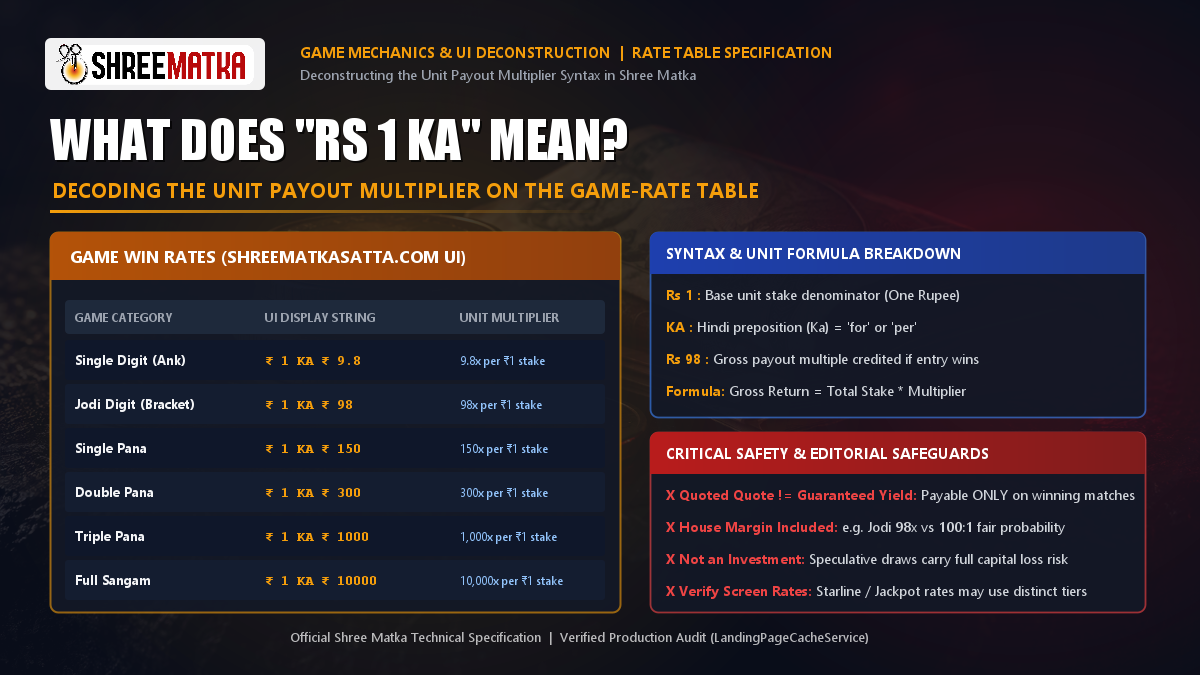
Table of Contents
- 1. The Direct Answer: Literal Meaning and Intended Unit
- 2. Where the Label Appears in the Shree Matka Interface
- 3. Verified Rate Table: Category Multipliers from Source Code
- 4. How to Read “₹1 Ka” Together with Surrounding Headings
- 5. What the Label Does NOT Establish: Quoted Rates vs. Guaranteed Yields
- 6. Common Misreadings Caused by Missing Headings and Broken Units
- 7. Frequently Asked Questions (FAQ)
1. The Direct Answer: Literal Meaning and Intended Unit
In the simplest terms, the “₹1 Ka” (रुपया 1 का) label is a unit payout multiplier ratio. The Hindi preposition “Ka” translates directly to “for” or “per” in English commercial parlance.
Literal Formula Translation:
[₹ 1 Unit Stake] → [Quoted Payout Multiplier if Winning]
When the display states ₹ 1 KA ₹ 98, it means: “For every ₹1 of nominal unit stake placed on this market entry, the gross return credited upon a verified winning draw is ₹98.”
This display convention has been standard across Indian speculative markets for over five decades. Rather than expressing probability in European decimal notation (e.g., 98.00) or UK fractional odds (e.g., 97/1), the interface expresses odds natively in terms of the Indian Rupee unit stake.
2. Where the Label Appears in the Shree Matka Interface
To eliminate guesswork, our technical team audited the production codebase of shreematkasatta.com. The label appears primarily in two distinct architectural locations:
Homepage “Game Win Rates” Section
HTML anchor <section id="rates" class="rates-wrapper">
Rendered on the public landing page directly underneath the Live Result cards and Market Status grid. Each entry consists of an SVG icon, the market game category name, and a high-contrast pill containing the exact string.
Mobile App & Native Bet Dialogs
Android Jetpack Compose UI (LandingPageConfig)
Rendered in the top summary banner of Android wagering and record-checking screens to remind the user of the active rate tier for the selected game type before any entry is confirmed.
Crucially, the label is generated dynamically by backend services. In LandingPageCacheService.java (lines 176–182), the backend evaluates the active system multiplier and executes a deterministic formatter:
private String formatRate(BigDecimal rate) {
    if (rate == null) return "₹ 1 KA ₹ 0";
    if (rate.remainder(BigDecimal.ONE).compareTo(BigDecimal.ZERO) == 0) {
        return "₹ 1 KA ₹ " + rate.toBigInteger().toString();
    }
    return "₹ 1 KA ₹ " + rate.stripTrailingZeros().toPlainString();
}
3. Verified Rate Table: Category Multipliers from Source Code
Different game categories feature distinct mathematical outcomes and correspondingly distinct payout multipliers. Below is the exact, verified rate table active in the production application:
| Game Category | UI Display String | Unit Stake Multiplier | Outcome Pool Size |
|---|---|---|---|
| Single Digit (Ank) | ₹ 1 KA ₹ 9.8 | 9.8× unit stake | 1 in 10 digits (0–9) |
| Jodi Digit (Bracket) | ₹ 1 KA ₹ 98 | 98× unit stake | 1 in 100 pairs (00–99) |
| Red Bracket (Family Jodi) | ₹ 1 KA ₹ 98 | 98× unit stake | 1 in 100 pairs |
| Single Pana (Unique Digits) | ₹ 1 KA ₹ 150 | 150× unit stake | 120 combinations |
| Double Pana (Pair Digits) | ₹ 1 KA ₹ 300 | 300× unit stake | 90 combinations |
| Triple Pana (Triplets) | ₹ 1 KA ₹ 1000 | 1,000× unit stake | 10 combinations (000, 111..) |
| Half Sangam | ₹ 1 KA ₹ 1000 | 1,000× unit stake | 1 Pana + 1 Ank combination |
| Full Sangam | ₹ 1 KA ₹ 10000 | 10,000× unit stake | Open Pana + Close Pana |
Triple Pana and Half Sangam share an identical baseline multiplier of 1,000×, while Full Sangam represents the maximum platform multiplier at 10,000×.
4. How to Read “₹1 Ka” Together with Surrounding Headings
A critical principle of data comprehension—as explored in our editorial on why copying number tables without headings changes their meaning—is that numerical figures derive their entire validity from their surrounding column headers.
When reading the Shree Matka rate card, always evaluate three adjacent variables simultaneously:
The Left Column Label
Confirms whether the rate applies to a 1-digit outcome (Single), a 2-digit outcome (Jodi), or a 3-digit outcome (Pana).
The “₹ 1 KA” Anchor
Confirms the quote is scaled per individual Rupee of stake, establishing the linear denominator for any calculated total.
The Trailing Value
The gross figure returned upon a verified matching result (e.g., ₹9.8, ₹98, ₹150, or ₹10000).
If a player allocates ₹10 on a Single Digit at a quoted rate of ₹ 1 KA ₹ 9.8, the linear return upon winning is calculated as:
5. What the Label Does NOT Establish: Quoted Rates vs. Guaranteed Yields
Mandatory Regulatory & Editorial Notice
The display ₹ 1 KA ₹ 98 is strictly a conditional payout quote. It is NEVER a promise of profit, an investment yield, or a guarantee of return.
Readers frequently fall victim to cognitive misreadings when interpreting rate cards. Here is what the label explicitly does NOT signify:
- It is not an unconditional deposit return: Depositing ₹1 into a user wallet does not transform into ₹98. The figure is payable exclusively if a specific numerical selection matches the official market draw declared by the market operator.
-
It does not reflect a 100% fair coin-flip: In a mathematically fair Jodi game without house commission, the payout for selecting 1 correct number out of 100 outcomes would be 100:1. Because Shree Matka quotes
₹ 1 KA ₹ 98, the 2.0% difference represents the built-in operating margin (the house edge). - It does not establish an investment program: Quoted multipliers must never be evaluated using annualized percentage yields (APY) or financial interest formulas. Each market draw is an independent, non-cumulative speculative event.
6. Common Misreadings Caused by Missing Headings and Broken Units
When rate cards are copied into message channels or discussion forums without their structural containers, three primary errors consistently arise:
Mistake 1: Confusing Net Profit with Gross Return
Some users assume that “₹1 Ka ₹98” means ₹98 of pure net profit plus their original ₹1 stake returned. In standard Matka bookkeeping, the quoted rate represents the total gross credited amount.
Mistake 2: Assuming Rates Apply to All Bet Combinations
A quote of 150× applies strictly to Single Pana (three distinct digits, such as 123). Placing a Double Pana (e.g., 112) under the assumption that it pays 150× is incorrect—Double Pana carries a 300× rate due to its smaller combination pool.
Mistake 3: Disregarding Market Specificity
While regular Day/Night markets (Kalyan, Milan, Rajdhani) share this standard table, specialized Starline or Jackpot hourly slots occasionally use distinct payout matrices. Always verify the active rate on the specific screen before relying on memory.