
Red Jodi (Lal Jodi) on Kalyan & Main Bazar Charts: What Those Red Boxes Mean
Scroll through a Kalyan or Main Bazar Jodi archive and suddenly certain boxes stand out in bold red ink: 00, 11, 38, 77, 05. Almost every other cell around them stays plain black.
Beginners often wonder whether red numbers mark cancelled draws, market warnings, or higher jackpot payouts. None of those guesses are true. A Red Jodi (called Lal Jodi on older printouts) is simply a visual highlight for 20 symmetrical digit pairs.
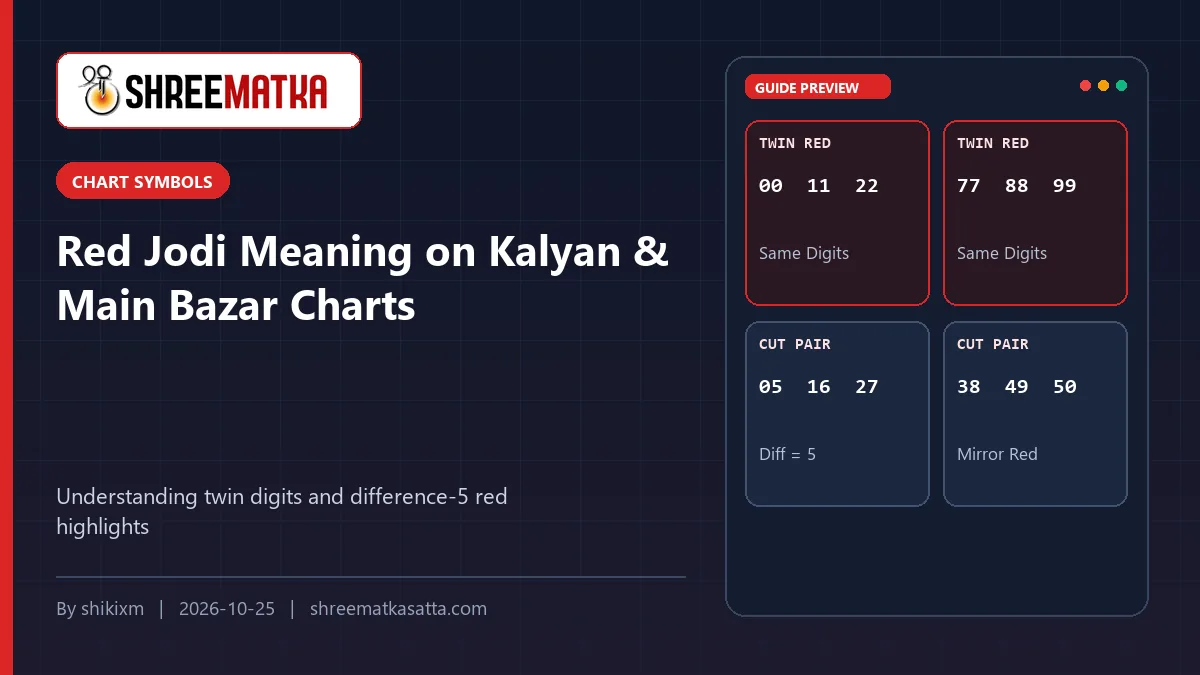
A Red Jodi is any 2-digit Jodi out of two groups: 10 matching twin pairs where both digits are the same (00, 11, 22 through 99) or 10 half-red cut pairs whose digits differ by 5 (05, 50, 16, 61, 27, 72, 38, 83, 49, 94). Red ink is strictly a visual label; payouts and odds stay identical to black Jodis.
Table of Contents
- The Two Families Inside Every Red Jodi List
- The Complete 20 Red (Lal) Jodi Chart Breakdown
- Wait: Does Hitting a Red Jodi Pay a Bonus?
- How Often Do Red Jodis Actually Land in a Normal Week?
- Why Some Websites Only Highlight Twin Numbers in Red
- Frequently Asked Questions
- Explore Related Jodi and Cut Rules
The Two Families Inside Every Red Jodi List
Traditional chart makers group the 20 crimson boxes into two simple buckets:
The first 10 are Full Red (Twin) pairs: 00, 11, 22, 33, 44, 55, 66, 77, 88, 99. Whenever the evening Close Ank repeats the afternoon Open Ank, the box turns red.
The next 10 are Half Red (Cut) pairs: 05, 50, 16, 61, 27, 72, 38, 83, 49, 94. Look at any pair and notice the simple spacing: add 5 to one digit and you land right on the other (1+5 = 6, 3+5 = 8, 4+5 = 9).
The Complete 20 Red (Lal) Jodi Chart Breakdown
| Red Category | Math Rule | Every Matching Jodi | Total Count |
|---|---|---|---|
| Full Red (Twin Pair) | Open Digit equals Close Digit | 00, 11, 22, 33, 44, 55, 66, 77, 88, 99 | 10 Jodis |
| Half Red (Cut / Diff 5) | Open & Close digits sit 5 apart | 05, 50, 16, 61, 27, 72, 38, 83, 49, 94 | 10 Jodis |
| Normal Black Jodis | All remaining open-close pairs | Remaining 80 pairs (such as 12, 34, 79) | 80 Jodis |
Wait: Does Hitting a Red Jodi Pay a Bonus?
No, and it's important to be completely clear about this. A Red Jodi does not carry any special multiplier, bonus prize, or fee.
If the Jodi game rate is 95x per rupee, hitting 11 or 16 pays the exact same ₹95 per ₹1 as hitting black Jodi 24.
How Often Do Red Jodis Actually Land in a Normal Week?
Because 20 out of 100 total Jodis are red, probability says roughly 1 in every 5 draws (20%) lands on a red number naturally.
On a 6-day Monday-to-Saturday chart like Kalyan, seeing one or two red cells inside a single week is completely ordinary. Three red cells in a week catches people's attention only because red ink pops off the screen, while scattered black pairs blend together.
Why Some Websites Only Highlight Twin Numbers in Red
Open two different websites and you may see one page showing 05 and 38 in bright red while another prints only twin numbers (00, 11... 99) in red and leaves 38 black.
That difference is just visual design preference by whoever maintains that website. Neither color changes the underlying draw numbers or Main Bazar archive history.
If someone claims 'two Red Jodis already hit this week, so Friday cannot be red', remember each market day draws independently from all 100 Jodis.
Frequently Asked Questions
How many Red Jodis exist in total?
Traditionally 20 out of 100 Jodis are counted as Red: 10 identical twins (00 to 99) and 10 cut pairs whose digits differ by 5 (05, 50, 16, 61, 27, 72, 38, 83, 49, 94).
Is Red Jodi the same thing as a market holiday?
No. Holidays show dashes (--) or 'OFF', while a Red Jodi represents a normal declared open-and-close draw.
What does Half Red mean vs Full Red?
Full Red refers to twin pairs like 22 or 88. Half Red refers to cut-ank pairs like 27 or 38.
Where can I look up past Red Jodis on Shree Matka?
Check any compact Jodi page such as /chart/jodi/kalyan or /chart/jodi/main-bazar.
Explore Related Jodi and Cut Rules
Now that the red markings make sense, look at how Cut Ank pairs connect across the rest of the chart wheel.
Continue reading: