
What Is a Matka Result Record and How Is It Displayed Online?
When browsing a website that publishes Matka-related records, you can encounter tables containing dates, numbers, and one of a kind end result classes. These entries are regularly defined as end result information. For someone unfamiliar with the format, it is hard to tell what every entry represents or the way to read the data efficiently.
A matka end result file is an access that files an end result related to a specific date, marketplace, or category, depending on how the website organises its facts. Online structures may additionally display that information in tables, dated lists, or ancient archives so site visitors can assess data from distinctive periods.
Understanding how these facts are provided can help you study chart pages more cautiously and avoid complicated one access with every other.
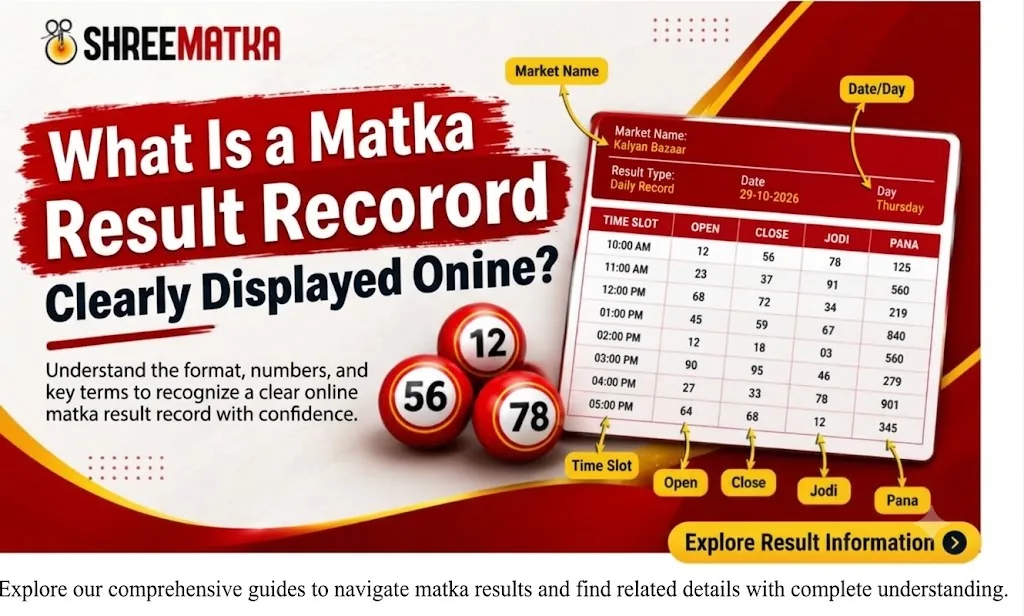
Online result pages can include dates, categories, values, and older entries. This guide explains what a matka result record means, how it may be displayed, and what to check before interpreting the information.
Table of Contents
- What Does a Matka Result Record Contain?
- How Are Result Records Displayed Online?
- How to Read a Result Record Correctly
- Why Do Some Websites Display Different Records?
- The Differentiation Between a Current Record and a Historical Record
- What Makes an Online Result Record Easier to Trust?
- Explore Result Information With Greater Clarity
- Frequently Asked Questions
What Does a Matka Result Record Contain?
There is not any single format used by each website. However, an end result report may additionally contain numerous primary information that assist perceive the access.
- Date: Indicates the day related to the document.
- Market or class call: Identifies the phase to which the access belongs, in which relevant.
- Result price: Shows the value published for that entry according to the internet site's format.
- Timing statistics: Some pages show a scheduled time or the time when information became posted or up to date.
- Historical reference: Older entries may additionally remain to be had so site visitors can overview preceding statistics.
Not every website includes all this information. Some pages show a date and an end result, even as others divide the statistics into numerous columns.
The key is to examine each access along its heading and surrounding labels instead of treating various as a whole report on its own.
How Are Result Records Displayed Online?
Websites use distinct presentation patterns depending on the quantity of data they publish and how their pages are designed. Three unusual formats are described below.
1. Table format
Tables set up data into rows and columns. A date would possibly appear in the first column, while the corresponding entry seems beside it.
This layout is useful when traffic needs to compare numerous dated facts without starting separate pages for each one. For example, a fictional website would possibly show the following table:
| Date | Category | Record |
|---|---|---|
| 5 October | Example Category A | Sample 1 |
| 6 October | Example Category A | Sample 2 |
| 7 October | Example Category A | Sample 3 |
These are invented placeholders, no longer real effects. They without a doubt show how an internet site may organise entries.
2. Date-sensitive lists
Some websites show records as a list grouped by means of day, week, or another time length. This may be handy when a visitor desires to discover one precise date.
The date usually acts as the place to begin. After locating the relevant day, the visitor can review the entry related to it.
3. Historical archive pages
An archive brings older information together in a single region. Depending on the internet site, visitors may be capable of browsing preceding months, pick a date variety, or circulate among distinct classes.
Archives can make older data easier to locate, especially when a website contains a big wide variety of entries. However, an archive is useful simplest whilst its dates, labels, and supply records are presented truly.
How to Read a Result Record Correctly
It is easy to overlook a heading or date when scanning a page quickly. A simple reading method will let you understand the entry in context.
- Step 1: Confirm the web page heading. Make certain the web page relates to the class you intended to view.
- Step 2: Find the date. Check that the report belongs to the correct day or period. Similar-looking entries may also relate to unique dates.
- Step 3: Read the labels. Look at the column names or phase headings to recognize what each fee represents.
- Step 4: Check for updates. If the website displays a closing-updated time or correction, be aware, study it before assuming the document is up to date.
- Step 5: Review the source. If an entry appears in a screenshot, copied message, or third-party post, compare it with the unique page when viable.
Following those steps enables less simple reading mistakes. It does not, by itself, show that a published record is accurate.
Why Do Some Websites Display Different Records?
You might from time to time locate that websites display different facts for what appears to be the same date. There can be several reasons.
The pages may additionally refer to different classes, use different date or time conventions, or show facts that were up to date at one of a kind times. One source may incorporate a previous entry or a correction that another source has no longer considered.
Before assuming that a record is wrong, take a look at whether each page checks with the same category, date, and reporting length. If the distinction remains unexplained, deal with the facts carefully as opposed to choosing one version primarily based on its appearance. A clear internet site ought to make applicable dates and adjustments easy to pick out.
The Differentiation Between a Current Record and a Historical Record
A current record typically refers to records provided for a recent or active reporting period. A historical record refers to an access from an in advance length that has been retained for reference.
The distinction topics due to the fact a web page can incorporate both recent and older facts. Without clear date labels, a vacationer may want to mistake an archived access for a current one.
When surfing, look for terms consisting of contemporary, preceding, archive, or history, but affirm what they suggest on that specific internet site. Labels are not always used consistently across systems.
Historical information documents beyond entries. They no longer establish what a future result could be, and previous patterns can no longer be treated as reliable predictions.
What Makes an Online Result Record Easier to Trust?
Presentation impacts how easily people can apprehend a record, but appearance on its own isn't always proof of accuracy. A useful result page needs to offer sufficient context for visitors to interpret its entries.
Look for these qualities:
- Dates and class names are visible.
- Table headings definitely describe the records under them.
- Update instances or corrections are defined when relevant.
- Historical entries are distinguishable from current statistics.
- The website offers clear data about its supply and guidelines.
- The web page avoids promises that past facts can guarantee future results.
Be cautious with pages that make unrealistic claims, display conflicting information without rationalization, or request unnecessary personal information. Where the supply cannot be demonstrated, it's better to renounce that uncertainty than to anticipate every entry is accurate.
Explore Result Information With Greater Clarity
A result record is more than various displayed on a page. Its date, class, labels, and book context all assist provide an explanation for what the entry represents.
When browsing online information, take a second to check the info before concluding. Tables can make information less difficult to test, even as date-smart lists and information allow you to locate older entries. The most useful layout is one that gives context without leaving site visitors to wager.
Explore end result data carefully, compare entries only after they talk to the identical category and length, and bear in mind that ancient facts describe the past rather than predict future results. Always observe the legal guidelines and guidelines that apply in your area.
Frequently Asked Questions
What is a matka result report?
A matka end result document is an access documenting a published result associated with a selected date or category. The precise info depends on the website showing it.
Where is the end result information displayed online?
They can also appear in tables, date-smart lists, individual result pages, or historical information. The format varies between websites.
Why is the date critical while reading a file?
The date helps perceive the duration to which an access belongs. Checking it is able to prevent confusion among statistics from specific days.
Can a web result file be modified?
A website may also correct or replace an entry, relying on its guidelines and how the statistics are maintained. Look for a correction notice or update timestamp while available.
Do historic result records expect future outcomes?
No. Historical statistics display facts from the past and should no longer be considered dependable predictions of future outcomes.
Comments (0)
Loading comments...