
What Cut Ank (0/5, 1/6, 2/7, 3/8, 4/9) Means in Matka Number Tables
Read any Matka group or chart commentary for two minutes and you'll spot confusing phrases like "open ka cut aaya", "3 cut 8", or "play the full cut family".
If nobody pauses to explain the slang, it sounds like insider code. Actually, Cut Ank (also called Katt Ank) is basic grade-school counting: pairing each digit with the number five steps away.
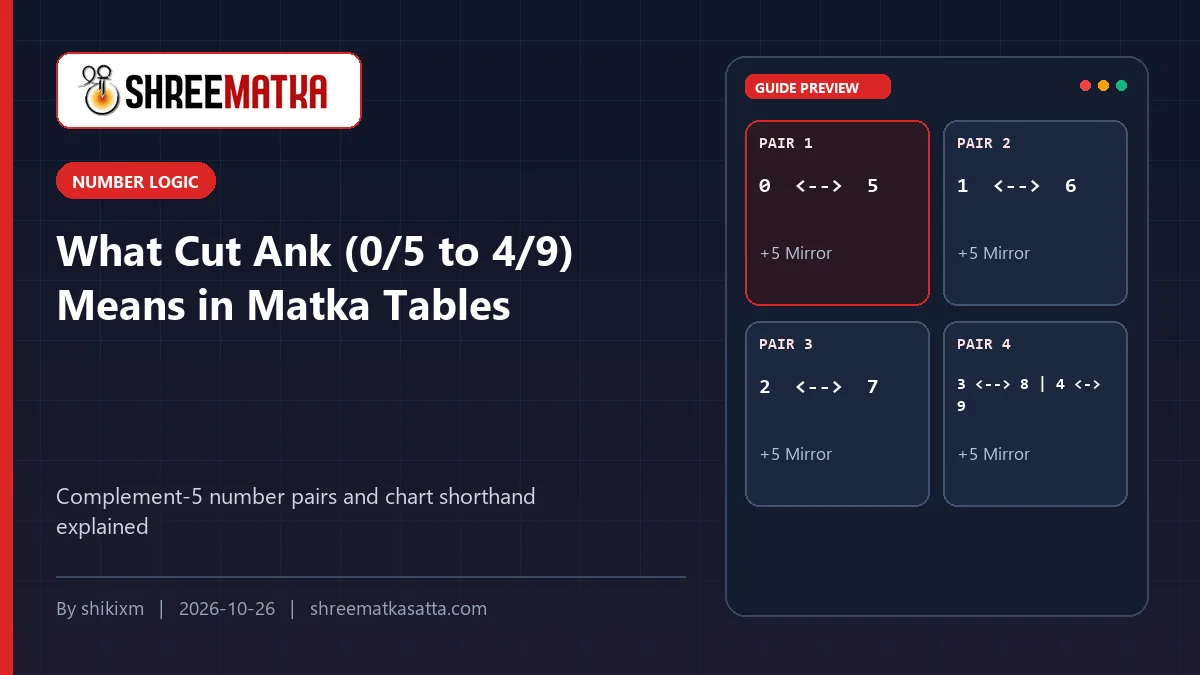
Cut Ank (Katt Ank) pairs every single digit 0 to 9 with its +5 partner: 0 with 5, 1 with 6, 2 with 7, 3 with 8, and 4 with 9. Players use it as shorthand to name half-red pairs and 4-number Jodi families, though all digits still keep an equal 10% chance per draw.
Table of Contents
- The Simple +5 Rule Behind All Five Cut Pairs
- The Complete Cut Ank (Katt Ank) Mapping Chart
- How One Cut Swap Turns a Single Jodi Into a 4- or 8-Jodi Family
- Honest Reality Check: Why Cut Pairs Don't Beat the Odds
- When Cut Ank Helps Read Charts vs When to Ignore It
- Frequently Asked Questions
- Read More Chart Vocabulary
The Simple +5 Rule Behind All Five Cut Pairs
Write 0, 1, 2, 3, 4 in one row, then write 5, 6, 7, 8, 9 directly underneath. Each top number sits exactly five steps away from the bottom digit below it.
That gives the five pairs people repeat everywhere: 0 ↔ 5, 1 ↔ 6, 2 ↔ 7, 3 ↔ 8, and 4 ↔ 9.
The pairing always goes both directions. Add 5 to 2 and you get 7. Add 5 to 7 (12) and drop the 1: you land right back on 2.
The Complete Cut Ank (Katt Ank) Mapping Chart
| Single Ank | Cut Partner (+5) | Half-Red Jodis | 4-Number Same-Digit Family |
|---|---|---|---|
| 0 | 5 | 05 and 50 | 00, 05, 50, 55 |
| 1 | 6 | 16 and 61 | 11, 16, 61, 66 |
| 2 | 7 | 27 and 72 | 22, 27, 72, 77 |
| 3 | 8 | 38 and 83 | 33, 38, 83, 88 |
| 4 | 9 | 49 and 94 | 44, 49, 94, 99 |
How One Cut Swap Turns a Single Jodi Into a 4- or 8-Jodi Family
When chart readers talk about a Jodi family, they swap one or both digits of a Jodi with their +5 cut partner.
Say today's example Jodi is 24. Digit 2 pairs with 7, and digit 4 pairs with 9. Mixing those options produces a 4-number family: 24, 29, 74, 79 (or an 8-number full family if you also flip the pairs to 42, 92, 47, 97).
Honest Reality Check: Why Cut Pairs Don't Beat the Odds
Knowing what Cut Ank means helps you read tips articles without feeling confused, yet it shouldn't fool anyone into paying for 'secret cut formulas'.
Here is the plain math: suppose Open lands on 1, and someone plays both 1 and its cut 6 on Close. Covering two numbers raises hit probability from 10% to 20%, simply because you paid for two entries instead of one!
Digit 6 has the exact same 1-in-10 odds on the Close draw as 2, 4, or 9.
The 0/5, 1/6, 2/7, 3/8, 4/9 table has been public knowledge for decades. Anyone asking for money to share a 'special VIP cut formula' is selling basic addition.
When Cut Ank Helps Read Charts vs When to Ignore It
Use Cut Ank purely as vocabulary so glossary discussions, Red Jodi highlights, and family listings make immediate sense.
- Great for: Understanding why Red Jodis pair 05, 16, 27, 38, and 49.
- Not useful for: Assuming a digit that hit Open is guaranteed to drop its +5 cut at Close.
Frequently Asked Questions
What does '2 cut 7' mean in Satta Matka?
Adding 5 to digit 2 equals 7, and adding 5 to 7 (12) ends back in 2. They are opposite digits on the 0-9 circle.
Is Cut Ank the same as Half Sangam?
No. Cut Ank is simply chart vocabulary describing +5 digit pairs. Half Sangam is a bet format pairing one single digit with one 3-digit Panna.
How many numbers are inside a full Jodi family?
Swap either digit with its +5 partner for 4 Jodis, and reverse the digit positions for 4 more, giving 8 Jodis total (unless it's a Red pair, which reduces duplicates to 4).
Do cut digits appear more often on Fridays or Saturdays?
No. Weekday calendars do not favor cut pairs over any other random digit.
Read More Chart Vocabulary
Once you know Cut Ank and Red Jodi together, almost 80% of forum jargon stops sounding mysterious.
Continue reading these connected reference guides: