
Matka Payout Calculator Math: Estimating Unit Returns for ₹10, ₹50 & ₹100 Stakes
Open any rate board in India and payouts look simple at first glance: phrases like "₹1 Ka 9.5" on Single Ank or "₹1 Ka 95" on Jodi. Still, when you are holding ₹50 or ₹150 in total across three slips, guessing payout numbers in your head leads to easy mistakes.
Let us write down the exact two-step rupee math once, run through worked examples for ₹10, ₹50, and ₹100 tickets, and highlight the one budget mistake almost every beginner makes.
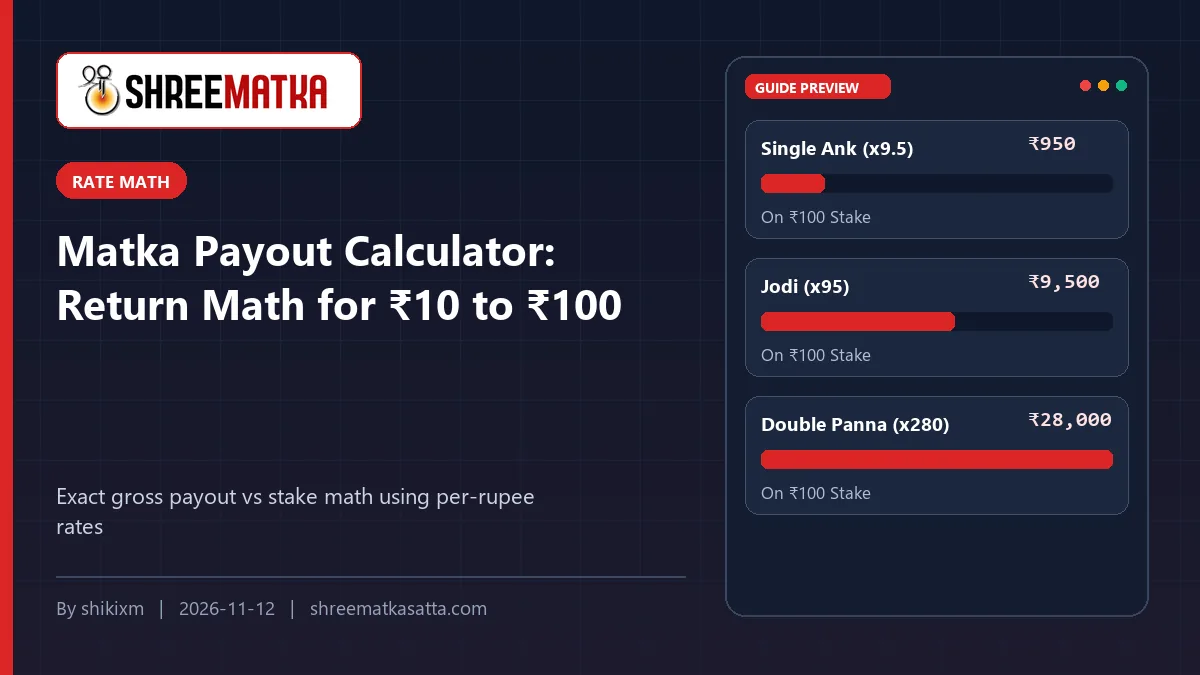
To find your total payout, multiply your stake on one winning ticket by the listed ₹1 Ka multiplier (for example, ₹50 x 95 = ₹4,750 on Jodi). To find your real profit, subtract EVERY rupee spent across ALL tickets in that session, not just the single winning ticket.
Table of Contents
- Step 1: Multiply Your Ticket Value by the ₹1 Ka Rate
- Quick Reference Payouts for ₹10, ₹50, and ₹100 Tickets
- Step 2: Why Playing Five Pannas Changes Your Real Net Profit
- Comparing Quoted Rates Against True Mathematical Chances
- Why You Should Question Any Poster Promising 'Full 100 Ka 10000'
- Frequently Asked Questions
- Check Live Multipliers & Odds Guides Next
Step 1: Multiply Your Ticket Value by the ₹1 Ka Rate
Think of every rate line (1 Ka 9.5, 1 Ka 95, 1 Ka 140) as a promise of total wallet return per rupee placed on a winning number. It is gross payout, which means your original ₹1 ticket money is already included inside that returned sum.
Say a friend plays ₹50 on Jodi 14 at 1 Ka 95 and Kalyan draws 128 - 14 - 590. His wallet goes up by 50 x 95 = ₹4,750. His actual net profit on that ticket is ₹4,750 - ₹50 = ₹4,700, not ₹4,750 plus another ₹50.
Quick Reference Payouts for ₹10, ₹50, and ₹100 Tickets
| Game Format | Illustrative Rate | ₹10 Ticket Returns | ₹50 Ticket Returns | ₹100 Ticket Returns |
|---|---|---|---|---|
| Single Ank | ₹1 Ka 9.5 | ₹95 | ₹475 | ₹950 |
| Jodi (2 Digits) | ₹1 Ka 95 | ₹950 | ₹4,750 | ₹9,500 |
| Single Panna (SP) | ₹1 Ka 140 | ₹1,400 | ₹7,000 | ₹14,000 |
| Double Panna (DP) | ₹1 Ka 280 | ₹2,800 | ₹14,000 | ₹28,000 |
| Triple Panna (TP) | ₹1 Ka 700 | ₹7,000 | ₹35,000 | ₹70,000 |
Step 2: Why Playing Five Pannas Changes Your Real Net Profit
Here is where many casual players accidentally fool themselves when keeping mental score. Nobody complains when a ₹20 Single Panna hits ₹20 x 140 = ₹2,800. It feels like winning ₹2,780 clear!
Look closely at what actually left your wallet before the draw, though. Suppose you played five Single Pannas at ₹20 each (₹100 spent total) or checked three extra side Anks for ₹50 total. Your true profit for that evening is ₹2,800 minus all ₹150 spent = ₹2,650.
Comparing Quoted Rates Against True Mathematical Chances
Compare true chances against every row in a ₹1 Ka rate table and a clear pattern jumps right out:
Picking 1 correct Single digit out of 10 carries a true 1-in-10 fair ratio (10x), while standard boards pay 9x to 9.5x. Picking 1 correct Jodi out of 100 carries true odds of 100x, while boards pay 90x to 95x.
That missing 5% to 10% slice is the built-in operator margin across hundreds of draws. On Triple Panna (1000x raw permutation rarity paying around 600x to 700x), the percentage margin sits higher because single hits pay so dramatically.
Why You Should Question Any Poster Promising 'Full 100 Ka 10000'
Every few weeks an unknown banner online promises 100% no-edge rates like ₹10 = ₹100 Single or ₹10 = ₹1,000 Jodi with instant bonuses. Think for five seconds like a shopkeeper: if every winning rupee paid out the entire mathematical pool without keeping even 5% to cover servers and payouts, how would the platform pay winners when a popular Jodi hits?
Checking live rates directly inside verified rate guides sets realistic expectations before you ever spend a rupee.
The numbers in our guide show everyday reference math. Always check the live Rate Card inside the Shree Matka screen before entering any slip, as rates differ slightly by market format.
Frequently Asked Questions
If Jodi rate says ₹1 Ka 95, how much does a ₹10 win return?
Multiply 10 by 95 to get ₹950 total wallet return (which equals your ₹10 original stake plus ₹940 profit).
Why does Double Panna pay roughly double Single Panna?
A Single Panna (three distinct digits like 128) can appear in 6 raw draw orders out of 1,000, while a Double Panna (like 112) appears in only 3 raw orders. Half the chance gives double the rate multiplier.
Do Starline rates match Main Market Single and Panna rates?
Single Ank and SP/DP/TP math works similarly, though platforms may post specific Starline payout rates on the Starline rate screen.
Does spread-betting ten different numbers improve my long-term return percentage?
No. Covering 5 Anks at ₹20 each raises your chance of catching 1 hit to 50%, but cuts your gross payout down to ₹190 on ₹100 total spent, keeping the exact same 5% mathematical house edge.
Check Live Multipliers & Odds Guides Next
Once you can multiply ticket values and count total multi-slip costs honestly, surprises at settlement vanish completely.
Continue reading our rate and combination breakdowns: