
Single (120), Double (90), Triple (10) Panna: Why All 220 Panels Split This Way
Check any rate card and three three-digit Panna rows sit right next to each other with completely different multipliers: Single Panna, Double Panna, and Triple Panna.
Why are there 120 Single Pannas, 90 Double Pannas, and only 10 Triple Pannas? And why does picking one Triple Panna pay dramatically more than picking one Single Panna when both have three digits? Simple counting math answers both questions.
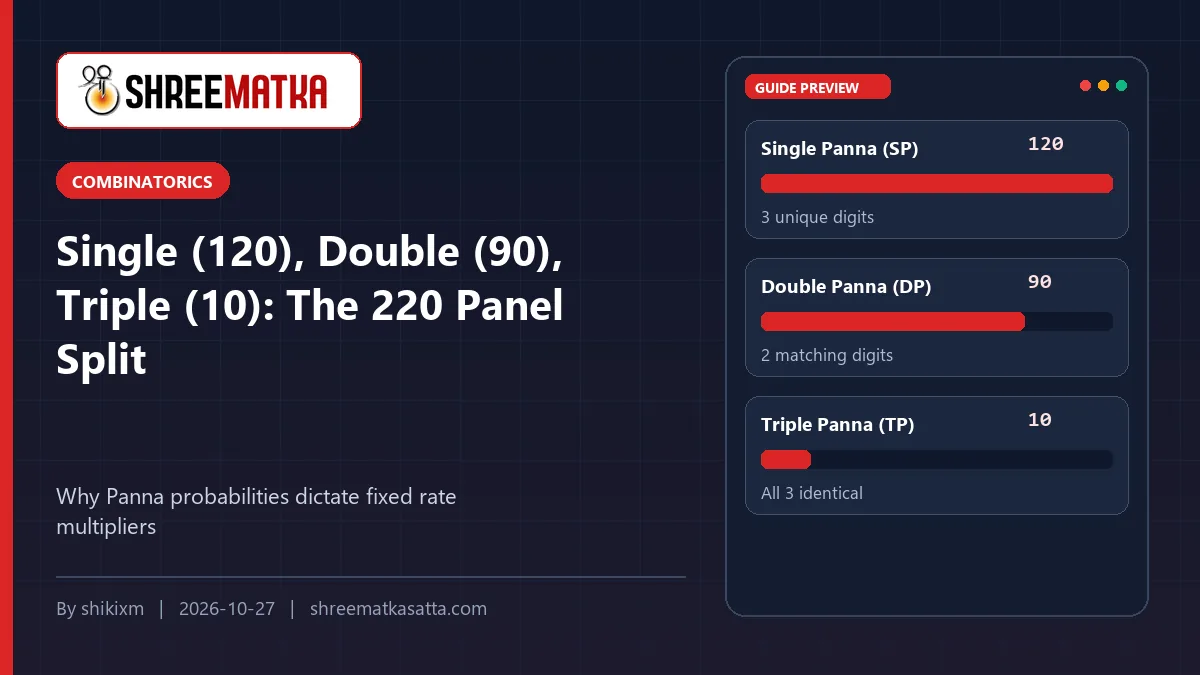
Out of 220 sorted Panna combinations, 120 use three unique digits (Single Panna), 90 repeat one digit twice (Double Panna), and 10 repeat the same digit three times (Triple Panna). A specific Single Panna matches 6 out of 1,000 raw three-digit orders, Double matches 3, and Triple matches just 1.
Table of Contents
- Where the Numbers 120, 90, and 10 Actually Come From
- The 220 Canonical Panna Pool Broken Down by Group
- Why a Triple Panna Pays Far More Than a Single Panna
- How Each Single Digit Holds Exactly 22 Pannas
- What You See Looking at 100 Weeks of Past Charts
- Frequently Asked Questions
- Check Complete Charts & Odds Guides
Where the Numbers 120, 90, and 10 Actually Come From
You start with ten digits from 0 to 9. Every valid Panna places three of them in ascending order (with zero ranked at the end).
To make a Single Panna (SP), pick 3 completely different digits. Out of 10 digits, there are (10 x 9 x 8) / (3 x 2 x 1) = 120 ways to pick three unique numbers.
To make a Double Panna (DP), pick 1 digit to repeat twice (10 choices) and 1 different digit for the third slot (9 choices left): 10 x 9 = 90 pairs.
To make a Triple Panna (TP), all three digits match (000, 111, 222 up to 999), leaving strictly 10 options.
The 220 Canonical Panna Pool Broken Down by Group
| Group | Digit Rule | Valid Pannas | Ways Out of 1,000 Raw Draws | Sample Pannas |
|---|---|---|---|---|
| Single Panna (SP) | 3 distinct digits (A < B < C) | 120 | 6 ways per SP (720 total = 72%) | 128, 347, 590 |
| Double Panna (DP) | 2 matching + 1 unique | 90 | 3 ways per DP (270 total = 27%) | 112, 400, 779 |
| Triple Panna (TP) | All 3 identical | 10 | 1 way per TP (10 total = 1%) | 000, 111, 777 |
| Complete Table | All 000 to 999 sorted | 220 | 720 + 270 + 10 = 1,000 total | Full 220 deck |
Why a Triple Panna Pays Far More Than a Single Panna
Here is the detail most beginners never stop to count: not every one of those 220 Pannas has the same chance of appearing!
Look at Single Panna 128. Before sorting, six different three-digit draws all collapse into 128: 128, 182, 218, 281, 812, 821. Look at Double Panna 112: only three draws collapse into it (112, 121, 211).
Look at Triple Panna 777: only one single draw out of 1,000 (777) lands on it! Because Single hits 6 times as often as Triple (and twice as often as Double), game-rate tables scale payouts sharply upward from SP to DP to TP.
128, 182, 218, 281, 812, 821)
112, 121, 211)
777 only)
How Each Single Digit Holds Exactly 22 Pannas
Open our 220 Patti Chart guide and count down any Single Ank column from 0 to 9.
Every single column holds 12 Single Pannas + 9 Double Pannas + 1 Triple Panna = 22 total Pannas. That even 22-per-digit balance confirms zero bias toward any single digit in the deck.
What You See Looking at 100 Weeks of Past Charts
Pick any historical Kalyan Panel archive and scan 50 recent results. Around 35 or 36 of those 50 panels will be Single Pannas (~72%), roughly 13 or 14 will be Double Pannas (~27%), and you might wait months just to see one Triple Panna (~1%).
Knowing that real 72% / 27% / 1% split stops people from chasing Triple Panna streaks with unrealistic expectations.
High payout rates on Triple Panna only reflect 1-in-1,000 rarity. Always compare probability alongside rate tables in our Odds & Payouts guide.
Frequently Asked Questions
Why are there 220 Matka Pannas instead of 1,000?
Because 1,000 counts different orderings of the same digits separately. Sorting digits ascending combines unordered sequences like 128 and 821 into 220 canonical sets.
Do Single Pannas really make up 72% of random 3-digit draws?
Yes. 720 out of 1,000 raw combinations from 000 to 999 contain three distinct digits, becoming Single Pannas.
Why do Triple Pannas happen so rarely?
Only 10 out of 1,000 combinations have all three digits matching (1% total across all ten Triple Pannas combined).
Is every Single Ank given the same number of Pannas?
Yes, every Single Ank from 0 to 9 maps to exactly 22 Pannas: 12 Single, 9 Double, and 1 Triple.
Check Complete Charts & Odds Guides
Understanding why SP, DP, and TP split 120, 90, and 10 makes reading every game-rate board click instantly.
Take a look at these next guides: