
Understanding Result Corrections and Updated Information
Online chart pages may additionally sometimes display corrected or up to date records after it has already been published. A date can be revised, an access may be amended, or an internet site may additionally clarify facts that became formerly incomplete. Without a clear rationalization, visitors can also struggle to apprehend what modified and which version they're viewing.
Understanding how corrections paintings can help users study online records extra cautiously. When reviewing matka result connection records, it is crucial to differentiate a genuine correction from a routine web page update, test the date associated with an entry, and avoid assuming that a newer model is robotically correct.
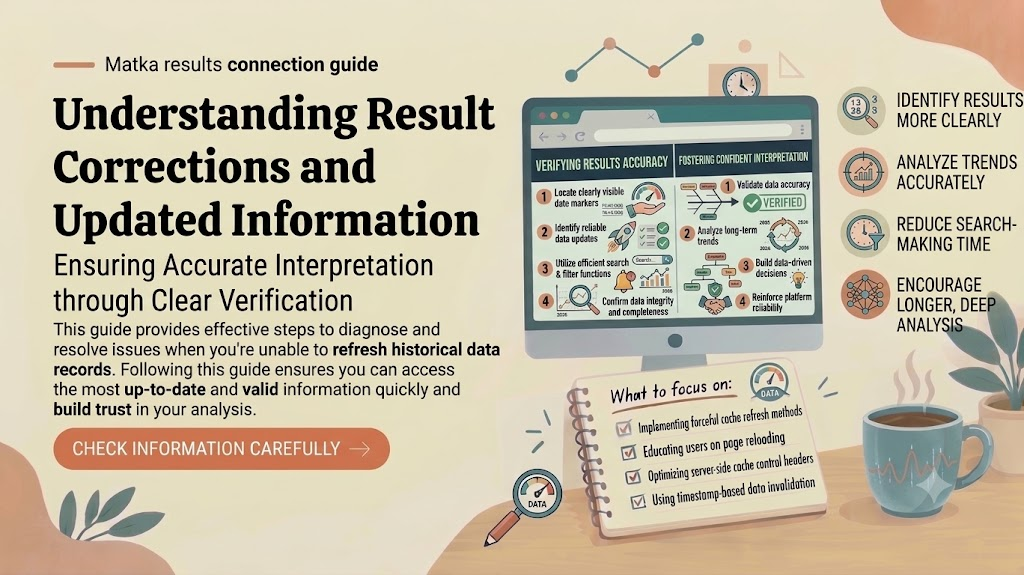
Online result pages may be corrected or updated after publication. Learn how to distinguish corrections from routine updates, check timestamps, compare entries, and interpret revised information carefully.
Table of Contents
- What Is a Result Correction?
- Why Might Online Result Information Be Corrected?
- How to Identify Corrected or Updated Information
- Correction vs. Routine Update: What's the Difference?
- Why Transparent Correction Notices Matter
- What Should You Do When Two Versions Show Different Information?
- Common Mistakes to Avoid
- Frequently Asked Questions
- Conclusion & Next Steps
What Is a Result Correction?
A result correction happens whilst a website changes information that was previously displayed due to the fact the sooner version contained an error or wanted explanation.
Depending on the website, a correction might contain a date, a class label, a typographical mistake, or a personal access. The website might also replace the original facts, add a correction, be aware, or put up a revised document.
A correction isn't like a routine update. A page can be up to date due to the fact its layout has been modified or new sections have been added, even when the underlying records stay the same.
Understanding this distinction enables readers interpret adjustments without making assumptions approximately why they occurred.
Why Might Online Result Information Be Corrected?
There may be numerous reasons why a website revises formerly posted statistics. The actual motive relies upon the instances and the web site's publishing system.
1. An Entry Was Published Incorrectly
An authentic entry may also contain a typing mistake or other factual errors. If the website verifies the problem, it could submit a rectified model.
2. A Date or Label Was Incorrect
Sometimes the data itself is unchanged, but the date, heading, or class associated with it needs correction. Updating the label can help users pick out the proper duration or segment.
3. Information Was Incomplete
A web page can also initially show best a part of the supposed data. A later revision may upload lacking details or explain an earlier access more truly.
4. The Website Revised Its Presentation
An internet site would possibly reorganize a table, rename a phase, or change how data is displayed. These changes could make the page simpler to use without necessarily changing the underlying facts.
It is vital not to expect that every revision represents a correction to an end result. The web page's update notes or authentic clarification, when available, offer better context.
How to Identify Corrected or Updated Information
A few simple tests can help you understand whether or not a web page has changed and what the trade might suggest.
Step 1: Look for a correction observer.
Check for labels inclusive of “Corrected,” “Revised,” or “Correction Notice.” These may also imply that the website is acknowledging an alternative to previously posted statistics.
Step 2: Check the date and timestamp.
A timestamp can suggest whilst a web page became modified, but it does not always give an explanation for what was modified. Read it alongside any correction notice.
Step 3: Compare the applicable access.
If an earlier model is available, evaluate the specific discipline or document in place of assuming that the entire web page has been modified.
Step 4: Read the website's rationalization.
A clean observer should preferably provide an explanation for what was revised and, in which appropriate, why. If the purpose isn't furnished, avoid guessing.
Step 5: Check the records in context.
Make positive the access belongs to the meant date and class. A difference between two pages may additionally definitely replicate distinctive reporting intervals or sections.
These steps can help users pick out seen changes, even though they can't independently affirm whether or not the revised records are accurate.
Correction vs. Routine Update: What's the Difference?
Feature
Correction
Routine update
Main purpose
Fix or clarify previously published information
Refresh or maintain the page
Possible example
Correcting a wrongly labelled date
Updating the page layout
Effect on records
May change a specific entry or detail
May leave the records unchanged
Useful evidence
A correction notice or explanation
An update timestamp or maintenance note
These are widespread differences. Individual web sites may additionally use exclusive terminology, so the which means of a label ought to be interpreted according to the web site's personal reasons.
Why Transparent Correction Notices Matter
When a website adjusts information without explaining the revision, visitors may additionally find it tough to understand which model they're viewing. Clear correction notices lessen that uncertainty by means of offering context.
Useful notices can include:
• The date and time of the revision.
• A description of the records that changed.
• A rationalization of the correction, when available.
• A distinction among corrected statistics and routine web page protection.
• A connection with the applicable access or reporting period.
Not every internet site affords a full revision history. If the record is doubtful, users need to deal with the trade carefully in preference to assuming that the most modern version has been independently validated.
What Should You Do When Two Versions Show Different Information?
Finding different facts on pages does not routinely imply that one includes an error. The pages may additionally cowl extraordinary dates, use one of a kind categories, or reflect a correction made after the first model changed into published.
To look at the difference:
• Confirm that each page consults with the identical date and category.
• Check whether or not both web pages include a correction or update observer.
• Compare the exact entries and labels involved.
• Review any reliable explanation of the revision.
If the difference remains unexplained, avoid treating either model as confirmed entirely as it seems newer.
A browser refresh may also assist whilst an older cached page is being displayed, however it cannot establish the accuracy of the internet site's underlying statistics.
Common Mistakes to Avoid
When reviewing updated chart statistics, avoid these common assumptions:
Assuming every replace is a correction: Some adjustments affect most effective the design or navigation.
Treating the most modern timestamp as proof of accuracy: A timestamp facts a time-related event, not unbiased verification.
Ignoring the date of the entry: The page's update date may additionally vary from the date associated with the document.
Comparing unrelated information: Check that both versions cowl the same period and class.
Relying on screenshots without context: A screenshot might not display later corrections or the full rationalization supplied by using the internet site.
Careful checking is more beneficial than drawing conclusions from an unmarried label or visual difference.
Frequently Asked Questions
What does a corrected end result mean?
It typically means that a website has revised information published in advance. The genuine nature of the trade depends on the correction notice and the website's publishing practices.
How can I tell whether or not facts have been updated?
Look for an update timestamp, a revision label, or an authentic be aware. If the internet site no longer gives an explanation for the alternative, you may be capable of becoming aware that a revision happened without knowing precisely what was modified.
Does a corrected access suggest the sooner model changed into fake?
Not always. The alternative ought to involve typing errors, an incorrect date, incomplete data, or a clarification. The website's clarification is needed to recognize the specific situations.
Can a timestamp confirm that a correction is correct?
No. A timestamp can display when a web page becomes modified, however it does not show that the revised facts are correct or complete.
What ought to I do if a correction observation is doubtful?
Check the relevant date and category, overview different legit notices from the internet site, and consult its aid channel if available.
Conclusion & Next Steps
In conclusion, it is advised that when making corrections and updates on information on the internet, clarity should be prioritized. Users can check timestamps, revision notices, and other similar tools to differentiate between updates and corrections.
In reviewing information related to the charts, one should be sure to examine details thoroughly while using logical explanations instead of making conclusions based on guesses. Most past records as well as amended entries signify that information is published but do not guarantee a certain result in future.