
How to Identify Updated and Archived Chart Information
When touring a web chart website, it is essential to apprehend whether the statistics displayed are recent or belong to an in advance duration. Some pages show up to date entries, while others hold older information for reference. If those types of statistics look similar, customers may additionally discover it difficult to perceive which one they're viewing.
Learning how to recognize updated matka charts and archived chart records can make surfing extra truthful. The key is to check dates, web page labels, update notices, and the corporation of the facts in preference to relying on appearance on my own.
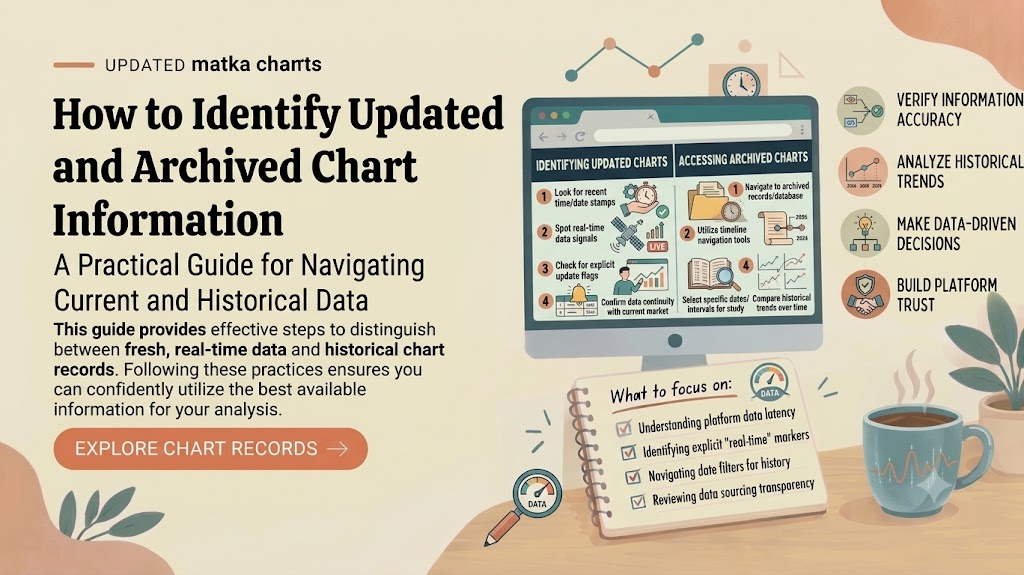
Updated and archived chart pages can look similar, making it important to check dates, labels, and update timestamps. This practical guide explains how to identify the relevant period and navigate historical records with greater confidence.
Table of Contents
What Is the Difference Between Updated and Archived Charts?
Updated and archived charts serve distinctive purposes, although both may additionally seem at the equal website.
An up to date chart is a web page or desk that has been modified recently. Depending on the website, the change should involve new entries, corrected details, revised formatting, or different web page content material. A current update does not always mean that each file has changed.
An archived chart includes records retained from an earlier date or duration. It allows users to consult beyond entries without complicating them with statistics displayed for an extra current period.
For instance, a website might show a chart for the present day date along a monthly archive. The current-date web page and the archived month-to-month page may additionally use similar layouts, however their date labels imply that they serve exclusive functions.
1. Check the Date Before Reading the Chart
The first step is to pick out the date related to the records. Look close to the chart heading, above the table, or beside the relevant access.
Pay interest to whether the date refers to:
• The day associated with chart access.
• The period included an ancient desk.
• The date the web page becomes published.
• The date the web page was closed was modified.
This info can imply different things. A page up to date these days may additionally nevertheless display records from an earlier month. Similarly, an older guide date does now not robotically mean that the information has in no way been revised.
Practical tip: Read the date together with its label. Avoid determining whether or not a chart is contemporary simply due to the fact the page has a current-searching timestamp.
2. Look for Update and Archive Labels
Websites may additionally use labels which includes “Latest,” “Updated,” “Previous Records,” “History,” or “Archive” to organize their facts. These labels can assist traffic and understand the supposed purpose of a web page.
However, naming conventions vary among websites. A label consisting of “Latest” should no longer be dealt with as proof of real-time updates until the website explains how its facts are maintained.
When an archive label is present, test whether it hyperlinks to a particular day, month, yr, or other historical length. This allows you to perceive the time variety covered by means of the statistics.
3. Examine the Structure of the Page
The layout can offer beneficial clues approximately the type of information being displayed.
An updated chart page might also emphasize a specific date or a lately revised segment. An archive web page may also organise facts into day by day, weekly, month-to-month, or yearly sections, depending on the internet site.
Look for:
• Date-based total navigation: Links that will let you pick out an advance in duration.
• Historical headings: Titles that identify a beyond day, month, or 12 months.
• Separate chart sections: Tables prepared by means of marketplace, category, or reporting period.
• Update notes: Explanations of corrections or modifications made to the page.
These capabilities assist with navigation, however format by myself cannot affirm whether the records are contemporary. Always cross-take a look at the date and any to have update details.
4. Compare the Relevant Dates Carefully
If you're unsure whether or not a web page displays more recent records, evaluate its date labels with those on the related page. Make certain you're evaluating the same segment and the same kind of file.
For instance, imagine an internet site has two pages:
Page label
Date shown
Possible interpretation
Current chart
25 October 2026
Information associated with the displayed date
Historical records
24 October 2026
Records associated with the previous date
Last updated
25 October 2026, 6:00 PM
The page was modified at the stated time
These dates are fictional examples, no longer actual chart outcomes. They illustrate why the date of a record and the timestamp of a page replace have to now not be dealt with as interchangeable.
If the dates appear inconsistent, take a look at the web page's explanation or replace notes before drawing an end.
5. Use Archived Records for Historical Reference
Archived facts are beneficial when you want to review in advance, locate a vintage entry, or understand how an internet site organises its data over the years.
To navigate an archive more successfully:
• Identify the period you need to check.
• Select the matching date, month, 12 months, or class if those options are to be had.
• Confirm the date shown at the resulting page.
• Check whether the page identifies the records as historic or archived.
• Keep the selected duration in thoughts while comparing it with some other chart.
An archive might not comprise each past entry, and the to be had date variety can vary by way of website. If a particular file is missing, do not assume that it never existed; the web page may additionally have confined its archive or reorganized its pages.
Common Signs That You May Be Viewing Archived Information
A chart may be historical rather than modern-day while:
• Its heading identifies a previous date or reporting duration.
• It appears beneath an actual labelled history or archive phase.
• The page offers navigation to earlier statistics.
• The data refers to a finished duration in place of the date you meant to view.
• A be aware explains that the web page is retained for reference.
None of those signs ought to be considered conclusive in isolation. A web page can contain ancient information and still have been updated recently, so the labels and dates need to be examined collectively.
What to Do When You Cannot Tell Whether a Chart Is Updated
If the page does not simply distinguish modern and archived facts, use an easy verification process.
-Refresh the web page. This can help in case your browser is displaying an older cached version, even though it will no longer create new statistics if the website itself has now not been up to date.
-Recheck the chosen date. Make sure the web page has now not remained on a formerly selected day or ancient period.
-Look for an update timestamp. If one is provided, test what it refers to. A page-level timestamp may not describe each access.
-Review website notices. Maintenance bulletins or causes of not on time updates can also offer useful context.
-Use the website's legit steerage. If the date labels stay uncertain, consult the web site's assist information or guide channel in preference to guessing.
Why the Difference Matters
Recognizing updated and archived chart facts allows prevent confusion among latest entries and historical information. It also makes it less complicated to navigate an internet site, evaluate the perfect periods, and apprehend what a timestamp actually describes.
Keep in mind that a replace label does not assure that facts are entirely or accurate. Archived records describe in advance data and have to no longer be handled as predictions of future results. Users ought to also comply with relevant neighborhood legal guidelines while accessing chart-related web sites.
Frequently Asked Questions
What are updated matka charts?
Updated matka charts are chart pages that have been modified or refreshed, relying on the website's technique. Users have to take a look at the displayed date and replace labels to understand what has in reality been modified.
How can I pick out an archived chart?
Look for labels such as “Archive,” “History,” or “Previous Records,” at the side of dates that identify an advance in duration. Confirm the selected period before decoding the entries.
Does a recently updated timestamp imply the chart has new records?
The answer to this is no; this timestamp may refer to a formatting change, rectification of the chart, or update of pages. Therefore, get to know the particular section of the chart with respect to date.
Can archived charts be compared with updated charts?
Yes, if the dates of the records, categories, and types are the same. Make sure both pages are about the same information and the periods are comprehended.
Why may the chart uphold old information despite refreshing it?
The reason for this could be the failure of the website to publish new findings or the page is made in such a way that shows ground-breaking records. Apart from it, the caching of the browser may restrict what is displayed, while refreshing would not update anything that has not been done by the website.
Conclusion & Next Steps
The process of identifying updated and archived chart data begins with a thorough inspection of the date, interpretations of page names, and the comprehension of the distinction between record date and update date. These small efforts can significantly help the user find their way around chart pages and minimize any potential confusion while checking older information.
When searching for chart records, one should rely on the labels on the website, and archive passage, and be careful with ambiguous or unreliable update statements.