
How to Find a Specific Market on an Online Chart Page
Opening an online chart page can be confusing when the internet site lists several markets, dates, and styles of results in one region. If you know which marketplace you are seeking out, you possibly do not need to spend time commencing each chart simply to discover it.
The desirable news is that some easy checks could make the technique a lot more simpler. By looking at the website's menu, studying chart labels, and confirming the date range, you can typically slim down the statistics you need.
In this guide, we're going to give an explanation for a way to locate a specific marketplace on an online chart page and what to check before relying on the information displayed.
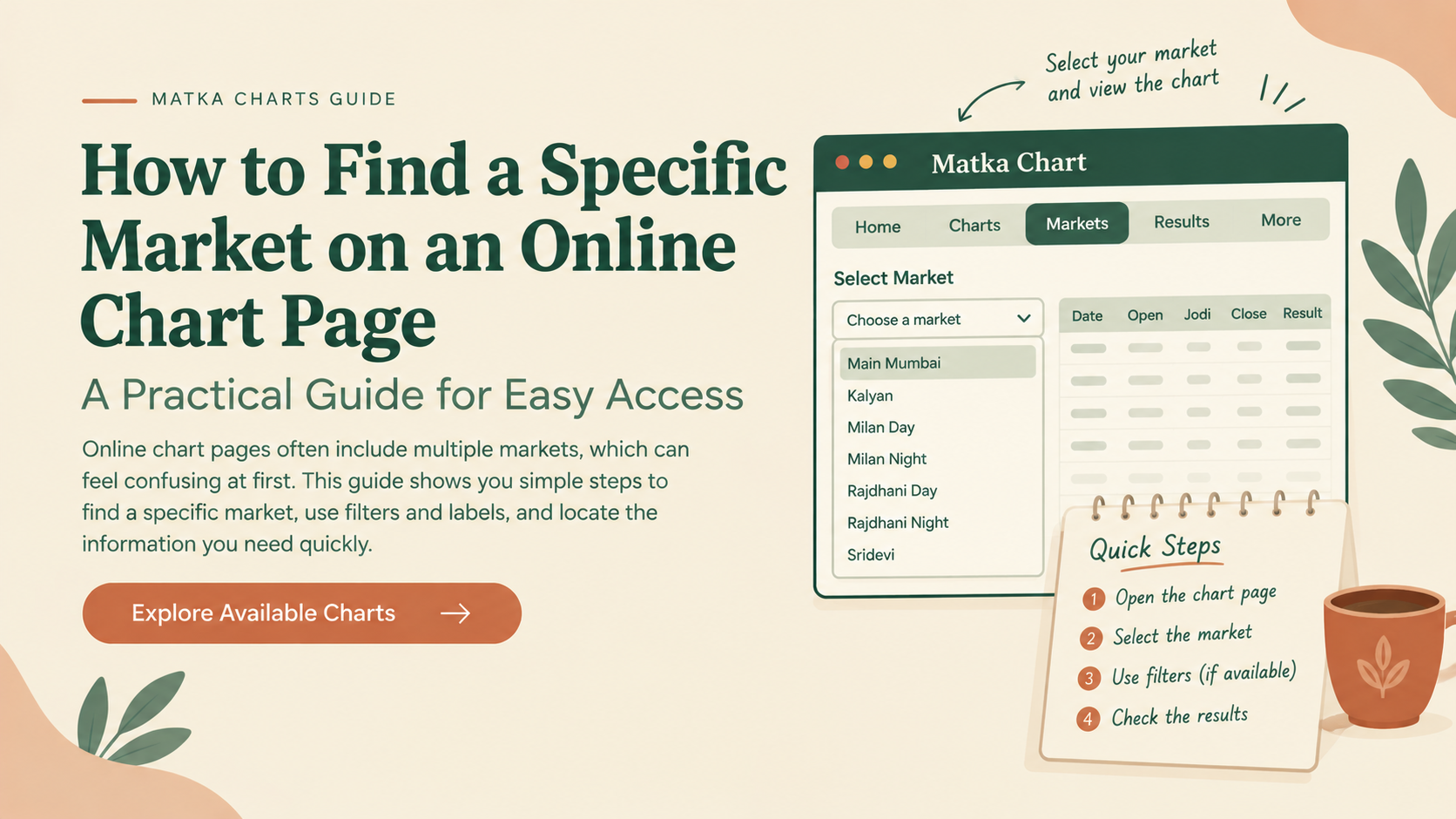
Having trouble finding a specific market on an online chart page? Follow these simple steps to navigate market lists, check chart headings, and locate the information you need.
What Are Matka Market Charts?
Matka marketplace charts are on line pages that organise market-related wide variety entries or historical information. Depending on the website, one of a kind markets may have separate chart pages, individual sections, or entries grouped within a bigger table.
Some pages are aware of one market, even as others list numerous markets in a listing. You may also locate separate sections for Jodi entries, Pana entries, or ancient statistics.
Because each website can organise its data in a different way, the first step is to recognize how the particular web page is established.
How to Find a Specific Market
1. Start With the Main Menu
Begin through checking the website's predominant navigation menu. Look for labels inclusive of Markets, Charts, Market List, Results, or Historical Records.
These labels might also lead to extraordinary sections of the website. If you're looking for an older access, as an instance, an ancient statistics section may be more beneficial than a page committed to the modern records.
Don't assume each website makes use of the equal menu names. Read the to be had options and pick out the phase that most carefully fits what you need.
2. Look for a Market List
Some websites provide a dedicated list of to be had markets. This may be less difficult to use than browsing person chart pages separately.
When you open the list:
• Scan the market names carefully.
• Check whether the site separates markets into categories.
• Look for links to person chart pages.
• Confirm that the market name matches the one you need.
If the internet site displays many alternatives, take your time studying the labels instead of deciding on the primary comparable-searching name.
3. Use the Website's Search Feature
If a search bar is available, input the marketplace name at once. This may additionally assist you find an applicable page without navigating via more than one section.
For better outcomes, strive for the total market name first. If that doesn't work, test whether the website makes use of a shorter label or a specific spelling.
Remember that an internet site's inner search may additionally return articles or popular statistics in preference to the precise chart web page. Check the page name earlier than commencing an end result.
4. Check the Chart Heading
Once you open a chart, observe its heading before analyzing the entries.
The heading needs to assist you verify which marketplace or chart category you're viewing. If the name is doubtful, check any nearby labels or introductory notes.
This step subjects due to the fact two pages may additionally have comparable layouts while displaying facts for unique markets.
5. Confirm the Date or Date Range
Finding the precise market is the handiest part of the system. You additionally need to ensure the web page covers the date you are interested in.
Some chart pages recognize contemporary data, while others offer older information in a date-wise table or archive.
Check whether the page presentations:
• A specific date.
• A date range or month.
• The present day to be had access.
• A timestamp showing while the page turned up to date.
A web page's remaining-updated time might not be similar to the date related to an individual record, so read that information separately.
6. Read the Column Labels
Before interpreting any numbers, check the table headings. A chart might include fields for Pana, Jodi, commencing entries, last entries, or different information.
The presence of a range of alone does no longer let you know what it represents. Its column label and the chart's personal clarification provide the essential context.
If the labels are lacking or uncertain, avoid guessing. Look for a word list or assist segment at the website.
What If You Can't Find the Market?
Sometimes a marketplace name may not seem where you anticipate it. Before assuming the page is unavailable, try those exams.
• Check spelling versions: The website can also use a shortened name or a barely special spelling.
• Look in any other segment: A market may appear underneath a chart listing, an archive, or a category menu as opposed to on the homepage.
• Review the date range: Some pages display handiest recent entries, even as older records may be saved in a separate historic phase.
• Check whether the page is available: A missing hyperlink, incomplete archive, or brief website difficulty may save you from viewing the data.
Avoid assuming that the missing facts method and end result was not recorded. The web page can also definitely be incomplete or organised differently.
Common Mistakes to Avoid
A few small errors can make it more difficult to find the right market chart:
Choosing a similar name without checking: Always verify the marketplace heading.
Reading the incorrect date: Make positive the entry matches the length you need.
Confusing chart types: A Jodi chart and a Pana chart might also show unique wide variety formats.
Ignoring update info: Check whether the page has been up to date and whether or not the timestamp refers back to the page or a particular access.
Assuming each internet site has the equal format: Menu names, filters, and chart classes can vary.
Taking a second to confirm this info lets you navigate the website online more confidently.
Frequently Asked Questions
1. How do I find a selected marketplace on a chart internet site?
Start with the internet site's principal menu or market directory. Use its search function if it has to be had, then verify the marketplace call and date at the chart page.
2. What are Matka market charts?
They are online pages that organise marketplace-related entries or historical information. The exact facts displayed rely upon the website and chart layout.
3. What actions need to be taken if a certain market isn't available?
You may need to check for misspellings of the market title, check other categories of charts, and historical archives. If none of this works, the market the user is looking for might simply not be available on the website.
4. How do I verify that I have opened the correct chart?
To ensure that the chart is the right one, check the page title, market name, the time interval, and headings of columns, as this should assist in determining which chart the user is looking at.
5. Is it possible to navigate all websites in the same manner?
No. While some websites are designed in such a way that suggests the presence of either search keyword or some filters, others may have different menus or lists of markets. In general terms, the approaches might be similar, but steps may differ.
Conclusion & Next Steps
In order to navigate the chart pages effectively, you should follow some simple procedure - starting with the menu for the needed market, going to the market section, retrieving the necessary name of the market and checking the time period and column names.