
Why Historical Result Records Should Be Clearly Organized
When a website shops records from previous dates, the manner that records are organized can make a sizable difference to the consumer experience. A huge series of statistics may also incorporate beneficial info, however finding a specific access turns into difficulty if dates, headings, and classes are inconsistent.
Clearly organized historic result statistics assist visitors recognize what they're viewing, discover data from a particular length, and distinguish older entries from lately published content material. Good organisation is not certainly about creating a page look neat. It is likewise about providing records in a manner that is simpler to navigate and interpret.
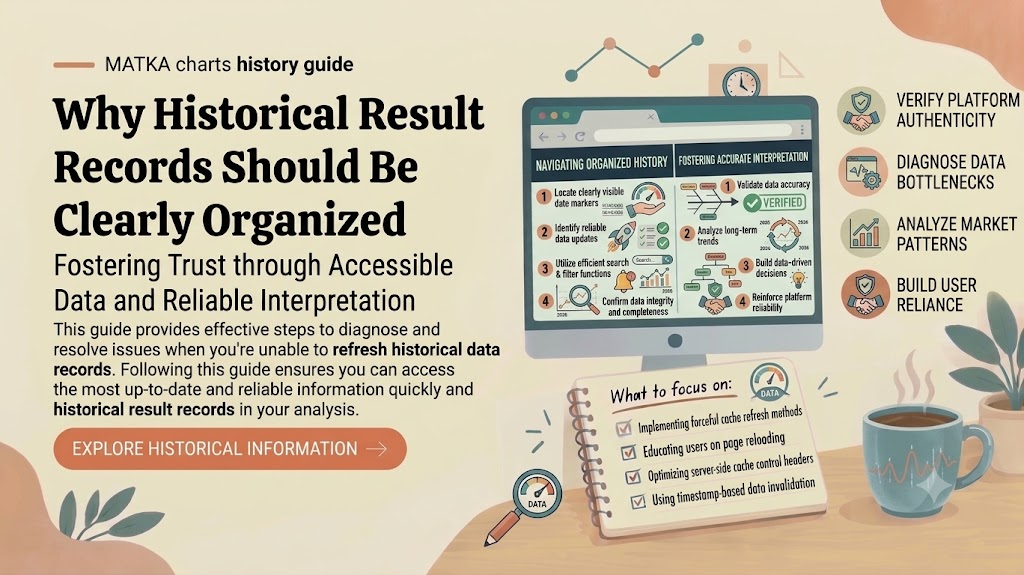
Well-organized historical result records help users find past information, distinguish dates, and navigate chart archives more easily. Learn how consistent labels, categories, and page layouts improve clarity and usability.
What Are Historical Result Records?
Historical result facts are entries preserved from earlier dates or durations. On chart-based total websites, these can be displayed in tables, date-smart lists, monthly data, or class-particular sections.
Depending on the internet site, a historic record can also consist of a date, a class or market name, an access, and different info applicable to that precise layout.
These data are exceptional from current statistics. Their cause is to offer entry to previously recorded info in place of to indicate what may additionally occur inside the future.
Because historic pages can incorporate records spanning many dates, a regular structure is critical for supporting users to discover the records they need.
1. Clear Organization Makes Information Easier to Find
One of the main benefits of organizing historical statistics is easier navigation. Visitors should no longer have to search via a whole page to locate data from a specific date.
A properly-based archive may also use:
• Date-wise headings to split one-of-a-kind days.
• Monthly or yearly sections for longer periods.
• Category labels to distinguish specific styles of facts.
• Navigation hyperlinks to move among to be had durations.
• Search or filter options, in which supported.
These functions lessen useless searching and assist customers understand in which each document belongs.
For instance, a month-to-month archive divided by calendar dates is typically easier to navigate than a single long table without clear separation between entries.
2. Consistent Dates Reduce Confusion
Dates are specifically critical while an internet site shows facts from more than one interval. If dates use inconsistent codecs or appear some distance away from the information they describe, site visitors may additionally misunderstand which entry belongs to which day.
A website can enhance readability by means of the usage of one consistent date layout at some point of its archive. It needs to additionally area dates close to the relevant facts and genuinely pick out the duration protected via every page.
For example, a heading inclusive of “October 2026 Historical Records” communicates the scope of a web page more certainly than a heading that genuinely says “Records.”
If a web page consists of an update timestamp in addition to historic dates, those info have to be labelled one after the other. The date related to a file isn't necessarily the date while the page was final up to date.
3. Clear Categories Help Users Compare Relevant Information
Historical data may additionally include several sections, markets, or styles of entries. Without clear labels, customers can accidentally evaluate statistics that belong to unique classes or durations.
Category headings and consistent table columns assist readers recognize how the data is grouped. If two information are intended to be compared, their dates and categories have to be clean to become aware of.
A beneficial structure might seem like this:
Date
Category
Record status
22 October 2026
Category A
Historical
23 October 2026
Category A
Historical
24 October 2026
Category A
Historical
This is a fictional format example, no longer actual result statistics. Its reason is to demonstrate how steady headings can assist readers distinguish one report from every other.
The unique classes and fields will vary in line with the website's layout.
4. Organized Records Improve Website Usability
Website usability refers to how without difficulty people can apprehend and use a website. Historical information can grow to be tough to navigate when pages include crowded tables, doubtful headings, inconsistent spacing, or poorly organized links.
An extra usable archive normally has a clean visual hierarchy. Main headings pick out the web page, subheadings separate intervals or classes, and desk headings provide an explanation for the data in each column.
On cellular gadgets, this will become even extra crucial. Wide tables, small textual content, and carefully packed entries could make historical pages tough to examine on smaller screens.
Useful layout practices include:
• Keeping headings short and descriptive.
• Using readable text sizes and enough spacing.
• Separating data into plausible sections.
• Making navigation hyperlinks clean to understand.
• Ensuring table paintings fairly properly on cell screens.
The intention is to assist visitors find and understand facts while not having to bet how the web page is organized.
5. Clear Labels Support Transparency
A well-organized historic archive must speak what its statistics represents. Labels inclusive of “Historical Records,” “Last Updated,” and “Date of Record” can help site visitors distinguish between special varieties of dates and web page statistics.
This is particularly vital whilst an internet site shows both current and archived cloth. If the two are presented without clean differences, users may additionally mistakenly anticipate that older entries are modern.
Websites can assist more transparency by explaining their date conventions, identifying the length included by way of each archive, and imparting replacement notes while relevant.
However, the company on my own does not prove that each access is correct or whole. Clear presentation enables customers to interpret the information, while accuracy relies upon the website's underlying facts and upkeep practices.
6. Better Organization Makes Historical Reviews More Practical
Users may also revisit an archive to discover a past access, overview a particular duration, or check how facts changed into supplied on an advance date. A regular shape makes these tasks extra possible.
For instance, a tourist searching out a document from a selected month can navigate at once to that period if the website presents month-to-month data. If the two are presented without clear distinctions, users may mistakenly assume that the older entry is modern.
Good agency also makes it easier to be aware of missing dates or doubtful labels. When the archive follows a predictable structure, inconsistencies are extra seen.
Historical records can help retrospective evaluation, but past entries do not guarantee or are expecting destiny outcomes.
Common Problems With Poorly Organized Historical Records
Organization problem
Why it causes difficulty
Possible improvement
Missing date labels
Users may not know which period an entry belongs to.
Add clear dates beside relevant records.
Inconsistent date formats
Dates can be misread or compared incorrectly.
Follow one consistent format.
Unclear categories
Different types of records may be confused.
Use descriptive category headings.
Long, crowded tables
Finding an entry takes more time.
Divide records into smaller sections.
Unclear update timestamps
Users may confuse page updates with record dates.
Label publication, update, and record dates separately.
Difficult mobile navigation
Information may be hard to read on smaller screens.
Improve responsive layout and spacing.
What Should Users Check When Exploring a Historical Archive?
Before relying on records from an archive, take a second to study how it is supplied.
• Confirm the length: Check the date, month, or 12 months protected by the web page.
• Read the headings: Make positive you apprehend the class or form of record.
• Check the date format: Avoid puzzling the date of an access with the web page's update time.
• Review the surrounding context: Look for notes explaining corrections, lacking facts, or adjustments in layout.
• Treat uncertain facts cautiously: If a date or class is ambiguous, do not expect its meaning without similar statistics.
These exams help readers interpret historical records extra carefully, even when the website's archive is sizable.
Frequently Asked Questions
What are historical result records?
Historical end result facts are entries preserved from earlier dates or intervals. They can be prepared in tables, lists, or files so traffic can assess previously recorded facts.
Why do historic facts need to be prepared by using date?
Date-primarily based organisation facilitates users to locate information from a selected length and reduces confusion between entries from distinct days or months.
How can websites make historical facts easier to study?
Websites can use constant date formats, descriptive headings, clear category labels, readable tables, and navigation links. Responsive layouts also can improve clarity on mobile devices.
Does an updated web page suggest its historic records are new?
No. A page can also have been changed currently at the same time as continuing to display older records. Users need to distinguish the page's update timestamp from the dates associated with man or woman entries.
Do historical result facts expect destiny effects?
No. Historical statistics describe statistics from the beyond. They must now not be dealt with as guarantees or predictions of future outcomes.
Conclusion & Next Steps
Clearly organized historical end result statistics make online records less difficult to discover, study, and interpret. Consistent dates, meaningful classes, readable tables, and obvious replace labels assist customers recognize what a record represents and which time it covers.
When exploring historical facts, take note of the structure of the archive as well as the entries themselves. A nicely-organized page supports better navigation and clearer interpretation, at the same time as customers need to nonetheless verify ambiguous details and keep away from treating past facts as predictions of future consequences.