
What Are Open and Close Results? Basic Terms Explained
If you have spent a while browsing Matka chart pages, you have in all likelihood stumbled upon the words Open and Close. They can also appear next to dates, Jodi numbers, or Panna entries, and it is tough to recognize what each label means when you're just starting out.
In simple phrases, those labels pick out exclusive parts of a result format used by some chart web sites. They help readers distinguish one entry from any other, but the actual layout can vary depending on the website.
This guide explains what open and close results suggest, how they'll appear in a chart, and what to check whilst studying them.
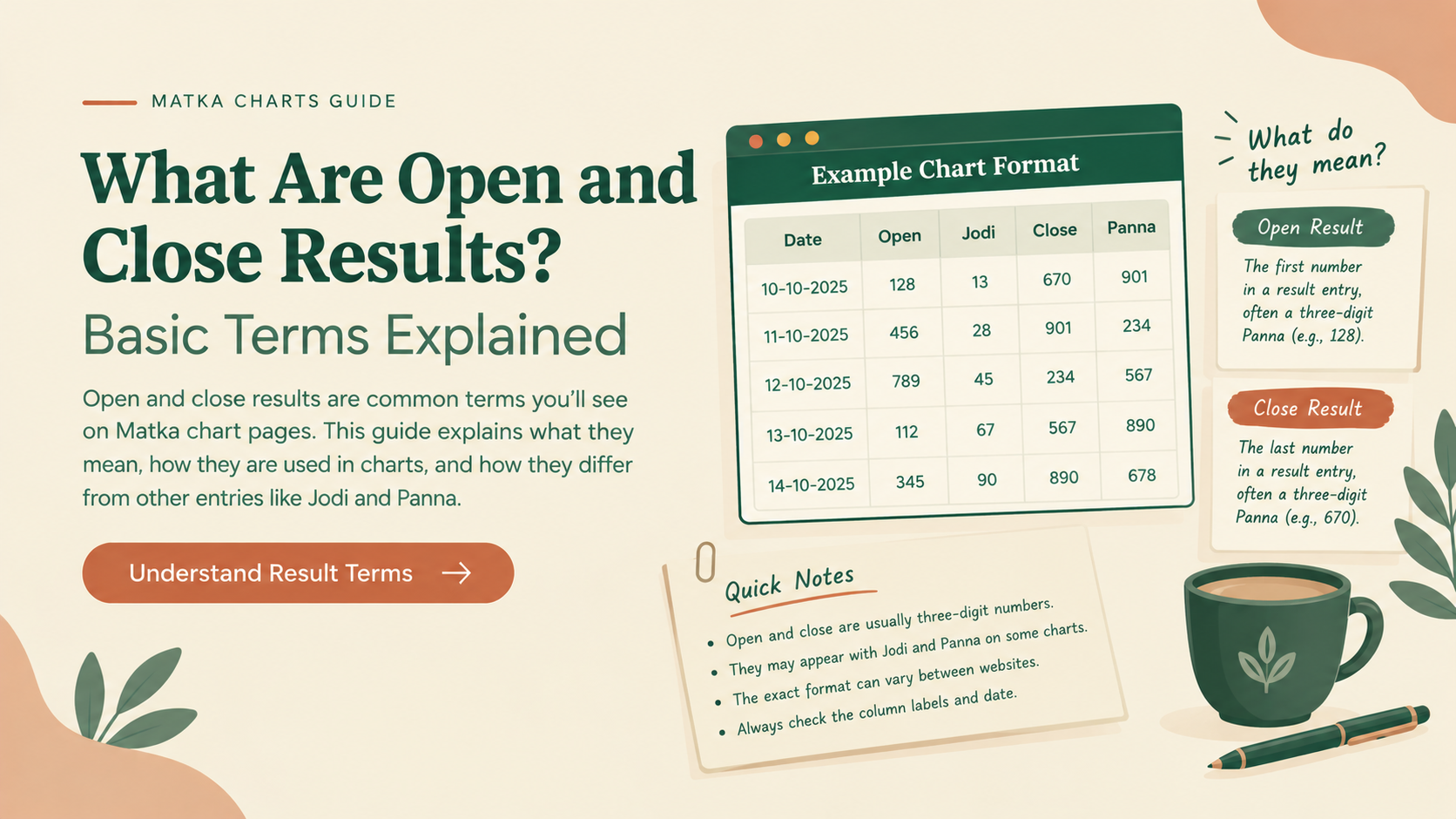
New to open and close results? This beginner-friendly guide explains these chart terms, shows how they may appear in a table, and clarifies the difference between Open, Close, Jodi, and Panna.
Table of Contents
- What Is an Open Result?
- What Is a Close Result?
- Open Result vs Close Result: What's the Difference?
- What to check
- The opening field's label and date
- The closing field's label and date
- How Open and Close Results Appear on a Chart
- Are Open and Close Results the Same as Jodi and Panna?
- How to Read Open and Close Fields Correctly
- Common Mistakes to Avoid
- Frequently Asked Questions
- Conclusion & Next Steps
What Is an Open Result?
An open end result usually refers to the whole part of a result in chart formats that use starting and remaining entries. On a few web sites, this area is related to an opening Panna or some other beginning range entry.
For example, a chart might show an opening entry labelled 128. In that specific layout, the number is the price displayed within the open area.
The critical point is to check the chart's very own labels. Not every internet site affords open results in precisely the same way, so it's satisfactory not to expect that one layout applies anywhere.
What Is a Close Result?
A near end result usually refers back to the last part of a bring about chart codecs that separate opening and remaining entries.
For example, a chart might show 670 in a subject labelled Close. In that chart, the wide variety is the displayed last access.
As with open outcomes, the meaning and format depend upon the website. Check the column heading and any accompanying explanation earlier than decoding the variety.
Open Result vs Close Result: What's the Difference?
The most important difference is a part of the end result each label identifies. An open discipline refers to the opening entry, at the same time as a near area refers to the final access.
Feature
Open Result
Close Result
Basic meaning
Opening part of a result format
Closing part of a result format
Where it appears
In a field labelled Open or similar
In a field labelled Close or similar
Number format
Depends on the chart
Depends on the chart
What to check
The opening field's label and date
The closing field's label and date
These terms describe how records are organised. They do no longer, via themselves, imply whether an entry is correct, whole, or connected to a future result.
How Open and Close Results Appear on a Chart
Some chart pages show beginning and ultimate entries inside the same row, alongside different facts. For instance, a desk would possibly appear like this:
Date
Open
Jodi
Close
10 October
128
13
670
11 October
456
28
901
12 October
789
45
234
The entries above are fictional examples created to explain the layout. They aren't actual results.
In this example:
• Date identifies the day associated with the document.
• Open suggests the access displayed inside the establishing subject.
• Jodi suggests a -digit mixture.
• Close shows the entry displayed in the final field.
An exceptional internet site might use unique column names, display Panna one after the other, or miss some fields absolutely. Always use the headings at the web page you are viewing.
Are Open and Close Results the Same as Jodi and Panna?
No. These terms describe various things.
• Open and Close perceive positions or classes inside positive end result codecs.
• Jodi refers to a two-digit aggregate.
• Panna, additionally spelled Pana, refers to a three-digit combination.
A chart might also display those fields together, but they're now not interchangeable phrases. The labels help give an explanation for what each entry represents.
For example, a row may comprise an opening entry, a -digit Jodi, and an ultimate access. The format tells you which subject is which; the range of digits alone may not give an explanation for the entire context.
How to Read Open and Close Fields Correctly
If you are looking at a chart for the first time, observe these simple tests:
1. Read the column headings. Confirm which subject is marked Open and that is marked Close.
2. Check the date. Make certain both entries belong to the date shown in the row.
3. Look for other labels. If the chart additionally shows Jodi or Panna, read the ones fields separately.
4. Check the website's clarification. If the layout is unusual, search for a word list or data web page that defines its phrases.
5. Pay attention to timestamps. A webpage's remaining-updated time may not be similar to the time related to a result access.
These steps help you understand the facts presented without making assumptions approximately in more than a few ways.
Common Mistakes to Avoid
Beginners can without problems mix up chart terminology, specially whilst several fields appear close collectively. Here are a few things to watch for:
Assuming each internet site makes use of the equal layout: Labels and layouts can vary between chart pages.
Confusing Open and Close with Jodi and Panna: Open and Close pick out fields in a result format; Jodi and Panna describe quantity combinations.
Ignoring the date: A quantity without its date and area label can be difficult to interpret correctly.
Mixing up result time and update time: These timestamps may discuss one-of-a-kind events.
Treating beyond entries as predictions: Historical chart statistics do not guarantee future effects.
If something on a page is uncertain, check the website's definitions rather than counting on assumptions.
Frequently Asked Questions
1. What does Open mean in a Matka chart?
Open usually identifies the whole part of a bring about chart format that separates commencing and last entries. The unique display relies upon the internet site.
2. What does Close suggest in a Matka chart?
Close usually identifies the remaining part of a result. Check the chart's column heading and explanation to understand how the internet site uses this label.
3. Are open and near results continually displayed collectively?
No. Some web sites show both fields in one desk, while others can also separate them into unique sections or use a special format.
4. What is the distinction between Open, Close, Jodi, and Panna?
Open and Close discover parts of sure result codecs. Jodi refers to a -digit combination, even as Panna refers to a 3-digit aggregate.
5. Can open and close outcomes expect future results?
No. Past entries are historic facts, now not reliable predictions of destiny results.
Conclusion & Next Steps
Open and Close are beneficial phrases to understand whilst reading chart pages. They normally pick out the outlet and remaining elements of a result format, while Jodi and Panna seek advice from precise variety mixtures.
The simplest way to avoid confusion is to check the date, study the column headings, and verify how the internet site defines each field.
Explore the comprehensive Shree Matka chart archives to review historical Jodi and Pana records across all active markets. For instant notifications, live open-close declarations, and verified results, you can also download the official Shree Matka Android app.